1.
? volumetric expansion coefficient [K -1 ]?T maximal difference temperature, ?T = (T h -T a )
[K] ? dimensionless viscosity ratio, ? = µ s /µ f Introduction he study of the natural convection mode in vertical porous channel is particularly developed in recent years because it relates to various applications such as cooling of electronic equipment, nuclear reactors, thermal insulation heat exchangers, building industry, geophysical flows and crystal growth [Chu and Hwang (1977), Nield, Bejan (1992), Mezrhab (1997)].
In recent years, a large number of experimental and numerical researches have been devoted to study the heat transfer in fully or partially porous vertical channels. [Debbissi (2000)] studied the water evaporation by natural convection between two flat plates. A uniform heat flux is imposed on one wet wall whereas the other plate is insulated or heated and supposed impermeable and is kept at a constant flow by taking into consideration the radiation plates.
[ Yan and Lin (2001)] studied the combined effects of buoyancy forces and heat and mass diffusion in a laminar natural convection flow inside a vertical pipe. These authors investigated the effects of wet walls temperatures, air humidity and the aspect ratio on the flow and heat and mass transfer. Recently, [Orfi, Debbissi, Belhaj and Nasrallah (2004)] examined the thin liquid film evaporation flowing down on the inner face of a vertical channel plate. The wet wall is subjected to a uniform heat flux and the second plate is insulated and impermeable.
The purpose of this work is to study numerically the natural convection in a vertical channel with two porous layers arranged vertically by examining the effect of the porous layers thickness on the flow structure, the T x y average Nusselt number and the temperature distribution within the channel.
2. II. Formulation Mathématique du Problème
The configuration of the problem studied is depicted in Figure 1. It shows the geometry of a vertical parallel-plates channel partially occupied by two porous layers. The vertical plates are isothermal and kept at the hot temperature T h . The analysis assumes that the porous media is homogeneous and isotropic. The fluid flow is incompressible, laminar and two-dimensional. The momentum equations are simplified using Boussinesq approximation, in which all fluid properties are assumed constant except the density in its contribution to the buoyancy force. The two-dimensional governing equations based on the Brinkman-Darcy model can be written in the following dimensionless form:
0 U V X Y ? ? + = ? ? (1) 2 2 2 2 x U U U P U U Pr U U V Pr X Y X X Y Da K ? ? ? ? ? ? ? ? ? ? + + = ? + + ? ? ? ? ? ? ? ? ? ? ? (2) 2 2 2 2 y V V V P V V Pr V U V Pr RaPr X Y Y X Y Da K ? ? ? ? ? ? ? ? ? ? ? + + = ? + + ? + ? ? ? ? ? ? ? ? ? ? (3) ? ? ? ? ? ? ? ? ? ? ? ? + + = + ? ? ? ? ? ? ? ? ?(4)Where
1 ? = , R k = 1, 1 ? = in the fluid region ? = ? , / k s f R k k = , ( ) ( ) p f c c ? ? ? ? = in the porous region.The boundary conditions corresponding to the considered problem are as follows:
-Solid plates boundary conditions: 0 ? Y ? 1, X = 0 and X = 1 0, 0, 1, 0 P U V X ? ? = = = = ? -Inlet boundary conditions: 0 ? X ? A and Y = 0 2 in 0, 0, 0, 2 -Q V U P Y Y ? ? ? = = = = ? ?Where Q in is the mass flow rate at the channel inlet.
1 0 0 [ ( )] in Y Q V X dX = = ? -Outlet boundary conditions: 0 ? X ? A and Y = 1 0, 0, 0, 0 V U P Y Y ? ? ? = = = = ? ? III.3. Numerical Procedure
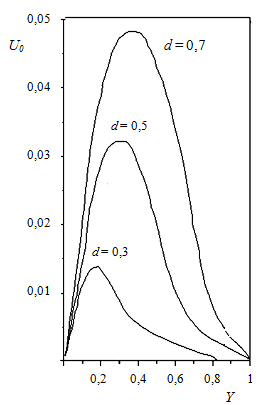
A series of calculations was done for the set of parameters given in Table 1, to determine the optimum non-uniform grid (i.e. the best compromise between accuracy and computational costs). A numerical simulations of the problem considered for two Rayleigh number Ra = 1×10 6 and 10 7 , A = 5 and Pr = 0.71 were performed with six different grids. From the table 1, it was found that the difference in Nusselt number obtained with a 30×140 grid and a 30×160 grid is only 0.1% percent. Therefore, all the computations in the present study were done with a non-uniform 30x140 grid. Table 1 : Results of the grid independence study for Pr = 0.71: Ra = 10 6 and Ra = 10 7 Furthermore, the numerical code has been validated by taking into account some numerical studies available in the literature. Firstly, it was validated on the problem of natural convection in a square porous cavity [Beckermann, Vistkanta and Ramadhyani (1986)]. The results found for the average Nusselt number for different Rayleigh number Ra, the Prandlt number Pr and Darcy number Da are in good agreement with the present results as shown in Table (2). Secondly, the code has been tested on the problem of natural convection in an asymmetrically heated vertical channel partially filled with a porous medium. A comparison of the velocity profile for three fluid layer thickness and for Da = 10 -2 between the predicted results and those obtained by [
4. Global Journal of Researches in Engineering
5. Results and Discussion
Numerical simulations are performed for Pr = 0.71, A = 5, R k = 1 and for Darcy number and porous layer thickness ranged respectively between 10 -8 ? Da ? As can be seen the different curves are located between two limiting curves corresponding to the fluid and solid behavior of the porous material Da = 1 and Da = 10 -8 . It is observed that the heat transfer decreases with increasing the porous layers thickness, which is more important as the Darcy number decreases. Indeed, we note that for sufficiently large permeability (Da = 1 and Da = 10 -2 ) the influence of the porous layer thickness on heat transfer is negligible and the average Nusselt number remains constant. However, for relatively low permeability the Nusselt number decreases with increasing e p * . It should be noted that it is sufficient to introduce porous layers of thickness less than 0.1 to reduce significantly heat transfer. To understand the shape of the isotherms, we plotted in Figure 6 the evolution of the dimensionless temperature profiles in the horizontal median plane of the channel for different porous layers thickness and for two Darcy number Da = 1 and Da = 10 -6 .
As we have previously reported, for large Darcy number (Figure 6. a), the introduction of porous layers has a negligible effect on dimensionless temperature whatever their thickness. However, for Da = 10 -6 (Figure V.
6. Conclusion
This paper presents a numerical study of natural convection in a vertical parallel-plate channel partially filled with porous medium. Numerical calculations were performed to investigate the effect of Rayleigh numbers Ra, Darcy number Da and porous layers thickness e p * on the flow field and heat transfer. We examined the Rayleigh number effect characterizing the convection intensity and we concluded that the heat transfer increases with increasing Rayleigh number Ra. We also showed that the variation of the porous layers permeability, through the Darcy number, affects significantly the heat transfer. Indeed, we have identified three zones and we found that for a fixed Rayleigh number and high value of Da, the Nusselt number Nuw is nearly constant and the flow is similar to that observed in a fluid channel. Whereas, for small Darcy numbers, the average Nusselt number decreases until it reaches a minimum for Da = 10 -6 where there is no convective exchange in the porous layers. Results show also that the heat transfer decreases significantly when the porous layer thickness is less than 0.1 (e p * ? 0.1). Finally, note that the isotherms and streamlines are very sensitive to variation of the porous layers thickness for relatively large Darcy number.
![dimensionless pression, (p+? o gy)bPrandtl number, ?/?Ra Rayleigh number, g?(T h -T a )b 3 /?? R k thermal conductivity ratio, k s-/k f T temperature, [K] T o average temperature, (T h + T a )/2, [K] u, v velocity component along x, y [m s -1 ] U, V dimensionless velocity components along x, y. U = ub/?, V = vb/? x, y cartesian coordinates [m] X, Y dimensionless cartesian coordinates, X = x/b, Y = y/b ? thermal diffusivity [m 2 s -1 ]](https://engineeringresearch.org/index.php/GJRE/article/download/984/version/100395/8-Numerical-Study-of-Natural_html/8464/image-2.png)






| Ra | Da | Pr | Beckermann | Nos Résultats |
| et al.(1986) | ||||
| 10 5 | 10 -1 | 1.0 | 4.724 | 4.648 |
| 10 5 | 10 -1 | 0.01 | 4.724 | 4.648 |
| 10 8 | 10 -4 | 1.0 | 24.97 | 24.891 |
| 10 8 | 10 -4 | 0.01 | 24.97 | 24.891 |
| 10 12 10 -8 | 1.0 | 48.90 | 48.854 | |
| 10 12 10 -8 | 0.01 | 48.90 | 48.854 | |
| Ra = 10 6 | Ra = 10 7 | |||||
| Nuw | ? max | Q | Nuw | ? max | Q | |
| (14x90) | 16.885 | 389.01 | 0.41495.10 3 | 18.282 | 783.18 | 0.83540.10 3 |
| (14x100) | 16.891 | 390.49 | 0.41653.10 3 | 18.287 | 790.92 | 0.84365.10 3 |
| (20x100) | 17.575 | 408.209 | 0.43542.10 3 | 19.125 | 853.69 | 0.91060.10 3 |
| (20x120) | 17.582 | 410.489 | 0.43786.10 3 | 19.132 | 896.143 | 0.93509.10 3 |
| (24x120) | 17.847 | 413.260 | 0.44081.10 3 | 19.513 | 882.758 | 0.94161.10 3 |
| (24x130) | 17.849 | 414.15 | 0.44176.10 3 | 19.517 | 896.14 | 0.95589.10 3 |
| (28x130) | 18.046 | 415.27 | 0.44296.10 3 | 19.797 | 895.557 | 0.95526.10 3 |
| (28x140) | 18.047 | 416.06 | 0.44380.10 3 | 19.800 | 908.96 | 0.96956.10 3 |
| (30x140) | 18.155 | 417.57 | 0.44541.10 3 | 19.907 | 915.19 | 0.97621.10 3 |
| (30x160) | 18.156 | 418.705 | 0.44662.10 3 | 19.914 | 941.68 | 1.0045.10 3 |
| Paul, Jha, | ||||||
| Singh (1998)] is shown in figure 2. Results show an | ||||||
| excellent agreement. | ||||||