1. Introduction
resh water is a basic necessity of man along with air and food. Man has been reliant on lakes, rivers and underground water reservoirs for fresh water necessities in domestic agriculture, life, and industry. However, practice of water from all sources is not always possible or desirable on account of the presence of large amount of harmful organisms and salts (Tsilingiris, 2011). Also in the south western region of Bangladesh, shallow aquifers contain arsenic, exceeding the allowable limit for Bangladesh standard (0.05 mg/l) and highly saline water exists in deep aquifers. Salinity and arsenic in water poses a serious problem for the development of appropriate water supply system. In these areas desalination techniques could be applied to meet fresh water demand produced from brackish or saline water. Most desalination techniques such as reverse osmosis, electro-dialysis, multi-stage flash etc. consume a huge amount of external energy e.g. fossil fuel/electricity (Nayak et. al., 2000).
Therefore, finding methods of using renewable energy to power the desalination process is desirable. Solar distillation is a simple desalination technique in which only solar energy is needed. A basin type solar still (BSS) is the most popular method of solar distillation compared with others due to its simplicity and longer design life. It could be one of the viable options for providing drinking water for a single house or a small community in arid, remote and coastal regions. On the other hand, uses of water from underground and surface water sources are not always desirable or possible because of the presence of large amount of salts especially in coastal areas. Excessive salinity causes various health hazard and diseases in coastal region. In these areas basin type solar still (BSS) could be a suitable technique for supplying potable water. The method will serve the community with fresh water reducing the harmful effect. Desalination or desalinization denotes to any of several processes that remove extra salt and other minerals from water. Generally, desalination can also denote to the removal of salt and other minerals from water. Solar distillation is a the simple treatment of brackish that contains dissolved salts. Solar distillation has been in practice for a long time. Tripathi and Tiwari (2005) have proposed a thermal modeling of passive and active solar stills for different depths of water by using the concept of solar fraction. In this experiment, it is observed that the internal convective heat transfer coefficient decreases with the increase of water depth in the basin due to decrease in water temperature. Tanoak and Nakatake (2006) conducted an experiment on effect of inclination of external flat plate reflector of basin type still in winter. They proposed a new geometrical method for calculating the solar radiation reflected by the inclined external reflector and then absorbed on the basin liner. Elsarrag (2008) conducted an experiment on evaporation rate of a novel tilted solar liquid desiccant regeneration system. In this study a corrugated blackened surface is used to heat the desiccant and an air flow is used to regenerate calcium chloride solution. In this study, a basin type solar still (BSS) is designed, constructed and field experiments have been carried out on the roof of the Civil Engineering building of Khulna University of Engineering & Technology (KUET) from June 07, 2011 to June 09, 2012 to check the productivity of the still.
2. II. Desalination Practice in Bangladesh
Due to scarcity of fresh water and presence of excessive arsenic in ground water in Bangladesh increases the demand of alternative source of drinking water. On the other hand surface water is not usable due to large scale of salinity. Thus solar desalination is one of the alternative options available for water supply in the arsenic affected areas. The water produced by solar desalination is completely free of salinity and can be mixed with tube well water to increase the volume of water for drinking water supply. The technology cannot produce an adequate quantity of water as a result of cost. The system required further development for use in water supply in rural areas. Gani and Shama (1993) conducted an experiment on basin type solar still from August to October. They used Ferro-cement basin with glass plate cover for storing saline water. The average daily production rate was found as 457 ml/m 2 .Mahmood and Rahman (1994) studied on basin type solar still. They used Ferro-cement basin with glass plate cover for storing saline water. The highest average daily output rate was found as 487.81 ml/m 2 in the month of May. Jafor (2011) studied on basin type solar still. He designed and constructed a basin type solar still (BSS) for solar desalination purpose which has an airtight rectangular Ferro-cement basin (90cm×60cm×5cm). The average daily and hourly production rate was found as 2.88 lit/m 2 -day and 0.233 lit/m 2 -hr, respectively.
3. III.
4. Methods of Desalination a) Solar Distillation
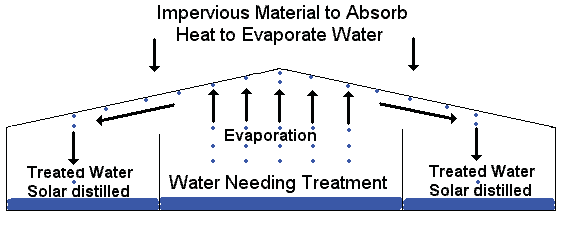
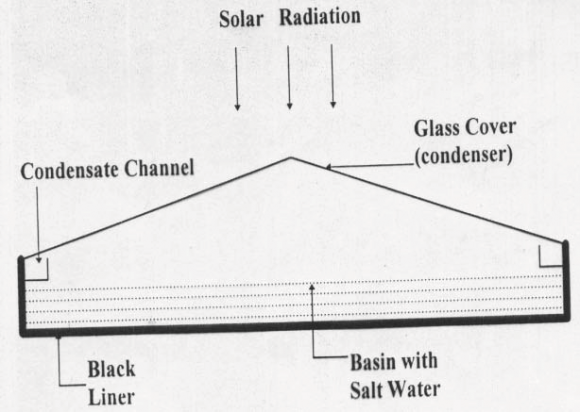
Solar stills should normally only be considered for removal of dissolved salts from water. If there is a best between polluted surface water and brackish ground water, it will usually be inexpensive to use a slow sand filter or other treatment method. If there is no fresh water, the majorre placements are rainwater collection, desalination and transportation. Solar distillation has been used for many years for relatively small plant outputs. Although solar stills are comparatively easy to operate and build, there are few, if any, economies-ofscale linked with larger plants. For example, the largest solar stills yet tested have produced only a few thousand gallons of water per day. A well designed solar still can produce 2 to 4 liters of water per square meter of basin area. A sketch of a solar still is shown in Figure 1.
5. Design of Basin Type Solar Still
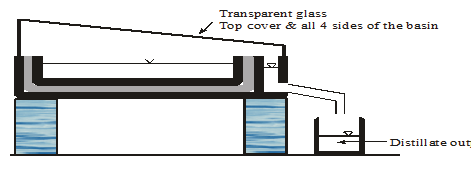
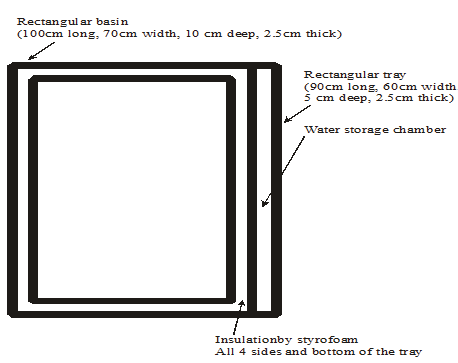
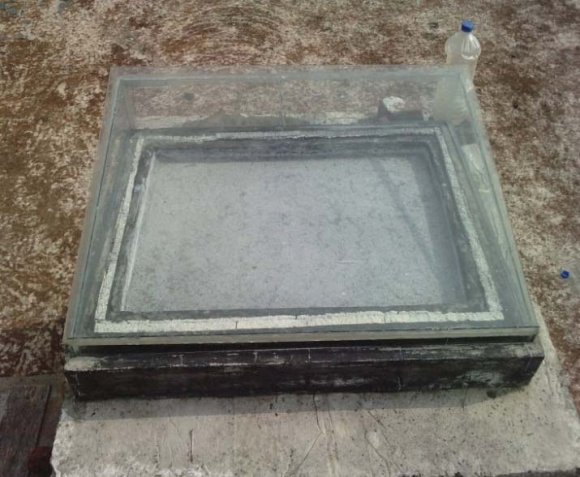
A conventional basin type solar still (BSS) is designed and constructed in previous year using locally available materials. The still is 100cm long, 70cm wide, 10cm deep and made of 2.5cm thick Ferro-cement materials which is covered with transparent glass of thickness 5mm as condensation surface. The inclination of the glass is 10°with horizontal. The four sides of basin are covered by glass with lower and upper height is 7.5 cm and 22.5 cm, respectively. The still have rectangular basin 90cm long, 60cm wide, 5cm deep and also made of 2.5cm thick Ferro-cement materials. Inside surface and bottom of the basin are insulated by Styrofoam (known as cork sheet) of thickness 2.5cm for protection of heat transfer. To increase the productivity of the still the lower and upper heights are reduced by 2 inch in February 25, 2012. Figure 3
6. Field Experiment
The field experiment on the constructed BSS was carried out on the top roof of Civil Engineering building from June 07, 2011 to June 09, 2012. The daily production of distillated water was collected into a bottle everyday approximately two hours after the sunset. Hourly production and ambient air temperature for May 20, 21, and 22 in 2012 were measured during the day time. Figure 4 shows the photograph of the field experiment.
7. VI. Data Collection
Daily production of distilled water was measured approximately two hours after sunset and tabulated in Table 1. Hourly production and ambient air temperature for May 20, 21, and 22 in 2012 were also measured during the day time and given in Table 2.
8. Data Analysis
Data collection and measurement in Section 3.3 were used to calculate the daily (June 07, 2011 to June 09, 2012) and hourly (May 20, 21 and 22, 2012) distilled water production per unit surface area of the saline water in the trough for the BSS and given in Table 3 and Table 4 respectively.
9. Results
Figure 5 shows the variation of the daily production rate throughout the study period. It is observed that the production is higher in summer time (April to June) and lower in winter time. The average production rate is found as 1.8 lit/m 2 -day, whereas the maximum and minimum productions are found respectively as 3.76 and 0.21 lit/m 2 -day for July 2011 and December 2012. Figure 5 : Variation of production rate of the BSS Figure 6 shows the variation of the hourly production and ambient air temperature for three typical days May 20 to 22, in 2012. The maximum air temperatures are obtained between 12:00 to 13:00 but the maximum hourly productions are observed between 14:00 to 16:00. The maximum hourly productions are found as 0.35 (15:00), 0.46 (13:00) and 0.40 (14:00) lit/m 2 -hr for May 20 to 22 of 2012, respectively. 7 shows the average daily production for various months for the study period and given in Table 5. The highest and lowest values are found respectively as 2.87 and 0.73 lit/m 2 -day for April and December. Figure 8shows the comparison of maximum daily production rates for the conventional basin type still with the stepped one (Imran, 2012) throughout the study period and tabulated in Table 6. It is found that the production rates are approximately 16% higher in case of stepped basin type still.
10. Global Journal of Researches in Engineering
11. Cost Analysis
Table 7 shows the cost analysis for the BSS. The construction cost of the still is estimasted as Tk. 1200 with a design life of 10 years. The production cost of the distilled water is calculated as 0.33 Tk./lit.
12. Results
The scarcity of fresh water is increasing day by day in arid, remote and coastal areas. Also in the south western region of Bangladesh, shallow and deep aquifers contain arsenic and high salinity, respectively. Salinity and arsenic in water poses a serious problem for the development of appropriate water supply system. In these areas desalination techniques could be applied to meet fresh water demand produced from brackish or saline water. Among desalination techniques, solar desalination is a simple and low cost technique due to no use of fossil fuel or electricity. A basin type solar still (BSS) is the most popular method of solar distillation compared with others due to its simplicity and longer design life. In this study, a conventional basin type solar still (BSS) is designed, constructed and field experiments have been carried out fromJune 07, 2011 to June 09 2012 on the top roof of Civil Engineering building. The average daily and hourly production rates are found as 1.80 and 0.20 lit/m 2 -hr, respectively. The maximum daily and hourly productions are found as 3.76 lit/m 2 -day in July, 2011 and 0.46 lit/m 2 -hr, respectively. It is observed that the production is higher in summer time (April to June) and lower in winter time. The average daily production for various months with highest and lowest values is found as 2.87 and 0.73 lit/m 2 -day for April and December, respectively. It is found that the production rates are approximately 16% higher in case of stepped basin type still. The construction cost of the still is calculated as 1200 Tk. /BSS and the water production cost is estimated as 0.33 Tk/lit with a design life of 10 years.
13. X.
14. Conclusion
The design, construction and operation of BSS are very simple. Also operational and maintenance cost is very low. Since the initial and water production cost of the still is low, it could be one of the acceptable options for providing drinking water for a single house or a small community in arid, remote and coastal regions.

| Daily distilled water production (ml/day) | ||||||||||
| Day | Year (2011) | Year (2012) | ||||||||
| June | July | September November December February March | April | May | June | |||||
| 1 | - | 285 | - | - | 520 | - | 1300 | 1730 | - | 950 |
| 2 | - | 510 | - | - | 610 | - | 1010 | 1750 | - | 1125 |
| 3 | - | 464 | - | - | 645 | - | 1240 | 1745 | - | 1735 |
| 4 | - | 1076 | - | - | 580 | - | 1325 | 1695 | - | 1670 |
| 5 | - | 1180 | - | - | 540 | - | 1125 | 1795 | - | 1365 |
| 6 | - | 1100 | 1050 | - | 580 | - | 1250 | 1250 | - | 1245 |
| 7 | 2080 | 1410 | 980 | - | 530 | - | 1305 | 1710 | - | 1490 |
| 8 | 1489 | 975 | 755 | - | 690 | - | 1415 | 1605 | - | 1580 |
| 9 | 1927 | 800 | 390 | - | 710 | - | 1270 | 1000 | - | 1610 |
| 10 | 1705 | 1393 | 780 | - | 530 | - | - | 1468 | - | - |
| 11 | 1078 | 1100 | 1010 | - | 425 | - | - | 1415 | - | - |
| 12 | 602 | 1300 | 1105 | - | 400 | - | - | 1512 | - | - |
| 13 | 1626 | 1105 | 1073 | - | 150 | - | 1100 | 1455 | - | - |
| 14 | 901 | 1040 | 928 | 920 | 120 | - | 1225 | 1670 | - | - |
| 15 | 923 | 1180 | 790 | 450 | 170 | - | 1500 | 1765 | - | - |
| 16 | 647 | 1020 | 920 | 230 | 160 | - | 1350 | 1900 | - | - |
| 17 | 529 | 980 | 200 | 760 | 210 | - | 1330 | 1860 | - | - |
| 18 | 201 | 1073 | 830 | 785 | 280 | - | 1260 | - | - | - |
| 19 | 100 | 420 | 925 | 410 | 190 | - | 705 | - | - | - |
| 20 | 351 | 105 | 1015 | 500 | 300 | - | 1255 | - | - | - |
| 21 | 627 | 250 | 1050 | 710 | 240 | - | 1500 | - | - | - |
| May 20, 21 and 22, 2012 | ||||||
| Hourly distilled water | Ambient air temperature | |||||
| T Time of Day | production (ml/hr) | ( o C) | ||||
| May 20 May 21 May 22 May 20 May 21 May 22 | ||||||
| 7.00 am | 0 | 0 | 0 | 32 | 32 | 32 |
| 8.00 am | 8 | 10 | 5 | 33.5 | 32.5 | 33.5 |
| 9.00 am | 16 | 30 | 5 | 33.5 | 33.5 | 34.5 |
| 10.00 am | 40 | 34 | 21 | 36.5 | 30.5 | 35 |
| 11.00 am | 120 | 98 | 46 | 39 | 32.5 | 35.5 |
| 12.00 pm | 166 | 140 | 90 | 40 | 34 | 37 |
| 1.00 pm | 180 | 256 | 187 | 38 | 36 | 37.5 |
| 2.00 pm | 195 | 224 | 222 | 33.5 | 34 | 38.5 |
| 3.00 pm | 197 | 223 | 214 | 33.5 | 33.5 | 38 |
| 4.00 pm | 189 | 191 | 226 | 33 | 33.5 | 38.5 |
| 5.00 pm | 144 | 155 | 167 | 34 | 33.5 | 38.5 |
| 6.00 pm | 130 | 135 | 170 | 36 | 33 | 36.5 |
| 7.00 pm | 120 | 115 | 106 | 36 | 32.5 | 36 |
| 8.00 pm | 36 | 51 | 67 | 36.5 | 32 | 30 |
| VII. | ||||||
| Year 2013 | ||||||||||
| I | ||||||||||
| XIII Issue v v III Version | ||||||||||
| Volume | ||||||||||
| D D D D ) | ||||||||||
| ( | ||||||||||
| Global Journal of Researches in Engineering | Day 1 2 3 | June --- | July 0.51 0.91 0.83 | Daily distilled water production (Lit/m 2 -day) Year (2011) September November December February March April May June Year (2012) --0.93 -2.32 3.08 -1.69 --1.1 -1.80 3.13 -2.01 --1.15 -2.21 3.11 -3.1 | ||||||
| 4 | - | 1.92 | - | - | 1.03 | - | 2.37 3.03 -2.98 | |||
| 5 | - | 2.11 | - | - | 0.96 | - | 2.01 3.21 -2.44 | |||
| 6 | - | 1.96 | 1.88 | - | 1.04 | - | 2.23 2.23 -2.22 | |||
| 7 | 3.71 | 2.52 | 1.75 | - | 0.95 | - | 2.33 3.05 -2.67 | |||
| 8 | 2.66 | 1.74 | 1.35 | - | 1.23 | - | 2.53 2.87 -2.82 | |||
| 9 | 3.44 | 1.43 | 0.70 | - | 1.27 | - | 2.27 1.78 -2.88 | |||
| 10 | 3.05 | 2.49 | 1.40 | - | 0.95 | - | - | 2.62 - | - | |
| May 20, 21 and 22, 2012 | ||||||
| T Time of Day | Hourly distilled water production (lit/m 2 -hr) May 20 May 21 May 22 | Ambient air temperature ( o C) May 20 May 21 May 22 | ||||
| 7.00 am | 0 | 0 | 0 | 32 | 32 | 32 |
| 8.00 am | 0.014 | 0.018 | 0.009 | 33.5 | 32.5 | 33.5 |
| 9.00 am | 0.029 | 0.054 | 0.009 | 33.5 | 33.5 | 34.5 |
| 10.00 am | 0.071 | 0.061 | 0.038 | 36.5 | 30.5 | 35 |
| 11.00 am | 0.214 | 0.175 | 0.082 | 39 | 32.5 | 35.5 |
| 12.00 pm | 0.296 | 0.251 | 0.161 | 40 | 34 | 37 |
| 1.00 pm | 0.321 | 0.457 | 0.333 | 38 | 36 | 37.5 |
| 2.00 pm | 0.348 | 0.400 | 0.396 | 33.5 | 34 | 38.5 |
| 3.00 pm | 0.352 | 0.398 | 0.382 | 33.5 | 33.5 | 38 |
| 4.00 pm | 0.338 | 0.341 | 0.404 | 33 | 33.5 | 38.5 |
| 5.00 pm | 0.257 | 0.277 | 0.298 | 34 | 33.5 | 38.5 |
| 6.00 pm | 0.232 | 0.241 | 0.304 | 36 | 33 | 36.5 |
| 7.00 pm | 0.214 | 0.205 | 0.189 | 36 | 32.5 | 36 |
| 8.00 pm | 0.064 | 0.091 | 0.119 | 36.5 | 32 | 30 |
| VIII. | ||||||
| Average production rate | ||
| Name of months | (lit/m 2 -day). of conventional BSS | |
| Year (2011) Year (2012) | ||
| January | - | - |
| February | - | 2.12 |
| March | - | 2.50 |
| April | - | 2.87 |
| May | - | 2.51 |
| June | 1.60 | 2.53 |
| July | 1.92 | - |
| August | - | - |
| September | 1.52 | - |
| October | - | - |
| November | 1.05 | - |
| December | 0.73 | - |
| IX. |
| Sl. No. | Item Description | Unit | Rate (Tk.) | Quantity | Amount (Tk.) |
| 1 | Cement | kg | 9 | 35 | 315 |
| 2 | Sand | cft | 20 | 2 | 40 |