1. INTRODUCTION
he use of Fiber Reinforced Polymer (FRP) reinforcements in concrete structures has increased rapidly in the last 10 years due to their excellent corrosion resistance, high tensile strength, and good non-magnetization properties. However, the low modulus of elasticity of the FRP materials and their nonyielding characteristics results in large deflection and wide cracks in FRP reinforced concrete members. Consequently, in many cases, serviceability requirements may govern the design of such members. In particular, FRP rebar offers great potential for use in reinforced concrete construction under conditions in which conventional steel-reinforced concrete has yielded unacceptable service.If correctly applied in the infrastructure area, composites can result in significant benefits related to both overall cost and durability. Other advantages include high strength and stiffness to weight ratios, resistance to corrosion and chemical attack, controllable thermal expansion and damping characteristics, and electromagnetic neutrality. The FRP is made of continuous fibre filaments embedded in resin matrix to form various types of shapes such as bars, structural sections, plates, and fabric. There are three types of FRP materials commonly available in the market are Carbon Fibre Reinforced Polymer (CFRP), Aramid Fibre Reinforced Polymer (AFRP), and Glass Fibre Reinforced Polymer (GFRP). Saadatmanesh (1994). Studies the behavior of GFRP bar available in the market is manufactured in the same form and diameter as normal carbon steel. Compared with conventional steel the GFRP bars offer more benefits such as high tensile strength to weight ratio, corrosion free, lightweight, non-magnetic, and non-conductive. However, despite those benefits, the GFRP bars have low elastic modulus and behave elastically up to near failure (Clark, 1994). Osborne (1998) studied the emerging problem of steel corrosion in reinforced concrete structures leads to the development for more durable concrete and corrosion resistant reinforcement to be used for structures where the risk of corrosion is high. One of the method to enhance the durability of concrete is by the incorporation of pozzolanic materials such as slag, silica fume, and fly ash in the concrete mix. As for durable reinforcement, stainless steel is one of the options. However, the cost of stainless steel is very expensive compared to carbon steel. Therefore, the search for less expensive and more durable reinforcement continues. Taerwe et al. (1999) conducted in the study ,in the last two decades, researchers explore the possibility of using Fibre Reinforced Polymer (FRP) materials to be used as concrete reinforcements. same load level compared with control beam. However, the performance of the GFRP reinforced concrete beams improved slightly when stainless steel mesh was used as shear reinforcement. Sungwoo Shin et al.(2009) had conducted an experimental work on strengthening of reinforced concrete structures using advanced fiber reinforced polymer (FRP) composites is a very popular practice because they are light and highly resistant to corrosion. The results of the investigation can be summarized as follows: (1) Deflections and strains of concrete beams reinforced with GFRP re-bars are generally larger than those reinforced with steel bars; (2) the strength of the concrete has a negligible effect on crack spacing and crack width; (3) and the FRP overreinforced concrete beams in this study are safe for design in terms of deformability. Mohamed et al.( 2011) investigated and evaluate the flexural behavior of concrete cantilever beams when using locally produced GFRP bars as a longitudinal main reinforcement. The experimental program includes six concrete cantilever beams. The main parameters were the type of rebars (steel or GFRP), strength of concrete and ratios of GFRP rebars. The results of experiments were the ultimate flexural capacities were calculated theoretically. Then a comparison between both experimental and theoretical results was done. This comparison indicated that the theoretical analysis gives results which are about 30% lower than the experimental ultimate flexural capacity for GFRP-reinforced cantilever beams. These two characteristics may affect the behaviour of concrete beams reinforced with such reinforcement, i.e. the stiffness and mode of failure. As from the structural point of view the stiffness is an important aspect to be considered since it affects the load carrying capacity of the member and the deflection at service load. This paper presents the suitability of GFRP bar and Stainless Steel bars to replace the conventional steel as the main tensile reinforcement. The short-term flexural behaviour of concrete beam reinforced with GFRP bar and Stainless steel bar was investigated. The behaviour of the GFRP reinforced concrete beam and Stainless steel reinforced concrete beam was also compared with Conventional concrete beam.
2. II.
3. RESEARCH SIGNIFICANCE
This paper presents the experimental results of testing concrete beams reinforced with GFRP bars and stainless steel bars under static loading conditions up to failure. This study investigates various behaviors including ultimate moment behavior, load-deflection pattern, crack width pattern and modes of failure. The behavior of concrete beams reinforced with GFRP bars is compared with the behavior of beams reinforced with stainless steel and conventional beam. This study focuses on the effects of concrete strength and the reinforcement ratio on the behavior of concrete beams. This study also aims to provide engineers and researchers with a better understanding of the behavior of GFRP-reinforced concrete beams and stainless steel reinforced concrete beams. The results obtained throughout this study are valuable for future field applications and the development of design guidelines for concrete elements reinforced with GFRP bars and stainless steel bars.
4. III.
5. EXPERIMENTAL WORK
The current research program was carried out to investigate the flexural behavior of concrete beams with main reinforcement of GFRP bars and stainless steel bars.
IV.
6. MATERIAL CHARACTERISTICS
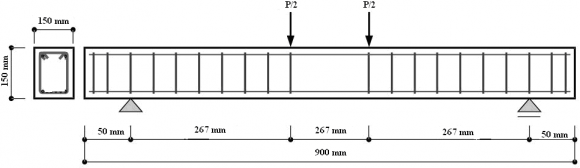
Seven reinforced concrete beams were cast and tested to failure. The overall dimensions of the reinforced concrete beam tested were 150 x 150 x 900 mm. The control beam, RCCB, was reinforced with 2@12 mm diameter deformed. The others are three GFRP beam reinforced with 2@12 mm diameter of GFRP bars and remaining three of SSR beams were made in reinforced with 2@12 mm diameter of Stainless steel bars. The shear reinforcement for beams GFRP and SSR was provided using a GFRP-10 mm diameter and Stainless steel plain10 mm diameter bar. All of the beams tested were designed to fail in flexure. The concrete with an average strength of 30 MPa at 28 days was used throughout the study. The compositions of the concrete consisted of ordinary Portland cement, coarse aggregate and natural river sand. The coarse aggregate used in concrete mix was a combination of crushed and uncrushed gravel with the nominal diameter of 20 mm. The water-cementations ratio used was 0.50.All of the beams were cast in steel moulds and manufactured in the laboratory. The beams and cubes were cured in good water available in the laboratory at room temperature.
V.
7. TEST SETUP AND TEST PROCEDURE
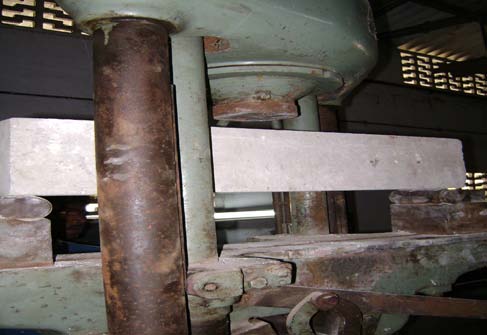
The simply supported beam with the effective span of 800 mm was tested under four-point loads at the age of 28 days up to failure. The two-point loads were applied in the middle of the beam at a distance of 267 mm apart. The schematic diagram of the beam and test setup is shown in Figure 1 and Figure 2. The load is monotonically applied during testing in a 400 kN U.T.M (Universal Test Machine). Deflection of the tested beams is measured with a deflectometer at mid-span. During testing, cracks are marked and crack width is measured using a hand-held microscope. Crack spacing is measured within the constant moment zone. Deflections, ultimate capacities, and failure modes are also investigated.
8. ( E )
9. RESULTS AND DISCUSSION
10. a) General Behavior
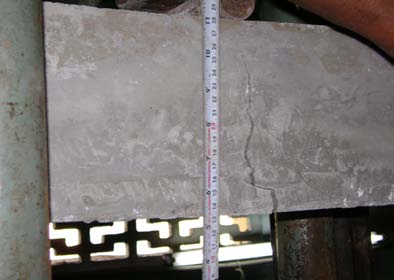
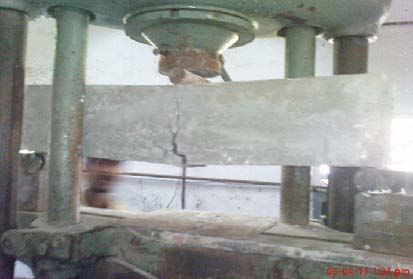
The steel reinforced control beams (RCCB) develop flexural cracks at mid-span after the first crack, flexural cracks are uniformly distributed throughout the tension zone. Following yielding of the steel bars, beam deflections increase without an increase in load. A ductile flexural failure occurs with yielding of the reinforcing steel. The amount of energy absorbed through plastic deformation in the reinforcement demonstrates the advantage of steel as a reinforcing agent. The behavior of the FRP reinforced beams differs from that of the steel reinforced beam. Final failure occurs in two distinctly different modes, as shown in Figure 4.The first mode is the FRP rupture of the underreinforced beams. Tensile rupture of the GFRP bar occurs in all beams that are reinforced with lower balanced reinforcement ratios. These results demonstrate the brittleness of FRP materials. The second mode of failure is the crushing of concrete in the over-reinforced beams. As expected, the failure in beams reinforced with more than the balanced reinforcement is due to the compressive failure of concrete crushing. Observed cracks within and near the constant moment region expand in a vertical direction. As the load increases, shear stress become more critical and induces inclined cracks. Table 2. shows the average crack spacing in tested beams at service load and high load. The effect of the concrete strength and the reinforcement ratio on the crack spacing is negligible, and the crack spacing decreases as the load increases.
11. b) Load-Deflection Behaviour
The short-term load-deflection behaviour of all the beams tested is shown in Figure 3. Initially all beams show relatively linear elastic behaviour up to the cracking load when the concrete cracked at the tension face. Thereafter, the stiffness of the beams, particularly for the GFRP reinforced concrete beams, was reduced at a faster rate, resulting in a larger deflection. This may be due to the effect of low elastic modulus of the GFRP bar compared to stainless steel.
Comparing the deflection between beams GFRP and RCCB the former had, for a given load, larger deflection in the order of 1.75 to 2.0 times the deflection of the control beam (RCCB).The average measured deflections at near failure for beams GFRP and RCCB were 14.5 mm and 8.2 mm, respectively. This indicates that direct replacement of steel with GFRP bars, on the basis of the same area of reinforcement replacement, will not produce the same performance as beam reinforced with steel. Therefore, some modification in the design has to be considered when GFRP bar is to be used as reinforcement.
The use of stainless steel as reinforcement in beam (SSRB) resulted increased deflection on same load was observed when compared to glass fiber reinforced concrete beam (GFRPB) and control beam(RCCB) also in slight improvement on the stiffness of the beam were observed. The deflection ratios, at the same load level, between beams SSRB and RCCB were in the range of 1.75 to 2.15 which show slight only slight difference as compared with the GFRPB beam. The deflection of the beam near to failure was 18.5 mm. This indicates that the use of stainless steel as reinforcement not only provides reinforcement to resist load but also increase, to some extent, the stiffness of the beam. The ultimate failure moment of all the tested beams are presented in Table 1.From the Table1 it was observed that the control beam(RCCCB), had higher load carrying capacity compared to the GFRP reinforced concrete beam, by about 30% .This shows that the low elastic modulus of the GFRP bar had an effect on the load carrying capacity of the beam.
As for beam SSRB, the use of stainless steel as reinforcement has improved, to some extent, the ultimate failure moment of the stainless steel reinforced concrete beam (SSRB) by about 12% compared to beam GFRPB. This was due to the effectiveness of stainless steel as shear reinforcement.
Table1 : Comparison between experimental and theoretical ultimate moments d) Cracking and mode of failure All of the tested beams failed in flexure with crushing of concrete in the compression zone at the failure stage after the development of flexural cracks. The failure mode and crack pattern of the tested beams are presented in Figure 4.From Table 2 it was observed that all of the beams cracked in tension under a relatively small load of about 7.5% to 11% of their ultimate load. The first visible crack formed between the locations of the two point loads in the region of maximum bending moment. Thereafter, as the load was increased more cracks started to form over the shear span on both sides of the beam.
Beam GFRPB recorded about 25% less number of cracks and more crack spacing by about 40% compared with the control beam(RCCB). This may indicate that the stiffness of the GFRP bar had an effect on the cracking behaviour of the beam. In compare to the control beam and stainless steel reinforced beam (SSSRB), experienced greater number of cracks with smaller crack spacing. The average crack spacing for beam B3GM was about 20% less than the control beam. Thus, it shows that stainless steel can be used to reduce the cracking of the reinforced concrete beam.
12. CONCLUSIONS
The main conclusions that can be drawn from this study are as follows:
1. Concrete beam reinforced with GFRP sections experienced lower load carrying Capacity and stiffness compared with the conventional reinforced concrete beam(RCCB). 2. Beam reinforced with GFRP bars showed different flexural behavior than that of beam reinforced with stainless steel bars this was mainly due to the lower elastic modulus of the GFRP section. 3. The number of cracks for beam reinforced with GFRP section was lower than the conventional beam. In addition, the average crack spacing of the GFRP reinforced concrete beam was also larger compared with the control beam.

| Experimental | Theoretical | ||
| Ultimate | design moment | Capacity ratio | |
| moment(kN m) | (kN m) | ||
| GFRPB1 | 4.00 | 6.50 | 0.62 |
| GFRPB2 | 4.21 | 6.50 | 0.65 |
| GFRPB3 | 4.10 | 6.50 | 0.63 |
| SSRB1 | 4.60 | 6.50 | 0.71 |
| SSRB2 | 5.06 | 6.50 | 0.78 |
| SSRB3 | 5.20 | 6.50 | 0.80 |
| RCCB | 6.00 | 6.50 | 0.92 |