1. INTRODUCTION
elf-compacting concrete (SCC) is the current research area today. Many intrinsic properties of the concrete are yet to be understood clearly. The differences between High performance Concrete (HPC) and Self compacting concrete (SCC) are essentially in the use of special admixture [16]. Due to the use of chemical and mineral admixtures, the micro cracks study are more essential in SCC compared to NC [7,31].
Many investigators have evaluated the mechanical characteristics and durability of SCC mixes. The improved pore structure and better densification of matrix have bearing on the fracture characteristics like fracture energy (G F ) and critical stress intensity factor (K Ic ). It has been reported in literature that increased density will increase the compressive as well as tensile strength of concrete and also fracture energy [11]. Characteristic length (l ch ) will decrease with an increase in density [13].
Fracture behavior of plain concrete is the basis for all the studies on behavior of reinforced concrete (RC) and prestressed concrete structures via fracture mechanics. Experimental studies have been conducted to ascertain the effect of the aggregate on the fracture behavior of concrete. It is reported that an increase in the size of aggregate decreases the brittleness of hardened concrete and increases the fracture energy as well as fracture toughness [1,2,29].
Prokopski et al. [22] from their studies on the use of silica fume and effect of water-cement ratio on concrete have concluded that the stress intensity factor increases with addition of silica fume. The variations in stress intensity factor are closely related to the variation in the concrete matrix. Chen and Liu [6] have studied the effect of aggregate on fracture behavior of HPC and have shown that G F and K IC increase with increase in the aggregate size.
Planas and Elices [21] have shown that the fracture energy, G F is size dependent. Ries and Ferreira [24] have studied the effect of specimen notch-depth on fracture energy and have shown that the specimen dimension do effect G F and fracture energy increases with increase of notch to depth ratio, i.e. higher the notch to depth ratio, higher will be the fracture energy.
Hence it has become a contentious topic in the fracture mechanics of concrete.
2. II.
3. EVALUATION OF FRACTURE CHARACTERISTIC
a) Fracture energy (G F ) from work-of-fracture
Many methods have been recommended to determine the fracture energy and characteristic length, using simple three point bending tests (TPB) [17,19,20,30,4,10,18,12,9].
One can apply the recommendation of the Technical Committee RILEM [25] to perform three-point bend tests in notched beams. The Fracture energy is defined as the amount of energy necessary to create a crack of unit surface area projected in a plane parallel to the crack direction. As the beam is split in two halves, the fracture energy can be determined by dividing the total dissipated energy by the total surface area of the crack. According to the RILEM [26] to control the fracture energy can be calculated as (1) Where G F = fracture energy (N/m), W 0 = area under the load-deection curve (Nm), m = weight of the beam between supports (kg), t = thickness; b = depth ; S Displacement corresponding to P = 0 and a = initial notch of the beam.
4. i. Intrinsic brittleness
It is well known that the brittleness of concrete is characterized not only by the fracture toughness but also by a parameter related to it through other fracture and/or elastic constant. This parameter is a measure of the length of the fracture process zone. The smaller its value, the more brittle is the material. According to the fictitious crack model (FCM) [28], the brittleness can be expressed:
(2
)Where E is modulus of elasticity in [MPa] and f t is the tensile strength [MPa].
ii. Fracture toughness The fracture toughness K IC is calculated according to the RILEM [27] using the equation
5. EXPERIMENTAL STUDY a) Mix properties
The cement used was 53 grade, having at 3, 7 and 28 days strength of 26.50, 33.20, and 53.40 MPa, respectively. Crushed granite aggregates of maximum size 16 mm were used. The specific gravity, dry-rodded unit weight, and water absorption of the coarse aggregate were 2.71, 1, 550 kg / m 3 and 0.5 by weight of the aggregate, respectively. River sand passing 4.75 mm was used. The specific gravity of the sand was 2.62 and the fineness modulus was 2.48. Class F fly ash from the thermal power plant near Raichur, India, was used. The CaO and loss on ignition (LOI) contents of y ash were 59, 1.02 and 1.08, respectively. The quantity of SCC (SCC1, SCC2 and SCC3) are listed in (Table 1).
IV.
6. EXPERIMENTAL RESULTS
7. a) Fresh properties of SCC
The slump flow test is the most widely used method for evaluating concrete consistency in the laboratory and at construction sites. The consistency and workability were evaluated using the slump flow, U-Box, L-Box, J-Ring, V funnel and fill box tests.
The slump flow of SCC concrete was in the range of 650-750 mm, which is an indication of a good deformability. The time to reache 500 mm slump was in the range of 3-5 s, the J Ring was in the range of 3-8 mm, the funnel test flow time was in the range of 3-7 s, the funnel test flow after 5 minutes was in the range of 1-3 s, L-box, U box and Fill box were in the range of 0.8-1, 3-10 mm and 90-100% respectively. The fresh properties of SCC are summarized in (Table 2).
8. b) Mechanical properties of SCC
Compressive strength, modulus of elasticity, exural strength and tensile splitting strength tests were conducted on all specimens of SCC mixes. The mechanical properties like compressive strength, exural strength, split tensile and modulus of elasticity of SCC were obtained testing 150 x 150 x 150 mm six cubes, 100 x 100 x 500 mm six prism and 150 x 300 mm cylinders the results are summarized in (Table 3).
The amount of powder usually cement +fly ash + microsilica used in SCC was in the range of 400-640 kg / m 3 for different grades of concrete. The density of SCC slightly decreased with decrease in the waterpowder ratio. This may be due the combination of AEA and VMA which formed large amount of air pockets in concrete specimens. The compressive strength increased with the decrease in the percentage of y ash and water-powder ratio. The compressive strengths of SCC at 28 days varied from 15 to 45 MPa and increased by 10% at the end of 90 days.
The split tensile strength, exural strength and modulus of elasticity at the end of 28 days also showed reduction due to addition of y ash. This is because of the slower pozzolanic reaction of the mineral admixture, which caused slow rate of setting and hardening.
V.
9. ANALYSIS OF RESULTS
a) Fracture Energy (G F ) from work-of-fracture In this category, the experiments were carried out using different mixes (SCC1, SCC2, and SCC3) with different sizes (440x100x100 and 850x100x100 mm) for notched and un-notched beams. Following two types of specimens were used: (i) un notched and (ii) notched with the ratio notch/depth equal to 0.5 and 0.1 for the spans of 400 and 800 mm respectively. Three-point bending tests were conducted using a closed loop Dartec Servo Controlled testing machine with a crack mouth opening rate of 0.001 mm/sec. The details of the concrete mixes labelled SCC1 to SCC3 for batches 1, 2,
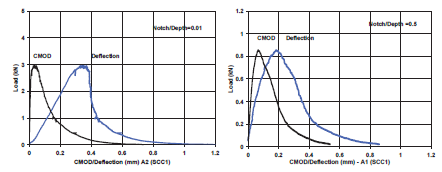
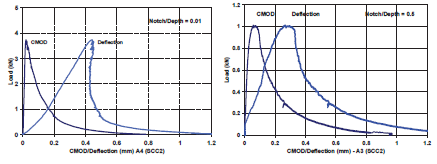
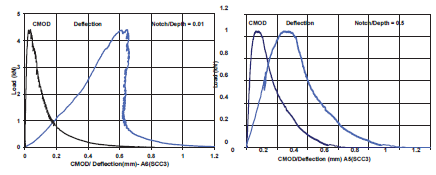
= ? 0 l ch (mm) = EG F /f 2 t K IC = 3(P 0 ) S ? ?ag 1 (?) 2b 2 t [M P a ? m g 1 (?) = 1.99 ? ?(1 ? ?)(2.15 ? 3.93? + 2.7? 2 ) ? ?(1 + 2?)(1 ? ?) 3/2 ?= G C = (K IC ) 2 /Edifferent materials for various mixes of and 3, respectively, are given in Table 1. Before casting the beam specimens, a notch was introduced at the mid-section. It was 0.5 depth for the 800 mm beam and 0.1 depth for 400 mm span beam. The tests were controlled by the crack mouth opening displacement (CMOD). The complete load-deection and load-CMOD data were automatically stored on the computer. The (Figs. 1, 2 and 3) show the typical load-displacement and load-CMOD plot for SCC1, SCC2 and SCC3 with notched and un-notched respectively. In general, it is seen that as the notch to depth ratio increases, at peak load there is an increase in deection and CMOD.
From the (Figs. 1, 2 and 3), it is evident that; (i) the pre-peak stiffness of load-deection curve in the case of un-notched beams is more than that of notched beams. This is attributed to the presence of notch; (ii) there is a sudden drop after peak load in the loaddeection curve in un-notched beam which highlights the brittleness induced to the absence of notch. However this is not observed in notched beam; (iii) the ratio of peak loads of notched and un-notched beams is about Fracture energy, G F is the energy needed to create a crack of unit area and also called as specific fracture energy. The work of fracture was calculated by measuring the area under the load-deection plot and the fracture energy was calculated from the (Eq. 1) as recommended in the RILEM guidelines and the values of G F are given in (Table 4).
From the result of GF that is obtained by work of fracture, it is evident that the G F is greatly affected by the size of beam and noth-depth ratio. Hillerborg [14] also showed that G F increases with an increase in specimen size. The variability of G F with specimen size and for its significant departure from G c is mainly due to the violation of the two basic assumptions: (i) the work done by the external load goes solely into stable crack extension and (ii) the energy required to create a crack of unit area is independent of geometry and loading configuration. Several investigators have identified many processes, such as crushing of material, thermal loss, energy consumed in minor cracking, etc. other than the stable crack extension on which some energy is expended. Hence, it is clear that some errors are attributable to the determination of W F and A lig , which can explain the variability in G F . It is also seen from the literature that for normal grade concrete, G F varies from 40 to 130 N / m [15] and for the HPC it varies from 116 to 120 N / m [8]. From the present study, it is observed that GF for the notch/depth ratio 0.5 and span of 800 mm varies from 146 to 200 N / m and for un-notched beam varies 126 to 185 N / m. It can be seen that the fracture energy obtained with the span of 400 mm is slightly less than that of beam with span 800 mm. The value G F of SCC in the present study is slightly more compared to that of normal concrete and HPC, this is due to the effect of porosity. SCC has higher porosity and less density compared to HPC and normal concrete.
Khalil Haidar [13] also has shown that the concrete becomes more ductile as the porosity increases (mass density decreases) and fracture energy is extremely dependent on the mass density of material.
Moreover, G F is not constant but varies with the notch/depth ratio and G F increase with an increase in depth of beam. (Fig. 4) shows the variation of fracture energy G F with compressive strength. It is seen that the fracture energy increases with increase in strength as well as the increase in notch-depth ratio. As expected, the present work showed that the fracture energy, G F , is a fracture parameter that is size-dependent [21,24]. It is found that G F values show a definite trend to increase with increase of notch to depth i.e. un-notched depth has a lower value of G F .
Fracture toughness (K IC ) is the value of critical stress intensity factor K, for which the crack starts growing. K IC values for various mixes were obtained from a peak load based on LEFM approach (Eq. 3) and are given in (Table 5). It is seen from the literature that the KIC values for various mixes varies from 0.8 to [23,3], while in the present study it varies from 0.58 to for notched beam and for un-notched varies from 0.24 to for the span of 800 mm length. It is observed from the (Table 5) and (Fig. 5) that with an increase in compressive strength of SCC, there is an increase in the fracture toughness for notch and unnotched beam. There is significant difference between K IC of notched and un-notched beams. This is due to the presence of notch, which increases the ductility, when compared with an un-notched beam. It may be stated that in practice the beams are un-notched and hence the value of K IC is over estimated.
For elastic brittle material G F = G c . However, for concrete, which is a quasi brittle material, G F is higher than G c because in the case of quasi-brittle materials there is stable crack growth before failure takes place. G c normally varies between 3 to 20 N=m [15] for normal concrete and for HPC is varies between 17 to 40 N/m [5], while G c varies between 18 to 20 N=m for notched beam and for un-notched beam varies between 2.9 to 3.2 N/m. The variation of K IC is also reected in the corresponding toughness value G c , since K IC , and G c are directly related as per (Eq. 5).
The characteristic length l ch of SCC or brittleness of SCC based on FCM as per (Eq. 2) is given in (Table 5). Generally for normal concrete l ch is about 200 to 500 mm [15,20] and for HPC it varies between 120-450 mm [23]. In SCC, l ch varies from 580 to 740 mm for notched beams and varies between 540 to 640 mm for un-notched beams. It is also seen the l ch decrease with an increase in compressive strength and notchdepth ratio.
10. CONCLUSIONS
Experiments were conducted to determine the mechanical properties of SCC and fracture characteristic of SCC beams under three-point bend notched and unnotched beams were tested at the department of Civil Engineering of the Indian Institute of Science in order to study the fractures properties of SCC. The main conclusions that can be drawn from this study are the following:
1. The results obtained by the work-of-fracture method follow the trend of "fracture energy increasing as the compressive strength of the concrete increases". 2. As expected, the present work shows that the fracture energy, G F , is a fracture parameter that is size-dependent [21,24], i.e dependent on the specimen dimensions. It is found that G F values show a definite trend to increase with increase of notch to depth i.e. 50 mm and 10 mm notch depth have a higher value of G F compared to that of an un-notched beam. The size dependence is mainly due to irrecoverable damages outside the cracking plane which tends to increase with the specimen size.
11. The range of brittleness numbers found in this study
shows that SCC is more ductile than HPC. Hence can be used at least for large size structures. 4. The values of characteristic length of SCC (l ch ) is to be more when compared with HPC, NC and high strength concrete. It may be concluded that the SCC is more ductile compared to HPC.
12. REFERENCES REFERENCES REFERENCIAS
![, P 0 = the measured maximum load [N] + self weight of the beam [N]. The result corresponds to the mean values of at least three tests. The critical energy release rate G C is related to K IC as:](https://engineeringresearch.org/index.php/GJRE/article/download/538/version/100104/4-Fracture-properties-of-Self-Compacting-Concrete_html/2066/image-2.png)
| January 2012 |
| 31 |
| Volume XII Issue v v v v I Version I |
| ( E ) |
| Journal of Researches in Engineering |
| Global |
| Tests | SCC1 SCC2 SCC3 | ||
| Slump Flow (mm) | 750 | 700 | 670 |
| T50cm Slump Flow | 3 | 4 | 5 |
| J-ring (mm) | 3.2 | 3 | 8 |
| V-funnel (Sec) | 4 | 6 | 7 |
| V-funnel at T5 | 2 | 3 | 3 |
| L-box (H2/H1) | 0.8 | 1 | 0.95 |
| U-box (H2 ? H1) | 5 | 3 | 5 |
| Fill-box(%) | 95 | 95 | 95 |
| Mix | Density | f c | E | f t | f r | |
| kg/m 3 MPa GPa MPa MPa | ||||||
| 2044 | 17.1 | 17 | 1.5 | 2.6 | ||
| SCC1 | 2074 | 16.8 | 17 | 1.8 | 2.7 | |
| 2074 | 16.1 16.5 | 1.7 | 3.0 | |||
| 2006 | 29.8 | 21 | 2.7 | 4.2 | ||
| SCC2 | 1956 | 30.4 | 22 | 2.7 | 4.2 | |
| 2010 | 31.4 | 22 | 2.7 | 4.2 | ||
| 32 | 2163 | 45 | 28 | 3.4 | 6.2 | |
| Volume XII Issue v v v v I Version I | SCC3 | 2133 2104 | 46 43 | 28.2 27 | 3.4 3.4 | 6.3 5.9 |
| ( E ) | ||||||
| Journal of Researches in Engineering | ||||||
| Global | ||||||
| Series | a/b | b | S | G F (N/m) | Average | |||
| f c | Beam | G F | ||||||
| (M P a) | mm mm | 1 | 2 | 3 | (N/m) | |||
| A1 (SCC1) | 15 | 0.5 100 800 143 149 147 | 146.3 | |||||
| A3 (SCC2) | 30 | 0.5 100 800 162 179 166 | 169.0 | |||||
| A5(SCC3) | 45 | 0.5 100 800 173 210 218 | 200.3 | |||||
| A7(SCC2) | 30 | 0.1 100 400 122 148 N/A | 135.0 | |||||
| A9 (SCC3) | 45 | 0.1 100 400 165 185 216 | 188.7 | |||||
| HPC* | 48 | 0.5 100 800 125 110 147 | 127.3 | |||||
| A2 (SCC1) | 15 | 0.01 100 800 124 128 N/A | 126.0 | |||||
| A4 (SCC2) | 30 | 0.01 100 800 136 149 140 | 141.7 | |||||
| A6(SCC3) | 45 | 0.01 100 800 165 185 207 | 185.7 | |||||
| A8 (SCC2) | 30 | 0.01 100 400 117 130 116 | 121.0 | |||||
| A10(SCC3) | 45 | 0.01 100 400 167 184 193 | 181.3 | |||||
| January 2012 |
| 33 |
| Volume XII Issue v v v v I Version I |
| ( E ) |
| Journal of Researches in Engineering |
| Global |