1. Introduction
ince their appearance in 1975, fractals have been used in many areas related to engineering applications and have proven useful for increasing performance while using less volume. It has been shown that the self-likeness of fractal patterns could be used to create an effective distribution system over geometric surfaces.
Originally, they emerged as geometric shapes that are repeated in an iterated manner at different scales and that are self-similar. In the first decade of its development its geometric properties and its possible connections with other disciplines were obtained. Subsequently from the work of Nigmatullin [1], it began to incursion with connections of the area with fractional or fractional calculation, and from this, in the 21st century the possible applications to the various engineering. This work is part of the fractal theory to heat transfer, through simulated constructions by computer, which are feasible to build, on fins whose surface is fractal.
The essential characteristics of fractals is the irregularity of surfaces that can be repeated at different scales, this allows to improve heat transfer, for instance the surfaces of the fins under Euclidean geometries have been used in a classical way [2], [3]. One of the applications of surface engineering with fins is the radiator. By attaching the metal sheet to the water pipes at a defined temperature, the area of the convection surface increases and thus increases the heat transfer rate [4], if this is changed from geometry to fractal geometry, the transfer efficiency should be markedly improved.
Due to the increasing use of methods to improve the design of the heat exchanger in the industry, Compact heat exchangers have been developed which ones have a high proportion of heat transfer surface to heat exchanger volume, considering the fractal capacity to increase heat transfer. These are divided into fin tubes and fins plates [5] [6], which allow a high heat transfer coefficient in the high turbulence flow as that offered by a laminar flow in a flat tube situation [7].
This project investigated a tube heat exchanger based on the use of the Sierpinski fractal pattern where the spaces are not square but circular, and those are given by an operation fractal operation called convolution. Using computer modeling software, this indicated that with fractal iteration, an increase in heat transfer is achieved. Another research interest involving fractals in engineering has been the effects of fractal on surface diffusion rates.
In reference to radiators, they can use any type of compact exchangers, for the purpose of controlling the engine temperature when the engine is too high [8]. Based on the different models of cooling systems manufactured in [9], [10], [11], it decided to analyze the behavior of the design of the radiator with convolution fractal distribution fins, because in heat transfer fractal designs have shown better results than common geometries [12], [13].
The following simulations presented was made through CFD software since it allows us to study trends and properties [14].
2. II.
3. Methodology
This project methodology is divided in four parts: fin calculus, fractal distributions, CAD and simulation.
4. a) Radiator Design
A radiator has four parts: inlet tank, outlet tank control cap and diaper (figure 1). The principal parameters are the diaper dimensions [15] which includes fins and tubes, these last parameters are those that will be considered to implement the fractal geometry.
5. Fig. 1: Parts of a radiator
Tubes design: The chosen parameters to realize the tube design were: Cross section (1), total internal perimeter (2), and hydraulic diameter (3).
Where Nt is the radiator tubes number, thi is height of the tube, twi is the internal width of the tube.
Fin design: To design the heat transfer area on the side of the tube Aefect, tube and the area Ac, these can be expressed as:
6. b) Design using the Sierpinski distribution
Considering the values obtained of ( 4) and ( 5), it was necessary to find an efficient distribution, for this reason it was decided to use the Sierpinski distribution to locate the tubes.
To determine the location of the centers of the holes, we considered the dimensions of the fin, because the fin has a rectangular form, this one was divided into four squares, and in each one we applied the Sierpinski distribution. Finally, we made a Matlab program which calculates the center and the location of the holes, the result of the algorithm is illustrated in figure 2.
7. Fig. 2: Result obtained from Matlab c) Fractal Convolution
In 2015, Cotton, McLeman y Pinchock proposed process to combine two fractals [16], one into each other and they explored the combined effect on fractal dimension. This project explores that effect over a radiator and its effect calculated through a simulation. The construction follows the parameters exposed in [16], except that apart from the Sierpinski we build a new fractal (figure 3) and the result of the convolution between Sierpinski and the fractal designed will be determinate the radiator perforations. The contribution in this project was the use of these ideas to simulate the behavior of the radiator. The figure 4 shows the result of the fractal convolution that was made, and the fractal dimension was calculated through HarFa v5.3.33 software [19], its result was illustrated in the figure 5. With the values previously found, the measurements of the drill bits are determined for the diameters of the holes and tubes passing through them, which corresponds to 1?8 "for the small hols and 3?8" for the central holes. The figure 6 shows the result of the convolution implemented in a fin design.
8. Fig. 6: Fin design in CAD
Meshing: Because the geometry radiator had 36 tubes and more that 500 perforations, it was necessary to use a mesh with the right size to analyze in CFD study and skewness coefficient that was less than 0.86 to be compatible with Fluent. Table 1 shows the mesh parameters implemented.
9. Results
10. a) CFD
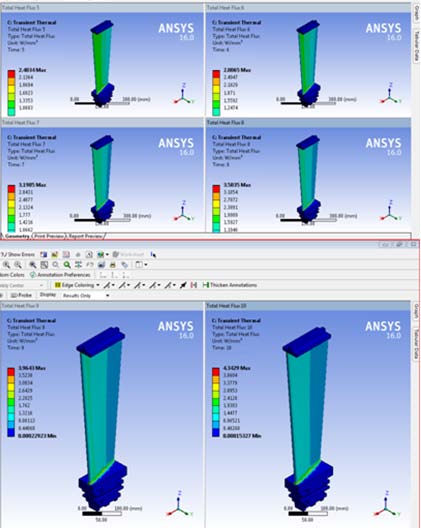
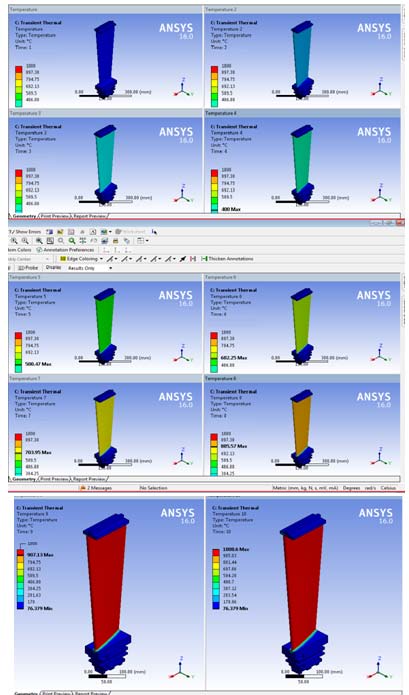
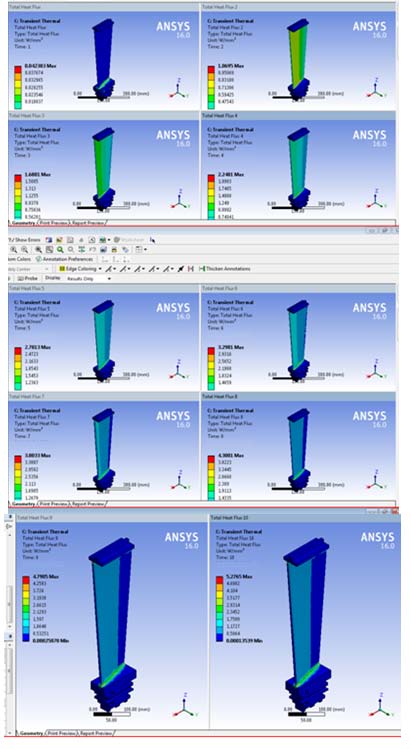
Simulation was performed in Ansys, it was made in order to analyze the temperature in the radiator in a time of 30 seconds. Figure 7 shows the difference between temperature at time t=1s and final temperature at time t=30s.
11. b) Data processing
The data processing in this radiator has the purpose to find the function that fits better to fractal design. The first step consists in taking a temperature model and adjusting to a Mitag-Leffler function. To realize it, it was necessary to analyze the temperature decreasing, taking as reference the fluid initial temperature at the inlet radiator as T (0)inlet= 385K.
Figure 9 shows the change of temperature at the outlet of the radiator. When estimating the model purchased with (7) we find that:
T (t) = 6 + 70e ?0.47t (8)When the adjustment analysis of the regression is performed, we find that: This is a lumped system, which temperature varies with the time, but remains unformed around the system at any time. The temperature of a lumped body of arbitrary shape with a mass m, volume V , surface area As, density ? and specific heat Cp, initially at a temperature Ti, that is exposed to convection at a time t = 0 at a medium temperature T? , with a heat transfer coefficient h is expressed as:
T(t) ? T ? Ti ? T? = e ?bt (9)Where,
For the design of this radiator, the parameters of table III were considered.
12. Table 3: System Characteristics
Because the fractal form used is a fractal one and before the estimation by means of the calculation of Mittag-Leffler, definitions will be proposed that seek to link the parameters with the fractal dimensions, as follows: Definition 1: We will call fractal dimension of convection (dF c) to: Being the natural logarithm of the coefficient of heat transfer coefficient h and the natural logarithm of the product of ?? Lc? Cp. This definition can be expressed as:
Where D F is the fractal dimension of the convolution made in (6) Replacing the equation 10 with Tabla 3 data, we obtained the value of dF = 0, 4084 Calculate the ? value: However, since the construction is fractal it is suggested to adjust the classical model to a Mitag-Leffler function with a value of ? To find the value of ?, it was taken as a reference the value of dF found in (11), and considering some observations given by Tatom [18] with some modifications appropriate to the project: Which value of ? = 0, 31.
If Mitag-Leffler function with a value of ? = 0.3 is presented in the form of a Fox H-function, we get: As Haubold, Mathai and Saxena [17] indicates, when we performed the adjusting analysis with ? = 0.3, we find that: R 2 decreases to 0.23, the square root of the average square decreases to 5.17 and p = 4, 59X10 ?5 , as shown in figure 11. The improvement of the adjustment suggests that there must be a connection between the value ? = 0.3 and the fractal dimension of the proposed design convolution ds1* ds2 = 1.3991.
When making the adjustment, it resembles the theoretical calculation of [18]. However, the values proposed by Zhao should be changed by the values of the model adjusted for this case of the radiator, in the following way: µ 2 ? is the thermal conductivity of the fractal material designed using the Sierpinski distribution, ?? its density, c? specific heat, for the authors these values must be changed by their natural logarithm and the corresponding ? of the fractional order of the equation must be changed to the value ? of this model.
13. IV.
14. Conclusions
The simulation has shown that the fin surface in heat transfer and fractal shape and the yield of the fractal fins improve heat transfer or flow by improving fin efficiency.
The fundamental hypothesis on which the authors of the project are based is that since the fractals are self-similar objects and work at any scale, it is feasible to apply them at any scale of the engineering.
The Mittag-Leffler model with ? = 0, 3, fits much better than Newton's classic model because it changes from a distribution of a Euclidean geometry to a fractal geometry, in the design of fins in a radiator and the distribution of tubes.
To estimate a fractal object under the condition of thermal conductivity, when making the estimation it is suggested that it must relate to the Fourier equation of fractional type in fractal medium as we saw in [18] This simulation further suggests that the reconstruction of the fins not in the form of the classical geometric euclidea but fractal and with operations of convolution between fractals markedly improves the behavior of heat transfer. It is further suggested to explain these phenomena with the possible connection with fractional calculation, which allows innovation within heat transfer and its associated engineering, we will therefore say that we have a promising future through these ideas.
| Size Function | curvature |
| Size | 3.3208 e-2 mm |
| nodes | 3409535 |
| number of elements | 2835588 |
| III. | |
| Convection (forced) | 80 W/K.m 2 |
| Fluid inlet temperature | 385 K |
| Ambient temperature | 300 K |
| Initial mass flow | 0.1 Kg/s |