1. Introduction
hen a designer is designing for a kid-centric brand, obviously it's important to focus on the kids. But also he should remember it's not just about the kids. It's about their parents, too. Kids are the main focus of the Indian families, thus the parents wish to dress up their kids like them. Parents consider few things while buying a dress for their new born like material, style, design, comfort and most importantly whether it is easy to wear and remove without disturbing their baby.
A kid's wear designer should be aware of few things before designing for new born babies. For first few days' right after birth, babies will be sporting umbilical cord out for the first 10-20 days. This umbilical cord can be short or long depending on where it was clamped. so the designer should bear in mind and design in such a way that the dress won't rub and irritate the baby.
Designer should also consider that the mother will feel little bit intimidate in the beginning to put or remove the babies dress. so the design of the dress should not be like pull something down over baby's head. And he should also keep in mind about the fabric he going to use according to the demography. The authors discussed about the lean role in the industries that is discussed below: "Children's clothing serves as a screen on which are projected all kinds of beliefs, anxieties and Aspirations about children." (Bodine, 2003, 60) How and why should we think about children and children's clothing in the field of organization W studies?
How does children's emotionally 'uncontrollable' and dressed bodies impact on the everyday life of organizations? What could the clothing of children as a seemingly mundane, earthy, and material topic potentially offer to the field of organization studies (OS), more broadly? As a multidimensional, inherently personal and theoretically rich territory, clothing and dress intimately connect material cloth to our skin and bodies (Entwistle, 2009).
Clothes relate to our identities, embodied experiences, and social contexts, more broadly. Acting as something of an intermediate skin, protection or aesthetic surface between 'inside' and 'outside' or 'us' and 'the world', the type of clothes we wear on the surfaces of our bodies make us act, move, perform and feel differently in our bodies. "It almost seems that to be human is to understand the structure of cloth, its interlacing's, and its feltings", Ripping (2012, 144) suggests.
The marketing literature relating to children's consumption has been and continues to be dominated by 'consumer socialisation' research (John, 1999) that is heavily underpinned by cognitive, developmental psychology and that aims principally to understand how individual children accrue -across predictable 'agestages' (Piaget, 1960) -an increasing level of sophistication in interpreting marketing messages and operating competently and autonomously within the market place (e.g. John, 1999; Oates et al., 2001; Chaplin and John, 2007). II.
2. Methodology
Method followed for achieving the desired result was followed through conduction of research starts with collecting secondary data through already available research papers and articles which give a wide view of kids wear market. The second step is collecting primary data by surveying, fixed number of consumer were interviewed, as well as by observation of present trend of clothing among kids by visiting various public places like parks and malls and local market was done. Finally the collected data was analyzed and results were developed.
3. a) Collecting secondary data
We have to keep in mind that the parents are going to be changing a lot of diapers throughout the day for newborns, so the designer should design clothing that makes this easier for the parents. Designer should also remember that newborns grow fast, so you really don't need to go crazy with newborn outfits. Few already existing designs for kids are.
Onesies are the staple of baby's wardrobe .People use onesies instead of regular shirts because they snap at the crotch, thereby preventing them from hiking up. Unless you live in a warm climate, longsleeved onesies are preferred to keep those pudgy little arms warm.
Pants, If it's not warm, babies need pants to accompany the afore mentioned onesie and cotton pants are much more comfortable. The footed onesie is the most awesome, easy, useful piece of clothing you can buy. Forget about an onesie, pants, socks, shoes, Jammies are also easier to find because stores just call them pajamas, unlike the aforementioned Footed jammies are the best to ensure those little feet stay nice and warm.
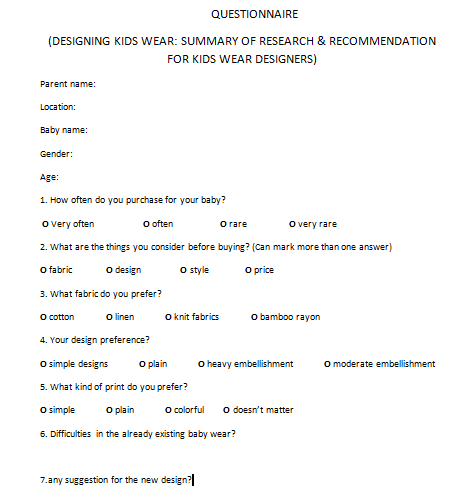
4. b) Preparing a questionnaire
Questionnaire is prepared accordingly: c) Analyzing the report 19 new born baby girls mother was asked to answer this questionnaire. Their answers are collected and analyzed to make a final report.
? 70 % people picked "very often" and remaining 30 % picked "often". The other two options were picked by none. ? 40 % people picked "style",30 % people picked "fabric",20% people picked "design" and only 10% people picked "price" ? 30%people picked "cotton", 40% people picked "knit fabric", 20 % people picked "linen "and only 10% people picked "bamboo rayon".
? 60 %people marked "simple" and "plain", 20% people marked "colorful", and the rest selected "doesn't matter".
5. Conclusion
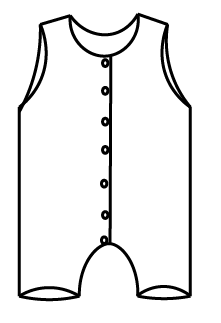
Thus from above review a design for new born baby girl is suggested and designed, This was to present a satisfactory clothing design for new born baby girl aged 0 to 1, the proposed focuses attention on the need for comfort and easy wearable design in the new born girls market, and provides a basis for development of designs that are comfortable for children to wear, and reflect preferences of both children and parents. A sample was made for one of the designs, and an evaluation showed very successful results. Summary of the research and the result will be also helpful for the kids wear designers.
6. Bibliography