1. Introduction
During the dyeing process of cellulosic fabric like as cotton, viscose or linen, after soaking into dye liquor the surface of the textile substrate get covered in negative ions and on the other hand some dyestuff such as direct dye or reactive dye also developed a negative charge which acts as a zeta potential [2] . As a result, the dye molecules are incapable to show a chemical reaction to the textile substrate and roll off the fabric surface that hinders the color changing capacity of the substrate. Salts play the role of glue that holds the dye molecules into the fabric and with the addition of alkali, certain percentage of dyestuff fixed with textiles.
Based on using salts as electrolyte various studies carried out. M.A Salam, P.K Sheik, F.I Faruoique observed the effects of salt on jute fabric dyeing with reactive, direct and mordant dyes [3] as well as Awais Khatri experimented to improve the process substantivity of cotton with reactive dyes in the presence of biodegradable organic salts [4] .
Reactive dyes are the leading class of dyestuff in the textile industries, and 50% of cellulosic materials dyed with it. They are also increasingly gaining importance for wool and polyamide fibers. Worldwide consumption of reactive dyes for cellulosic materials in the mid-1980s was about 10-12% [5] . As reactive dye reached the acme among various dyestuff so, now it is renowned for cotton dyeing with its superior fastness properties and a wide range of applications [6] . The reason of the excellent washing fastness is due to the covalent bonding between the fiber polymers and the dye molecules under alkaline pH conditions [7] , and reactive dye is the only class of dyes amongst all the dyestuffs that makes covalent bond with the fiber and becomes a part of it. Nevertheless, it has some drawbacks for example; large amounts of salt are required to force its deposition on the fabric due to its low affinity of substrate. In addition to that, to fix up the dye with the textiles materials, fixing agent is needed and dye hydrolysis (20-70%) is another demerit of reactive dye [8,9] . To overcome the shortcomings of reactive dyes one experiment carried out by adopting lower liquor ratio [10] . Divyesh R. Patel, Jigna A. Patel, Keshav C. Patel had worked in another article on Synthesis and evaluation of a series of symmetrical hot brand bis azo reactive dyes [11] . Therefore, to minimize the drawbacks of reactive dye, the motive of this experiment is observing that within six inorganic salts that which one gives the best results at optimum salt concentration. J fter the completion of three process that is adsorption, sorption and desorption then dye molecules saturated into the fabric and the overall procedure is known as exhaustion. The presence of dye alone in the dye bath does not fully dissipate in the fibers. For this reason, salt used as an exhausting agent with different colorants (direct dye, reactive dye) in textile dyeing process [1].
2. II.
3. Materials And Methodology
4. A
5. Author:
Lecturer, Department of Textile Engineering, Northern University Bangladesh, Bangladesh. e-mail: [email protected] Abstract: Aplenty of textile substrate especially cotton fabric dyed with reactive dyes because they produce a extensive gamut of bright colors with excellent colorfastness. As the reactive dye requires considerable quantities of salt and alkali for efficient application of colorants, this study is providing an assortment of knowledge about dyeing fabric with reactive dye and using some of the inorganic salts such as glauber salt, sodium chloride, zinc sulfate, aluminum sulfate, ammonium chloride and copper sulfate as an exhausting agent. Color strength measurements and colorfastness properties investigated here. In addition to, visage variation of dyed fabric also included in this study. In this experiment, 5 gm weights of samples dyed with 2% shade of a reactive dye at 60 0 c within 60 minutes where salts applied in three different concentrations like 50 gm/l, 20 gm/l and lastly 10 gm/l. It has observed that colorfastness of the reactive dyed sample with sodium chloride and zinc sulfate is slightly higher though the color strength of fabric dyed with glauber salt and sodium chloride are better than rest other salts.
Impress Newtex composite mills Limited and used without any further treatment.
ii
6. . Dye Stuff and Chemicals
The chemicals and dyestuff collected from Impress Newtex composite mills Limited. Dye: Reactive dye-Solazol red SP2B:2% Electrolyte: The process sequence of cotton fabric with reactive dye (Solazol red Sp-2B): Dyeing started in the neutral condition and at the ambient or room temperature (30 0 c).
Required water pureed in the dye pot as M: L ratio.
Add salt to the dye pot and check the p H Linear dosing of dye at 10-20 minutes and raise the temperature at 3 0 c/min. Add soda ash and sodium hydroxide.
After temperature reached, 60 0 c run the machine for 60 minutes at this temperature.
Then drain the machine, and rinse the sample at 30 0 c for 10 minutes.
At last, a hot wash done using a soaping agent at 90 0 c for 10 minutes.
7. ii. Measurement of color strength
The reflectance value of the dyed samples measured in the wavelength of 400-700 nm with 10 nm intervals using Data color 650 ® Spectrophotometer. This reflectance value is putting into the Kubelka Munk's theory to find out the color strength (K/S) of each specimen.
Color Strength, K/S = (1-R) 2 ÷2R.
8. iii. Measurement of colorfastness
To measure colorfastness properties of the dyed sample. Following fastness test done: Each sample tested for colorfastness to washing, rubbing, and perspiration that were prepared using Society of Dyers and Colourists (SDC) standard. As well as for assessing color change (ISO 105 A02) and color staining (ISO105 A03) standard grey scales utilized to obtain ratings of fastness test.
9. III.
10. Results And Discussion
The experimental results represented in a series of tables and charts. Which provides information about the activity of salts acts as exhausting agent with respect to their various concentration. Color strength assessed instrumentally, and colorfastness considered on visual experience regarding grey scale rating.
11. a) Visual appearance
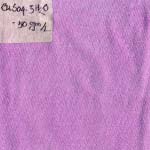
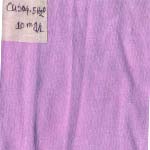
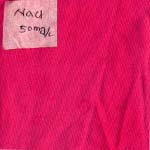
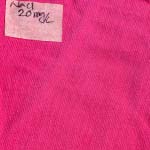
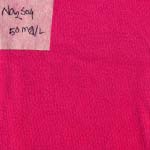
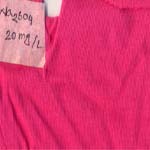
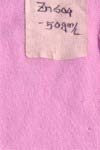
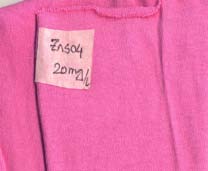
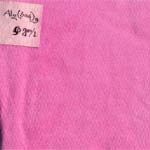
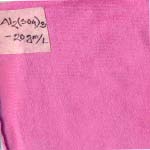
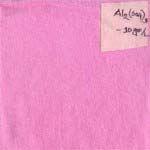
Although all the samples dyed with 2% shade of reactive dye, and higher variation observed in their look in the presence of different inorganic salt. Temperature: 60 0 c Table 3.1: Visual changes of dyed fabric using different salts with respective concentrations It mentioned earlier that all the samples are dyed in the shade %, so their hue should be the same at equal salt concentration. Nevertheless, their look is far different to each other. In addition to, it observed that zinc sulfate and ammonium chloride give bright shade at lower salt concentration while rest of the salts yield vivid color with higher salt concentration. The main reason for this fact is -
12. Global
The dye Solazol red SP-2B belongs to the vinyl sulphone functional group. Moreover, it works well in the alkaline media. It noticed from the following tabulated data prior dyeing only glauber salt exhibits basic media of salt solution then the sodium chloride is in slightly high pH condition, and other salt solutions are in the state of acid condition. Table 3.2: Before adding dye in water liquor the P H of the salt solution mentioned in the following table
13. b) Color Strength (K/S) Analysis
The color strength of sample dyed with sodium chloride and glauber salt are nearly same for 50 gm/l salt that is 9.1 and 9.2 respectably. However, the k/s value of sample using 20 gm/l salt is 5.2, and 10 gm/l salt is 4.7 for sodium chloride; whereas the k/s value of sample dyes with 20 gm/l is 6.5 and 10 gm/l is 5 in respect of glauber salt.
The color strength of dyed sample using ammonium chloride is not so high; nevertheless, it is higher than copper sulfate and zinc sulfate. So the series of salt regarding color strength- Color staining of wash colorfastness of dyed sample using different inorganic salts according to their salts concentration shown in figure 3.2. For 50gm/l, 20gm/l, 10 gm/l salt solution, zinc sulfate shows outstanding color staining wash fastness and copper sulfate exhibit lower color staining fastness grading. On the other hand, moderate fastness observed for sodium chloride and glauber salts. iii. Colorfastness to acid perspiration For 50 gm/l salt solution, color change to acid Perspiration of sample dyed with zinc sulfate is higher (grade 5), but in case of 20 gm/l and 10 gm/l, both glauber salt and sodium chloride expose grade 5 in rating scale for color change.
Regarding color staining, acid perspiration, fastness of colored fabric is better for zinc sulfate at 50 gm/l however; at 20 gm/l and 10 gm /l salt concentration, acid perspiration fastness is good for sodium chloride and glauber salt respectively. Color fastness to alkali perspiration For colorchange of alkali perspiration fastness, sample dyed with both zinc sulfate and aluminum sulfate is good(4.5) at 50 gm/l concentration but at 20 gm/l and 10 gm/l salt concentration fabric dyed with zinc sulfate, sodium chloride show equal color grading.
On the other side of the coin, alkali perspiration of color staining grading is good for dyed fabric with zinc sulfate at 50 gm/l and 20 gm/l, but sample dyed with sodium chloride has moderate color staining grade at those salt concentration, and at 10 gm/l, it shows good fastness properties for color staining.
14. Conclusion
This study has demonstrated that appropriate salt is an essential factor in the reactive dyeing process. After completing all experimental tests, it revealed that all color fastness properties of zinc sulfate is higher than sodium chloride and glauber salt but the color strength is incredibly lower. So concerning to the color strength and fastness properties, sodium chloride is the best electrolyte as an exhausting agent for reactive dye and then glauber salt come to the next among all salts.
![Glauber salt (Na 2 SO 4 .10 H 2 O): 50, 20,10 gm/l 2. Sodium Chloride (NaCl): 50, 20. 10 gm/l 3. Zinc sulfate(ZnSO 4 ) : 50, 20,10 gm/l 4. Aluminum sulfate[Al 2 (SO 4 ) 3 ] : 50, 20, 10 gm/l 5. Ammonium Chloride(NH 4 Cl) : 50, 20,10 gm/l 6. Copper sulfate(CuSO 4 .5H 2 O) : 50, 20,10 gm/l Alkali: Soda ash (Na 2 CO 3 ): 5 gm/l 2. Sodium hydroxide (NaOH): 0.2 gm/l Soaping agent (A340ND): 2 gm/l Acetic acid (CH 3 COOH):1 gm/l Time: 60 min M: L-1:8 b) Methodology i. Dyeing with Reactive dyesThe dyeing of cotton fabric carried out by alkali controllable reactive dye (Solazol red Sp-2B) on Fong's sample dyeing machine. Keeping the material to liquor ratio 1: 8 for the shade percentage 2%.](https://engineeringresearch.org/index.php/GJRE/article/download/1772/version/101455/5-Application-of-Different_html/31270/image-3.png)
| Name | 50gm/l salt | 20gm/l salt | 10gm/l salt | |||
| of the | concentration | concentration | concentration | |||
| salt | Wavelen | k/s | Wavele | k/s | Wavelen | k/s value |
| gth | value | ngth | value | gth | ||
| Glauber salt | 540 | 9.2 | 540 | 6.5 | 540 | 5 |
| Sodium chloride | 540 | 9.1 | 540 | 5.2 | 540 | 4.7 |
| Zinc sulfate | 550 | 0.45 | 550 | 1.8 | 540 | 2.3 |
| Aluminum sulfate | 554 | 1.15 | 550 | 1 | 550 | 0.48 |
| Ammonium chloride | 550 | 3 | 550 | 4.8 | 550 | 2 |
| Copper sulfate | 540 | 0.75 | 540 | 0.7 | 540 | 0.65 |