1. Introduction
2. Global Journal of Researches in Engineering ( ) Volume XVII Issue II Version I
Abstract-The present work aimed to study the feasibility of microreaction process for polyaniline synthesis under solar light. A chemical method to prepare polyaniline is presented in which a continuous operated solar photocatalytic microreactor is utilized to promote the polymerization of aniline. The photopolymerization method yields a polymeric material that has been scanned by electron microscopy (SEM). Results showed that the initial operating temperature has a positive impact on the rate of polymerization but affects negatively the yield of polyaniline. The yielded of polyaniline is decreased as LHSV of the microreactor increased. An optimum (oxidant/aniline) molar ratio of about1.25 is found to give the maximum yield of polyaniline.Comparison between microreactor´s performance and performance of previous published works were presented. Results of the present study confirmed the feasibility of the solar microreaction process for synthesis of polymeric materials. olyaniline (PANI) has been considered a valuable electric-conductive polymer due to its superior characteristics of conductivity, stability, different structures, feasible cost and other excellent performance (Benabdellahet al., 2011). PANI has been applied in many industrial fields such as LED, electrode manufacturing, isomerization of electro-materials, electrodes of storage batteries, enzyme fixation and etc. Langer et al. (2001). PANI has been synthesized by different methods such as chemical, co-mixing of solution, and co-blending by agitation (Malinauskas, 2004). The synthesis of PANI using ammonium persulfate (APS) as oxidizing agent was demonstrated by (Stejskal, 2002).Silver nitrate (AgNO 3 ) was used as oxidizing agent for aniline polymerization in the aqueous solution of HNO3 by (Blinovaet al., 2009). The effect of light adsorption on the macroscopic structure of polymer was investigated theoretically and experimentally by (Daset al., 2005). They concluded that polymerization of aniline is induced by light of suitable wavelength. A minimization in the time of aniline P polymerization under UV-irradiation was reported by (Gustavoet al., 2010). Most the production processes of polyaniline are using batch mode (Kulkarniet al., 2015). (Kulkarniet al. (2015) have useda spiral microreactor for the continuous production of polyaniline nanoparticles ofsize of 245.3 nm from a mixture of 0.04 M concentration of aniline and 0.05 M concentration of AgNO3as oxidizing agent They reported that AgNO 3 acts as a mild oxidizing agent and it was found to be more effective for obtaining nanosize of PANI particles. The effects of neutron and gamma radiations on the electrical, optical, chemical and structural properties of PANI for the same batch were studied by (Sonkawadeet al., 2010). They reported that PANI samples showing increase in conductivity after radiation. They observed the formation of new bands after irradiation which may be due to the cross-linking of polymer chain after irradiation.
Recently, microreaction process has been evolved as a novel technology which has been utilized to establish new concept for design, trouble shooting, and control in many fields of industry (?ali?et al. 2012(?ali?et al. , Rebrovet al., 2003;;Kusakabe, 2002). It is well-known that countries of the Arabian Gulf have received solar incident energy for almost 300 day per year. The measured average incident UV-energy is 45 W.m -2 -64 W.m -2 for class UV-A, and for class UV-B, the average VU-solar energy is 0.19 W.m -2 -0.33 W.m -2 (ISERC, 2012). This makes it promising to use the UV-solar energy for many environmental and industrial applications such as wastewater treatment and synthesis of polymeric materials. Solar irradiation for desulfurization of gas oil in a Y-shaped catalytic microreactor was utilized by (Abid, 2015). He investigated the effect of different operating variables (e.g., concentration of dibenzothiophene, liquid hour space velocity, initial feed temperature, and hydrogen peroxide: dibenzothiophene ratio) on the reactor performance. He reported that the percentage removal of sulfur in the Y-shaped microreactor was 65% in approximately 9 (min) comparing to 340-400 (min) in a batch reactor of macroscopic scale used for desulfurization operation of gas oil.
Aniline in 1 M HCL solution could be polymerized using (APS) as oxidant through two steps. The first is the oxidation to form PANI (emeraldine) hydrochloride. The second step is the deprotonation in
: ? ? § ? Author ? ¥ :ammonium hydroxide solution to yield PANI -emeraldine base (Faris, 2007;Sapurina and Stejskal, 2010). An overview on formation of image with PANI by photoinduced reaction was presented by (Kobayashi et al., 1998). They proposed that photogenerated holes on the irradiated surface of the sensitizer could oxidize the aniline derivatives initiate polymerization while the metal complexes reduced by the photogenerated electrons and precipitated on part of the sensitizer which needed to regenerate (flushed) after periods of operating time. The fractional degradation (x) of aniline was calculated according to equation 1. The percentage yield of PANI was calculated on the basis of the unreacted aniline and estimated according to equation 2:
Aniline conversion (x) =
(1)
3. Microreactor Design and Fabrication
Transport of heat:
(3)
The aim of the present study was to design, fabrication and application of a photocatalytic microreactor for a continuous operation of PANI synthesis under incident solar energy. Another objective was to investigate the influence of the operating variables (e.g., APS/aniline molar ratio, inlet mixture flow rate, and initial feed temperature) onthe morphology of the produced aniline and also on performance of the microreactor.
4. II. Materials and Methods
5. a) Materials
Chemicals used in the present study are: TiO 2 (80% (w/w) anatasa, average particle size 20nm, and specific surface area 60±10 m 2 /g) was supplied from Xinyue Chemical Co., China and used as a sensitizer. Aniline (99% w/w) was obtained from Thomas Baker Chemicals. Ammonium peroxydisulfate((NH 4 ) 2 S 2 O 8 , 98% w/w) was purchased from Fluke Chemical Co. Cobalt (II) chloride-6-water(CoCl 2 .6H 2 O) was obtained from Merk and used as an electron acceptor. Hydrochloric acid (36% w/w) and caustic soda (Flakes) were obtained from Bayer. Water used was obtained from the RO plant.
6. b) Methods
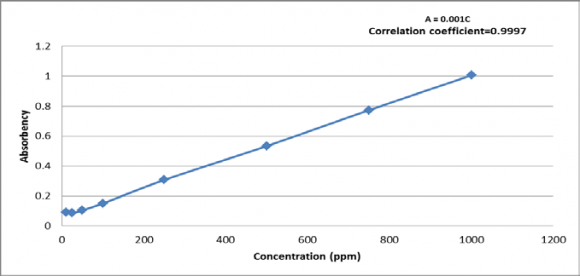
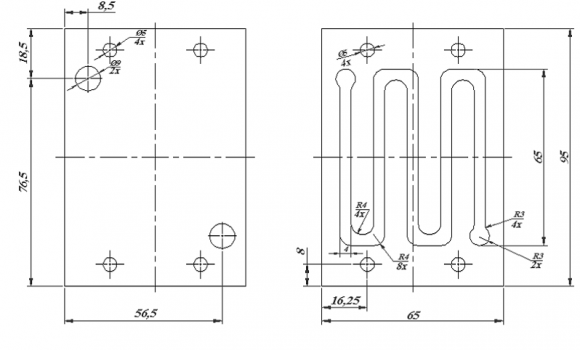
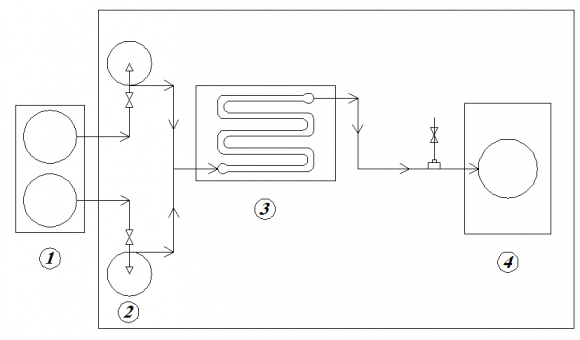
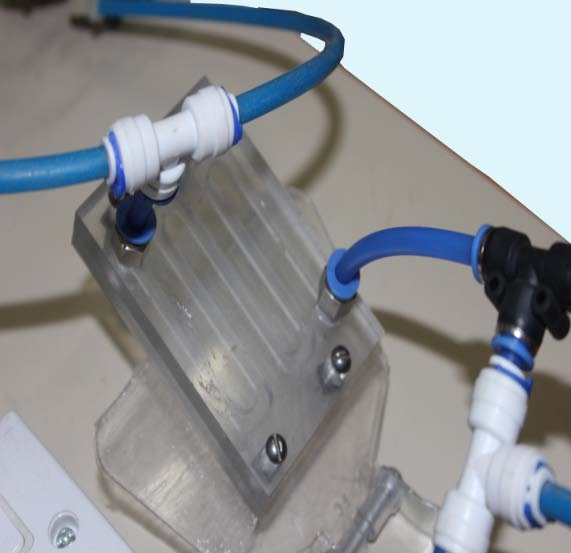
i. Analytical methods UV-Visible spectrophotometer type Shimadzu (UB-1201 PC) was used to record the UV-Vis spectrum of aniline in HCl. Scanning electron microscope (SEM) (Model: Inspect 50S, supplied by FEI-USA) was used to test the deposition process of photo-catalyst nanoparticles on the microchannel and also to examine the surface morphology of the polyaniline produced. To construct a calibration curve of aniline concentration vs. light absorbance, using UV-Vis spectrophotometer, different amounts of aniline (0.0027, 0.005, 0.0107, 0.032, 0.054, 0.086 and 0.107 mmole) is dissolved in 10 ml of 1 M HCl, respectively. Figure 1 Yong and Sangmo, 2003). Figure 2 shows the dimensions of the reactor pattern as designed and schemed using 2D AUTOCAD software. CNC milling machine type C-tek, at the workshops of the University of Technology (UOT), was used to fabricate the microreactor which was consisted of two parts, the upper one was made of a transparent elastic polymer and the lower one was made of aluminum alloy.
7. a) Catalyst
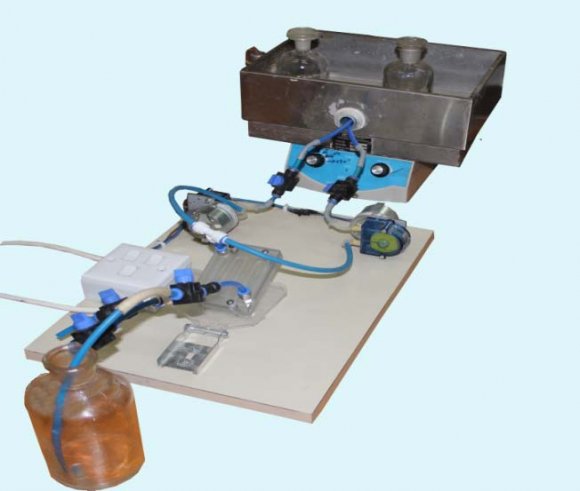
To enhance the polymerization reaction, TiO 2 particles were deposited onto the microchannel of the lower part of microreactor as follows (Abid, 2015): 1. The microchannel was first washed with a 5 wt% of caustic soda solution. 2. In a 25 ml beaker, half gram of TiO 2 catalyst was added to a mixture of 5 mL (5 % w/w HNO 3 ) and 10 mL of 50% (w/w) methanol. The mixture was intensively homogenized with a magnetic stirrer at 400 rpm. Table (1). Each experiment was repeated twice to get accurate results. After passing through the microreactor, the solution was collected in a product vial containing 1 M NH 4 OH for converting polyaniline hydrochloride to a polyaniline base. Reaction mixture was filtered under vacuum and washed with ethanol and then dried at 60 ? C for 6 h to obtain PANI emeraldine salt (ES) as a green powder. All containers and tubing outside the microreactor were shielded from UV-exposure. Flowrates of 0.75, 1, 1.5, and 2 L.min -1 were used which correlate to 6.9, 5.2, 3.46, and 2.6 min residence times, respectively. Each run was repeated at different molar ratios of (APS: aniline).
8. Global
The experimental runs were designed using the factorial method which has a high reliability. Real values of the controlled variables (F) such as (initial feed temperature, mixture flow rate, and molar ratio of APS: aniline) and their corresponding levels (Le) are shown in
9. a) Catalyst deposition
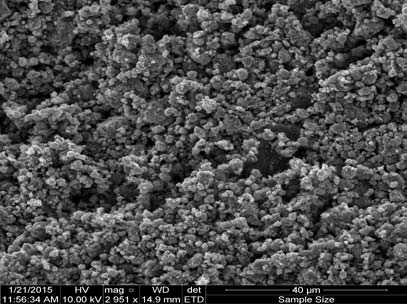
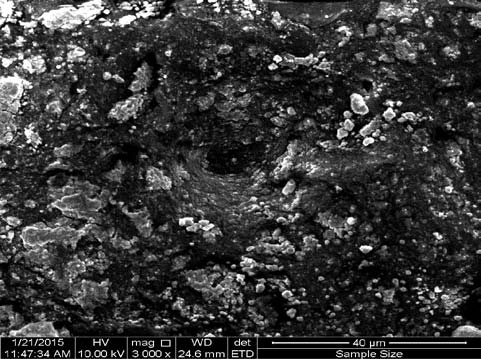
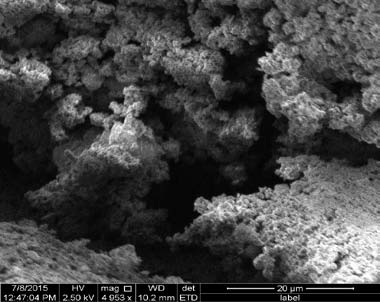
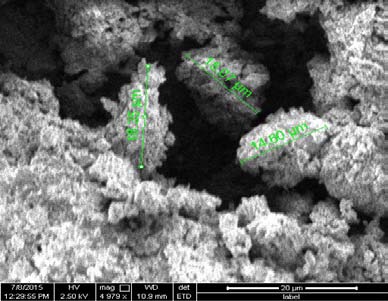
As can be seen in Figure 4 (a and b), the third coating with TiO 2 nanoparticles onto the microchannel lead to complete coverage. The total thickness of coating was approximately calculated by estimating the actual weight of TiO 2 nanoparticles used for coating, the area covered, and the known bulk density of dried nanoparticles. The total thickness was approximately estimated to be 6 ?m. (Faris, 2007). The SEM micrographs of Figures (5b) and (5c) confirmed that the morphology of PANI depends on the solar incident energy and initial feed temperature used for the preparation. The data reported by (Faris, 2007;Mattosoet al., 1994) indicated that decreasing of synthesis temperature may give a polymer of shorter chains with higher molecular weight.
10. C
The effect of LHSV and initial feed temperature on yield of polyaniline synthesized under solar light is illustrated in Figure 7. As can be observed, yield is reduced as LHSV is increased while initial feed temperature shows a different image. The explanation for these trends is that increasing LHSV resulted in decreasing retention time of reactant in the photocatalytic microreactor, consequently the rate of oxidation within the reactor is reduced. The yield of polyaniline is reduced from 94.0 to 84.2% as LHSV is increased from 0.145 to 0.385 min -1 at temperature of 25 o C. The influence of initial feed temperature on polyaniline yield could be also seen in Figure 7. The yield increased from 94.0 to 95.1% as the temperature is reduced from 25 to 5 o C at LHSV= 0.145 min -1 . As can be observed, at lower temperature, the increase of polyaniline yield was predominant. This could be due to the molecular chains which have less structural defects at lower temperature.
Figure 8 shows the influence of (APS: aniline) molar ratio on polyaniline yield. As can be seen when the APS: aniline ratio gradually increased, the yield of PANI increases correspondingly keeping other operating parameters unchanged. The yield reaches maximum value (i.e., 95.1%) after then further increase in molar ratio resulted a gradual decreasing of yield. It is expected that all the aniline which consumed by thereaction at the ratio higher than 1.25 would not increasethe yield but may cause its decrease because the over-oxidationmay convert part of the PANI to quinone. Furthermore, color of the filtrate solution was changed from green-blue to purple when the APS: aniline ratio was more than 1.25: 1. This could be an indication that chain of polyaniline begin to break up. These results agree well with the findings of (Natalia et al., 2007;Adams et al., 1996).
11. C
Comparison of performance between present study and previous published works of (Faris, 2007;Adams et al., 1996;Rodolfo etal.,2005;Gordanaet al., 2006) is presented. Different operating temperatures to synthesis chemically polyaniline with APS at equal molar ratio of (aniline: oxidant) and 1mol/L hydrochloric acid in a stirred batch reactor was used by (Faris, 2007). He reported yields of (86.4, 89, and 90.4%) at operating temperatures of (25, 0, and -25 o C), respectively. The Synthesis of polyaniline (PANI) catalyzed by soybean peroxidase (SBP) at 1 o C in either aqueous or partially organic media in a batch stirred reactor was studied by (Rodolfo et al.,2005). They claimed a yield of 71% at the optimum conditions of their experimental run. Gordana et al. (2006) investigated the kinetics of aniline polymerization in acid solution with ferric chloride as oxidant. They performed the polymerization in a special electro-cell batch reactor at 25 o C. They reported a maximum yield of 50%. The oxidative chemical polymerization of aniline in hydrochloric acid solution at low temperature was studied by (Rodolfo et al.,2005). They reported that among the reaction parameters studied which affected the molecular weight and yield of the polymer were: (a) reaction temperature; (b) solution pH at the start of the reaction; (c) molar ratio of oxidant: aniline; (d) total reaction time. They concluded that polyaniline of high molecular weight may be obtained by carrying out the polymerization at low temperatures, typically between -25 and -30 o C which required the use of an inert solute (lithium chloride was the preferred choice) to keep the aqueous reaction medium mobile. They reported that molecular weight (daltons) and yield% of synthesized PANI were (133000±10000, 94.2%), (153000±9000, 97.5%), (138000±7000, 94.9%) at reaction temperature -20, -25, -30 respectively and reaction time of approximately 15 h. Table 3 summarizes the results obtained by different authors.
12. Conclusion
The present work aimed to study the feasibility of microreaction process for PANI synthesis under solar light. The chemical polymerization of aniline in aqueous HCl solution with APS as the oxidant was investigated in a continuous operated solar photocatalytic microreactor with TiO 2 nanoparticles as photocatalyst.
The performance of the system was studied at different operating conditions (e.g. initial feed temperature, LHSV, and (APS/aniline) molar ratio). Scanning electron microscopy (SEM) was used to test the surface characteristics of the polymeric material produced. It was shown that surface morphology of PANI samples affected by solar incident energy characterized by reduced surface porosity. This could improve the conductivity of the polymer as confirmed by other published data. Results showed that initial temperature has positively affected the rate of polymerization but it affects negatively the yield of polyaniline, yield of polyaniline was decreased as LHSV of the microreactor increased, and an optimum (APS: aniline) molar ratio of 1.25 was found to give the maximum yield of polyaniline. Results indicated that solar incident irradiation enhanced the average yield by 5% over that of indirect solar while the average time of polymerization was reduced by 17%. The polymerization time was reduced by 20 to 27% when increasing temperature from 5 to 25 o C under indiect solar and direct solar, respectively. Data of batch reactors from published literature were used for performance comparison with the present work. Results showed that the solar microreaction system offered an excellent result (i.e., a yield of 95% under solar light at 5 o C within 14.5 min.) compared with other published data presented in this study. Results of the present work confirmed the feasibility of the microreaction process for analine polymerization under solar irradiation.
13. VI.
14. Global
Journal of Researches in Engineering ( ) Volume XVII Issue II Version I
| Real variables | |||
| F Le | Initial feed temperature [ o C] | Mixture flow rate[ml. min -1 ] | (APS: [molar ratio] aniline) |
| 1 | 25 | 0.75 | 0.8 |
| 2 | 5 | 1.00 | 1.0 |
| 3 | 1.5 | 1.2 | |
| 4 | 2 | 1.4 |
| Year 2017 | ||||||
| 14 | ||||||
| XVII Issue II Version I | ||||||
| ( ) Volume | ||||||
| Journal of Researches in Engineering | Substrate | Process | Type of reactor Retention time, [min] | Yield [%] | reference | |
| Global | Chemical (APS) | batch | 120 (0 o C) | 89 | Faris (2007) | |
| Enzymatic (SBP) +H 2 O 2 | batch | 480 (1 o C) | 71 | Rodolfo etal.,2005 | ||
| Aniline | Electrochemical (FeCl3) | Batch electro-cell | 180 (25 o C) | 50 | Gordanaet al., 2006 | |
| Chemical (APS) | batch | ~900 (-20, -25, -30 o C) | 94.2, 97.5, 94.9 (respectively) | Adams et al., 1996 | ||
| Solar photocatalysis (APS) | S-shaped microreactor | 14.5 (5 o C) | 95 | Present work | ||