1. Entransy Effectiveness for Analysis of Heat Exchangers
M. Khalil Anwar ? & Mostafa H. Sharqawy ? Abstract-The entransy effectiveness of heat exchangers relation is defined in this study. The effect of changing the number of transfer units (NTU), on entransy effectiveness for heat exchanger, is discussed. The entransy effectiveness is a measure of the irreversibility of the heat transfer process in the heat exchanger. Its behavior is same like as heat transfer effectiveness for heat exchanger. The flow pattern effect on entransy effectiveness is also discussed here. It is found that in case of counter flow type entransy effectiveness is higher than in case of parallel flow type. In addition, a detailed comparison between heat transfer effectiveness and entransy effectiveness is presented. In addition to that effect of changing heat exchanger effectiveness on entransy effectiveness is discussed here. Furthermore, the effect of changing ratio of inlet temperatures of cold fluid to inlet of hot fluid is also observed. It is found that with increase in this ratio, we have lower value of entransy effectiveness.
2. Keywords
3. Introduction
he entransy is a new physical parameter that has been identified to optimize the heat transfer process. This term has analogy with electrical energy stored in capacitor. So entransy of an object is the ability to transfer heat or in other words it is reflecting the heat transfer potential. This term has been analyzed precisely in parallel with conventional heat transfer analysis to understand its physical meaning. The term entropy and entropy generation may not describe the complete definition of 2nd law analysis. Recently in 2007 Guo et al. [1], defined the new terms entransy dissipation and entransy to understand and analyze the actual heat transfer process. Cheng et al. [2] agreed with this concept that entransy of a system can describe the irreversibility of it.
Bejan [3,4] introduced entropy generation in the heat transfer process. His main objective was to minimize the entropy generation with an optimum geometry and parameters of heat exchanger. He also described the effect of fluid viscosity on entropy generation. Shuang et al. [5] derived the relation for exergy effectiveness including pressure drop and neglecting pressure drop. Chen et al. [6] discussed about the entransy dissipation minimization in disc cooling system. Govind [7] introduced entransy balance equation for thermodynamic process Atkinson cycle. He concluded by his work that maximum entransy dissipation leads to maximum work output and minimum entropy generation could not describe the work output of the cycle.
The entropy generation in heat transfer process doesn't gives the clear picture of 2nd law analysis as in some cases this concept remains no more valid. Shah and Skiepko [8] studied about 18 different types of heat Year 2017 Global Journal of Researches in Engineering ( ) Volume XVII Issue IV Version I A exchangers and concluded by their work that effectiveness of heat exchanger can't be determined exactly with entropy generation minimization concept. Numerical simulation of finned tube heat exchanger, to compare the entropy generation number and the effectiveness of entransy based metric, was presented by Suxin QIAN et al. [9]. They concluded that for single phase heat exchanger entransy dissipation approach is better than entropy generation number approach to analyze the system when both are not influenced by pressure drop. They found entropy generation number approach suitable for two phase heat exchangers. Liu et al. [10] introduced energy equation in the form of entransy to describe the entransy variation in process of heat transfer and entransy exploitation. They defined the momentum equation and some boundary constraints for optimization of field of flow. Under the defined constraints, they found an optimized flow field numerically and concluded that optimum entransy consumption approach is more favorable than optimum entropy generation. Qun Chen et al. [11] presented a review on entransy, entransy dissipation and minimization. They compared entransy concept with entropy in many ways including heat transfer process, energy conservation and many other. Z.Y Guo [12] discussed about thermal resistance method and developed a relationship between it and effectiveness of heat exchanger which in independent of flow arrangement. He also defined equivalent thermal resistance based on entransy dissipation and entransy concept. Hu and Guo [13] presented the efficiency of heat transfer process and entransy as an available potential of energy. Bertola and Cafaro [14] stated that concept of minimum entropy generation is not applicable in the continuum mechanics field.
In the present study, a new term entransy effectiveness will be derived in terms of entransy flow in a heat exchanger. This entransy effectiveness will be a function of heat transfer effectiveness of heat exchanger.
The definition of entransy given by Guo [1] mathematically is described as:
(1)
The term is an internal energy of object.
II.
4. Mathematical Model
The effectiveness based on heat transfer, fora heat exchanger describes the performance of heat exchanger. In a similar way entransy effectiveness is described here for analysis of heat exchanger.
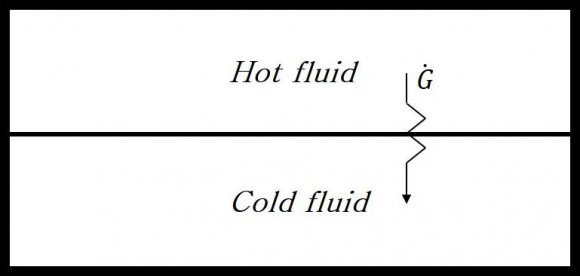
Consider a heat exchanger which isshown in Fig. 1. Entransy flow in heat exchanger can be observed from hot to cold fluid as it is the available potential in the form of heat. The heat transfer process along with fluid fluid are considered constant under operating conditions considered in the study.
Entransy flow rate for hot and cold fluid [12] can be describedas:
(2)
(3)Where Î?" ??? and Î?" ?? ?? are the entransy change in hot and cold side respectively. Entransy effectiveness can be described as: (4) (5) Thus, entransy flow for hot side can be written as: (6) Similarly for cold side (7) From heat transfer effectiveness, we can have following equation:
( 8 ) (9)Introducing equation ( 8) and (9) into equations ( 7) and ( 6) respectively we have: (10) and (11) Here ???????????=?? and ??=???????.
Equations ( 10) and ( 11) are describing entransy effectiveness for hot and cold fluid side respectively. Effectiveness for counter flow heat exchanger is
(12) ? ?= 1 2 ? ?? * ? ? ?? = ??? ?? ? = 1 2 ? ? * ? ?? 2 ? 1 2 ? ? ? ?? 2 ?? ? = 1 2 ? ? * ? ?? 2 ? 1 2 ? ? ? ?? 2 ? ?? = ???????? ð??"??? ??????? ???????? ???????? ð??"??? ? ?? = ? ??? ? ?? ??? ? ??,? = 1 2 ? ? ? ?? 2 ? 1 2 ? ? ? ?? 2 1 2 ? ? ? ?? 2 ? 1 2 ? ? ? ?? 2 ? ??,? = 1 2 ? ? ? ?? 2 ? 1 2 ? ? ? ?? 2 1 2 ? ? ? ?? 2 ? 1 2 ? ? ? ?? 2 ? ?? = ? ?? + ?(? ?? ? ? ?? ) ? ?? = ? ?? ? ??(? ?? ? ? ?? ) ? ??,? = ??(1??)[2???(1??)] 1??? 2 ? ??,? = ?(1??)[??(1??)+2??] 1??? 2 ? = 1?exp [????(1??)] 1??exp [????(1??)]5. Results and Discussion
In the present study, a double pipe heat exchanger is considered with annulus diameter 0.1 m and pipe diameter is 0.02 m. The length of the heat exchanger is assumed equal to 2 m. Turbulent flow is considered. Properties of fluids are assumed constant and calculated at inlet temperatures of either side of fluids. The equations are solved with EES and a parametric study has been presented here. Effect of changing NTU on entransy effectiveness, has been observed. The similar trends of entransy effectiveness has been observed as heat transfer effectiveness of heat exchanger. But one thing here is important to mention that with increase in capacity ratio, entransy effectiveness increases and it maximum at R=1. This is the only behavior of entransy effectiveness which contradicts with heat transfer effectiveness as heat transfer effectiveness is minimum at R=1. It can be noticed in Fig. 2 that with increase in NTU, the entransy effectiveness increases. Also, increase in capacity ratio of fluid results increase in entransy effectiveness. Similarly, Fig. 3 is presenting for hot fluid side entransy effectiveness.
Fig. 4 and Fig. 5 are showing the entransy effectiveness variation with NTU, with ??=0.4 for cold and hot side. It is observed that with increase in value of ?? we have relatively less entransy effectiveness. Similarly, Fig. 6 and Fig. 7 are showing ?????? ,?? and ?? ????,? variation with NTU for ??=0.6. Fig. 2 to Fig. 7 are for counter flow type heat exchanger.
Fig. 8 to Fig. 13 are for parallel flow heat exchanger. The similar trends for entransy effectiveness in parallel flow heat exchanger are observed for different values of ??. But one thing can be observed that entransy effectiveness is less in parallel flow type than counter flow.
The effect of changing flow pattern can be seen in Fig. 14 and Fig. 15. It can be observed that under same input parameters we have more entransy effectiveness value for counter flow heat exchanger. It is showing the same behavior of entransy effectiveness as conventional effectiveness of heat exchanger. So, for counter flow type heat exchanger is recommended in heat transfer process.
In Fig. 16 and Fig. 17 a comparison between heat transfer effectiveness and entransy effectiveness is shown for parallel flow and for counter flow heat exchanger respectively. It can be observed that entransy effectiveness is changing with NTU in a similar way as heat transfer effectiveness. For each type of flow, heat transfer effectiveness is more than entransy effectiveness for hot and cold fluid. This proves that the entransy effectiveness is showing the actual analysis of heat exchanger and more suitable approach.
Moreover the effect of changing heat exchanger effectiveness on entransy effectiveness can be seen in Fig. 18 for hot fluid with different values of ??. As value of ?? increases, the entransy effectiveness decreases and becomes zero for ??=1. The relation between entransy effectiveness and heat transfer effectiveness is almost linear. For ??=0.2 it is showing the maximum value of ?????? against ??. Fig. 19 is showing the entransy effectiveness, for cold fluid, relation with heat transfer effectiveness. For ??=0.2 , ?????? ,?? value is less for lower value of ?? but it increases gradually and becomes maximum for maximum value of ??. Similarly, trends are for other values of ??. At higher value of ?? the entransy effectiveness becomes maximum with lower value of ??. All the results are validated with author [5]. All the trends are like the trends which he got.
6. IV.
7. Conclusions
Entransy effectiveness is discussed for analysis of heat exchanger. The effect of changing NTU on entransy effectiveness, for Counter and parallel flow heat exchanger, is observed. It is found that entransy effectiveness is behaving like heat transfer effectiveness against NTU. With increase in NTU, we have higher value of entransy effectiveness. Moreover entransy effectiveness is compared for both type of flow arrangements (Counter and parallel). It is observed that entransy effectiveness for counter flow heat exchanger is higher than entransy effectiveness for parallel flow type if both type of heat exchangers are operating under same conditions. Also entransy effectiveness is compared with heat transfer effectiveness against NTU. It is observed that entransy effectiveness is less than heat transfer effectiveness under same operating conditions.
Finally effect of changing heat exchanger effectiveness on entransy effectiveness is observed at different values of ??. With increase in heat exchanger effectiveness, the entransy effectiveness increases. It is observed that increase in ?? value leads to decrease in entransy effectiveness and becomes zero at ??=1.