1. I. Introduction
he demand for potable clean water is increasing day by day due to the growing population and industrialization across all over the world. Air heating is one of the most important applications of solar energy [1]. Pandey [2] has given the bubbling effect of ambient air along with the simultaneous air bubbling and cooling of the glass cover, He has also compared an enhancement in distillate output which was reported 33.5 and 47.5 percent respectively on conventional single slope solar still. Al-Sulaiman et al. [3] studied the performance of two different configurations of deployment of an air heater before and between humidifier and dehumidifier (HDH) system. The study demonstrates that the HDH configuration with the air heater placed between the humidifier and the dehumidifier will give better performance and higher productivity as compared to the system when air heater is placed before the HDH. They have also reported the case when saline water is directly heated by the incident solar radiation and air enters into the humidifier through the nozzles, mixes with the water, gats humidified. Part of the air has condensed in the glass cover and the remaining air condensed in the dehumidifier system. The experiments have been carried out with the effect of solar air heater without turbulator and with the turbulator water heater. The maximum specific humidity gains were recorded 0.187 kg water /kg air. Whereas the humidifier integrated with the solar air heater without turbulator has given maximum specific humidity gain of 0.11 kg water / kg air . The peak distillate of 20.61 kg/m 2 day were collected and reported [4]. Evacuated solar water heater integrated with the desalination unit by Kabeel et al. [5]. Air has been circulated either by natural or forced circulation (The effect of three types of forced circulating air: up, down and up-down) in conventional solar still. It has been reported that the forced down air circulation system gives a higher performance as compared to forced up, forced up-down and natural air circulation. Agouz [6] has experimentally evaluated the effect of water temperature, air flow rate and water level on productivity in HDH desalination system. He has observed maximum productivity of the system which reaches to 8.22 kg/h at water temperature 86 °C and air mass with a flow rate of 14 kg/h. An experimental investigation of HDH desalination system has been used for water and air heating simultaneously during the distillation process. The heated air and water from the collector supplied to the humidifier, where the air gets humidified and moves towards dehumidifier for condensation. The system ability was investigated by varying the flow rate of air, hot water in the humidifier and cooling water in a dehumidifier. The system distillation capacity enhances the air and water temperature and flow rate of air, hot water, and cold water. The highest productivity was recorded 12.36, 14.14 and 15.23 kg/m 2 .day for the without turbulators, convex and concave turbulators in absorber plate respectively [7]. Kabeel et al. [8] investigated an experimental study of a double passes solar air collector-coupled modified solar still, with phase change material (PCM).
A comparison between modified still and PCM, forced hot air injection and conventional still was conducted to evaluate the development in the freshwater productivity under the same atmospheric conditions. The experimental results have revealed that the daily freshwater productivity of the modified still higher than that of conventional solar still. The freshwater productivity reached 9.36 L/m for modified solar still, which was 108% higher than that of the conventional solar still. Nada et al. [9] were proposed a hybrid air-conditioning and HDH desalination system. The effect of fresh air ratio, space supply air temperature, outside air wet bulb temperature on the freshwater productivity, refrigeration capacity, compressor power and percentage of power saving are also presented. Their analysis shows that the locating of an evaporative cooler after the mixing of fresh air with return air remarkably increased the productivity of the distiller unit. Ghazy et al. [10] have undertaken an analytical study of a direct solar distillation system that combined solar still with an air heating humidificationdehumidification subsystem. Various procedures have been employed to improve the thermal performance of the integrated system by recovering heat losses from one component in another component of the system.
2. II. Theoretical Background
Energy balance equations for evaluation of the heat and mass transfer coefficients within the hybrid solar still can be written as:
) q q ) q q (q )G ( (? ) C (m S dt dT a c,g a r,g g c,w g r,w ew g g pg g g g ? ? ? ? ? ? + + + ? = ? 1 (1)) q q (q ) C (m S dt dT ev,f f ew,w f cw pe e f f ? + = ? ? (2) ) q q q q q q q q G )? )( ? (( ) C (m S dt dT f c,w f ew,w f r,w g c,w ew g r,w c w c,b w g g pw w w w ? ? ? ? ? ? ? ? ? ? ? ? + + ? ? = ? 1 1 (3) ) q q G )? ? )( )( ? (( ) C (m S dt dT losses w c,b b w g g pb b b b ? ? ? ? ? = ? 1 1 1 ? (4) L q dt dm v ew e = (5)MATLAB software is used for evaluation of different mode of heat and mass transfer (conduction, convection, radiation, and evaporation), variation in temperature within the distiller unit and the distillate flow rate. In the forced convection mode, the relation between Nusselt (Nu), Reynolds (Re) and Prandtl number (Pr) was given by [11]
Nu = h cw L k i = 0.683 Re 0.466 Pr 1/3 (6)Where, h cw is the convective heat transfer coefficient that can be evaluated as,
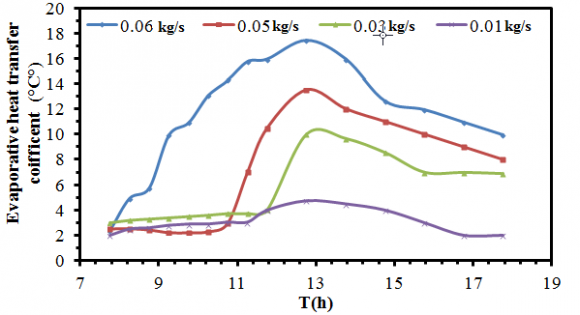
The evaporative heat transfer coefficient (h ew ) can be written as [11]:
T a w p v cw ew P M M c L h h 1 = (7)The ratio of the heat transfer coefficient and the mass transfer coefficient is equal to the specific heat per unit volume at a constant pressure of the mixture. Either the Lewis relation [12].
1 = p f m ew C h h ? (8) ) ( g w m e h A m ? ? ? = (9)Substituting Eqs. 7 and 8 in Eq.9 one can get .
) ( . . g w p f g cw e P P T R C M h A m ? = ? (10)3. III. Construction of Experimental Setup
The test rig is made with the help of stainless steel material of 3mm thick plate, which has 0.4 m 2 of the basin area. Lower and higher wall of distiller units are kept 480 mm and 610 mm high to make 30 o inclination of the glass cover, considering latitude 33°52 ? 53 ? N and Longitude 10°05 ? 53 ? E of city Gabès. Transparent 4 mm thick glass material is used as a cover for the basin area with about 90% transmittance. Gasket rubber material is used in between basin top and glass cover and further sealed with window putty to Therefore,
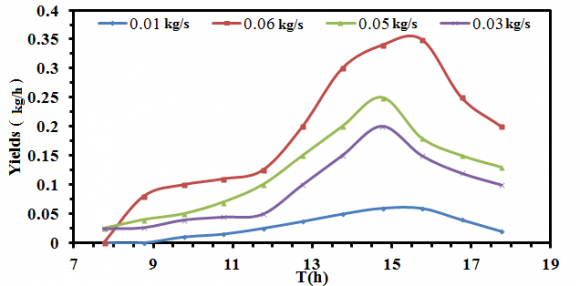
This research work depicts experimental evaluation results, viz. productivity, the behavior of heat transfer coefficients for active solar still hybrid with an air compressor for different flow rates of air within the hybrid single slope solar still integrated with the air compressor, to augment the production of drinking water.
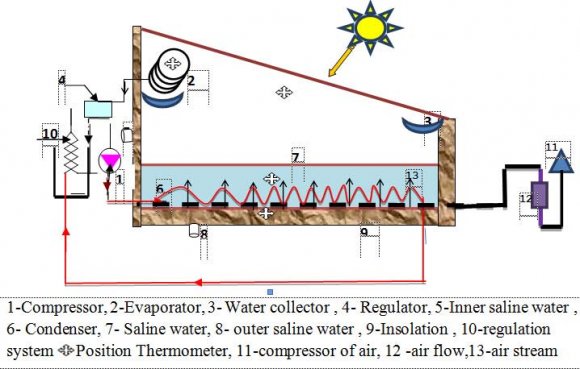
prevent the leakage of vapors from basin to ambient. The condensation water is collected in a collector channel, which is deposited at the lower end of the glass cover and small plastic pipe will be used to terminate collector channel. Fresh water is finally collected in an externally graded cylinder attached at the end discharge pipe. Feed raw/ saline water pipe has been connected to another side wall for feeding the brackish water into a distiller unit. Fig. 1a shows that the air compressor is connected to a screen equipped with holes for diffusing air into the seawater basin of distiller unit. It has been added in order to increase the evaporation rate of water containing in the basin by hybrid distiller unit. The air blower connected to an air screen, further it is connected to tap of a compressor.
4. Figure 1a: Schematic arrangement of SSDHP with air pump
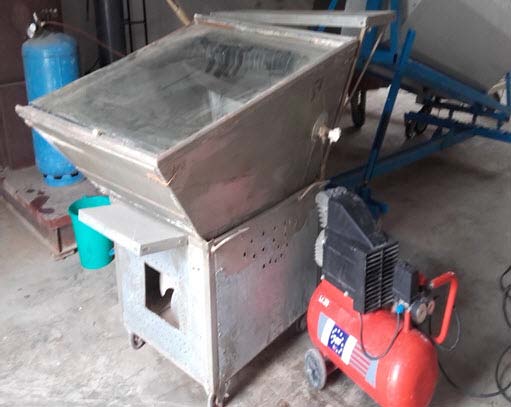
Figure1b: Actual photograph of SSDHP with air pump Different parameters viz., air flow rate, water temperature, water level and relative air humidity and temperature within the basin inlet and on the water surface, were recorded during the experiments. The water temperatures in the basin were also measured using the thermometer-Pt100 which works in the range from ?20 to +260ºC with an uncertainty of 2.6%. The relative humidity and temperature of air streams were measured using 2 thermo-hygrometers which work in the range from 0 to 100% RH and from?40 to+120ºC and its uncertainty is 1.4% tabulated in
5. IV. Experimental Procedure
The experimental setup is designed and constructed to investigate the effect on the productivity of hybrid solar still at a different flow rate of air within the test rig through compressor unit. While the experimentation temperature of the glass cover, water, and evaporator was recorded with the help of K type thermocouple, whereas the flow rate of air was recorded with the help of Rotameter and control with the help of regulatory valve. Distillate output is recorded with the help of graduated cylinder on an hourly basis. Each series of experiments were conducted for four different air flow rates (0.01, 0.03, 0.05 and 0.06 kg/s) at a constant water level of 10 cm. Incident solar radiation is recorded with the help of pyranometer.
6. V. Economic Analysis
Using economic analysis, estimation of the cost of one-litre distillate water has been made. In addition to the capital cost (P) of the hybrid solar still, other parameters such as sinking fund factor (SFF), annual salvage value (ASV), annual maintenance cost (AMC), and interest rate per year should be also considered. At this stage, the Capital recovery factor (CRF) is defined in terms of the interest per year i and also the number of life years of the system n [13,14] ( ) ( )
1 1 1 n n i i CRF i + = + ?(11)The interest per year i and the number n of life years of the system are assumed 12% and 10, respectively. Fixed annual cost (FAC) becomes:
FAC = P(CRF)(12)Where, P is the capital cost of solar still. The capital cost includes the cost of the hybrid solar still and air compressor as well as the costs of labor cost ( for the active system). In this work the capital cost P becomes 1026.$ By taking the salvage value of system S equal to 20% of capital expressed respectively as [15]: ( )
1 1 n i SFF i = + ?(13)Sinking fund factor (SFF) and annual salvage value (ASV) can be
For, S = 0.2P
Sinking fund factor (SFF) and annual salvage value (ASV) can be for the passive unit, 0.0569 and 0.1769 $ (by considering 205.20 $ for the pump price) for the active one. The AMC which is annual maintenance operational cost of the system consists of collecting the fresh water, cleaning the glass cover, washing inside the unit to remove the deposited salt, and maintenance of DC fan. Here, 15% of fixed annual cost is considered as maintenance cost:
0.15( ) AMC FAC =(16)Therefore the annual cost (AC) is:
AC FAC AMC ASV = + ?(17)Finally, the cost of fresh water per liter can be calculated as:
AC CPL M = (18)Where M is the average annual yield of the solar still, Cost per liter of fresh water is shown in Table .3 for the hybrid distiller unit with and without an air compressor.
7. VI. Result and Discussion
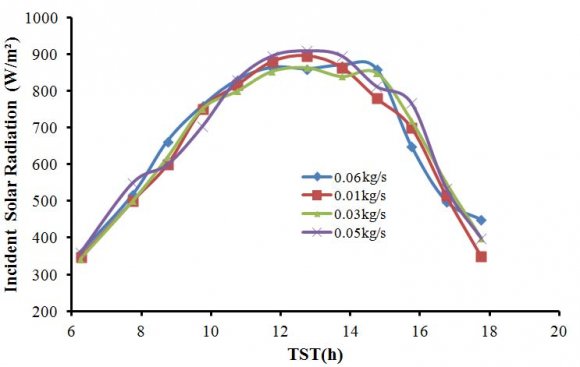
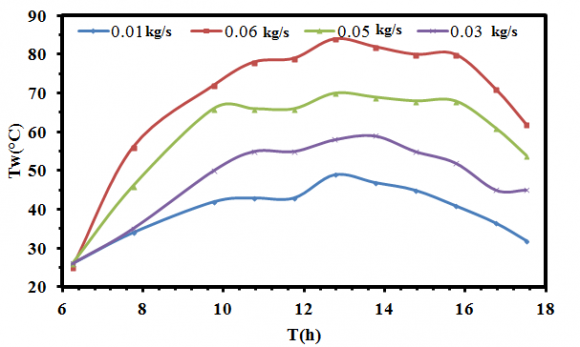
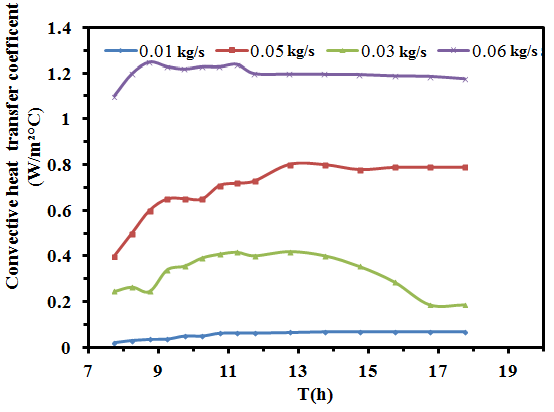
During working hour incident solar radiation on glass cover surface was recorded with the help of pyranometer for different air velocity during the test days, shown in Fig. 2. It is observed that the maximum solar incident radiation on glass cover during 12 h and 14 h around 900 W/m ² for all air velocity. Variation of water temperature at a different flow rate of air with respect to the time is shown in Fig. 3. It shows that the water temperature initially increases as solar radiation increases and further decrease as per the incident radiation. The convective heat transfer coefficient between the water surface and the flowing air at a different flow rate of air has been evaluated and shown in Fig. 4. Maximum heat convective heat transfer coefficient is recorded 0.0698 W/m²°C, 0.42 W/m²°C, 0.803 W/m²°C and 1.25W/m²°C at air flow rate of 0.01 kg/s, 0.03 kg/s, 0.05 kg/s and 0.06 kg/s respectively. It has been recorded 34. 71%, 40.81%, and 10.83% higher as compared to the air flow rate of 0.01 kg/s, 0.03 kg/s, and 0.05 kg/s respectively. Convective heat transfer coefficient at an air flow rate of 0.06kg/s will maintain its lead throughout the experimentation which causes to higher yield as compared to the lower mass flow rate of air. The convective heat transfer coefficient between the water surface and the flowing air at a different flow rate of air has been evaluated and shown in Fig. 3. Maximum heat convective heat transfer coefficients are recorded 0.0698 W/m²°C, 0.42 W/m²°C, 0.803 W/m²°C and 1.25W/m²°C at air flow rate of 0.01 kg/s, 0.03 kg/s, 0.05 kg/s and 0.06 kg/s respectively. It has been recorded 34. 71%, 40.81%, and 10.83% higher as compared to the air flow rate of 0.01 kg/s, 0.03 kg/s, and 0.05 kg/s respectively after the third hour of the time. Convective heat transfer coefficient at an air flow rate of 0.06kg/s will maintain its lead throughout the experimentation which causes the higher yield in comparison with the lower mass flow rate of air. Influence of variation in air velocity within the hybrid solar still will greatly influence the production rate of the newly developed hybrid solar still. The rate of heat and mass transfer is enhanced due to the formation of water bubbles within the distiller unit whereas fall in basin water temperature observed due to increase in wind flow rate. But the overall productivity of distiller unit was significantly improved as compared to hybrid solar still without air. This page is intentionally left blank
| Year 2017 |
| 32 |
| I |
| Journal of Researches in Engineering ( ) Volume XVII Issue III Version A |
| Global |
| ( ) Volume XVII Issue III Version I A |
| of Researches in Engineering |
| Global Journal |
| Type of distiller | Annual production, Kg | Annual cost ($) | Cost per liter of fresh water/$ |
| With air | 5840 | 197.13 | 0.031 |
| compressor | |||
| Without air | 3285 | 154.43 | 0.047 |
| compressor |