1. I. Introduction
variety of measures involves to determine the load bearing capacity of piles that might be either analytical or empirical in nature. The former requires an evaluation of soil and pile interaction along with several underlying assumptions. On the other hand, the latter is founded on the use of outcomes of in-situ tests and procedures (Medubi et al. 2012). when the soil condition is unpredictable, Pile load test is generally conducted. The test piles are constructed and load will be applied Before constructing the actual load bearing piles of the main structure so that various information's can be gathered. In geotechnical engineering, the bearing capacity determination for piles is a fascinating topic. Due to the complicated nature of the embedment ground of piles and lack of suitable analytical models for foreseeing the pile bearing capacity are the main reasons for the engineer's tendency to peruse further research on this issue. Among different common methods, pile load testing can represent reasonable results, but such tests are expensive, time-consuming, and the costs are often difficult to justify for ordinary or small projects (Thounaojam& Sultana, 2016).
Sometimes it is found that the capacity of the pile is too high comparing the design load, in such cases the actual piles to be constructed can be Author ? ? ? ? : Graduate, Ahsanullah University of Science and Technology, Dhaka, Bangladesh. e-mails: [email protected], [email protected], [email protected], [email protected] redesigned. By doing so foundation cost might be reduced. In Bangladesh generally the land owner or the contractors are not that much interested to conduct this test due to its high cost and time consumption. But it will be very helpful for the structure if this test is done. Once the substructure is complete after that any kind of change in sub structure very much costly and difficult. So instead of doing so if pile load test is done then any kind of mistake can be resolved in the initial level of structure.
Pile load test have been carried out to achieve following objectives-? To determine the settlement under working load ? To confirm the adequacy of design bearing capacity ? As proof of acceptability ? Determine allowable bearing capacity
2. II. Methodology
This report presents the test results of monotonic static axial pile load tests on cast in situ pile for the site of "A" in Dhaka city. This test was carried out with a view to confirm the carrying capacity of single pile under monotonic static load and to know the settlement behavior of this pile under test. The main purpose of the static pile load test is to demonstrate construction method and to confirm the design assumptions and the bored pile loading capacity. This test also shows the actual safety factor applied for the piles. Static analysis methods estimate shaft and base resistances separately and differently (Thounaojam& Sultana, 2016).However, the use of dynamic formula is highly criticized in some pile-design literatures. Dynamic methods do not take into account the physical characteristics of the soil. This can lead to dangerous miss-interpretation of the results of dynamic formula calculation since they represent conditions at the time of driving. They do not take in to account the soil conditions which affect the long-term carrying capacity, reconsolidation, negative skin friction and group effects.
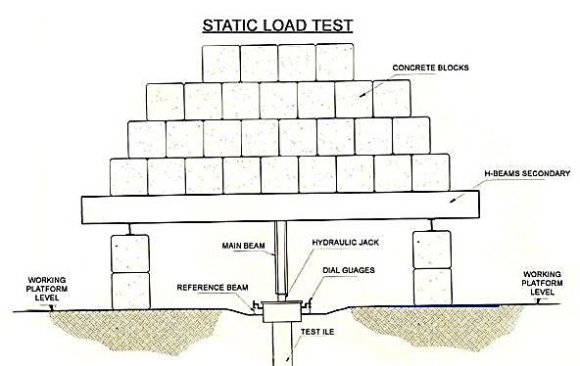
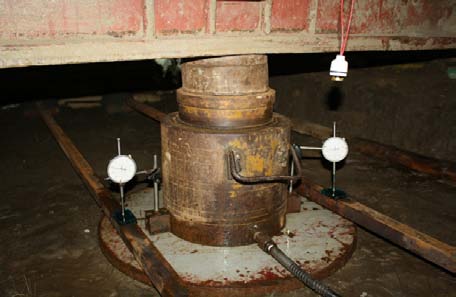
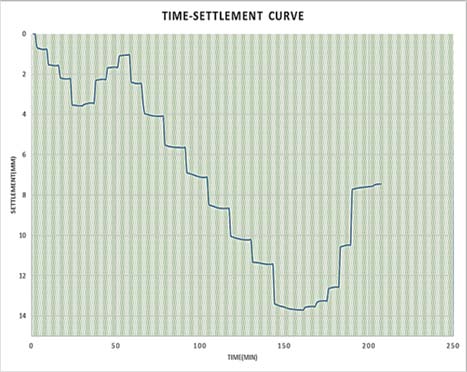
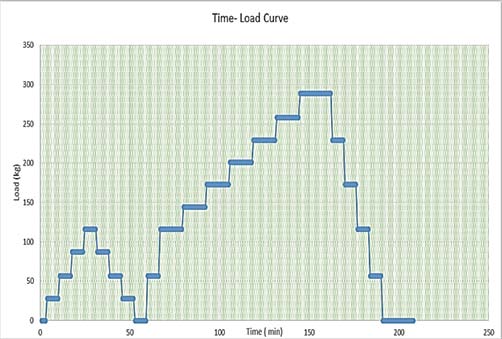
To observe the design capacity, a test pile is constructed and estimated load is given upon the designed pile. There are three kinds of static pile load testing. The readings are recorded in all the dial gages, the load cell, and the pressure gage for the jack at 1 minute intervals, on the Time-Settlement Data Sheet. The load is given to the pile up to 50%, 100%, 125%, 150%, 175% and 200% and the Gross settlement is checked. Again, with the same procedure stated above, Net settlement is observed. Settlement is checked to a precision of 1/5" (0.5 mm) on the reference points, at a minimum as follows: 1. Immediately before the test, 2. Immediately before rebounding from 100 percent of the design load (all cycles),
3. IV. Data Analysis
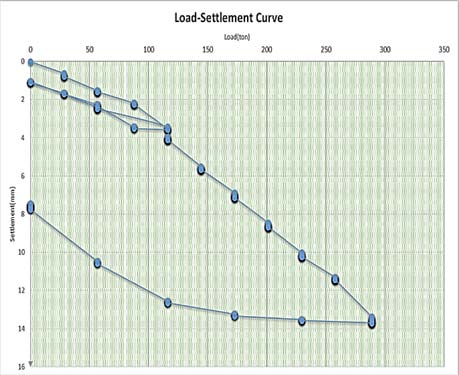
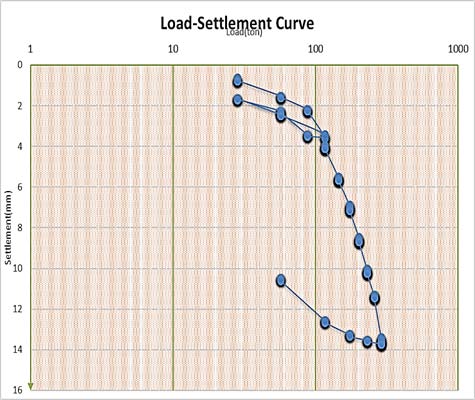
When pile is subjected to gradually increasing compressive load in maintained load stages, initially the pile-soil system behaves in a linear-elastic manner up to point A on the settlement-load diagram and if the load is realized at any stage up to this point the pile head rebound to its original level (Abebe& Smith, 2016).
4. VI. Conclusion
All results of static load test indicate very conservative pile design as the (settlement/pile diameter) ratios are less than 1% for all piles. Therefore, it is strongly recommended to optimize the pile design for projects by determining the actual ultimate pile capacity, which may need to conduct pile test to failure or near to failure. There were two test piles which was observed for both the tests but only the second test result calculation is discussed here. For the 1st test the net settlement was 3.055 mm & the design load was 110,000 kg. For the second test the net settlement was 7.455 mm & the design load was 115,954 kg. From the Load Vs Settlement graph, we found the value was nearabout 118 tons. So the allowable load capacity to be considered is 118 tons.
| Test pile no | Date of pile casting | Date of testing | Length of pile | Dia. of pile | Applied load | ||
| TP-16 | 17-06-2014 | 11-07-2014 | 35.250 m | 600 mm | 2,87,814 kg | ||
| Table-2: Description of equipment used | |||||||
| Test pile no | Plunger dia. | range | Pressure gauge Calibration date Regression equation | Dial gauge sensitivity range | |||
| TP 01 | 265 mm | 0-500 kg/cm 2 | 16-06-2014 | Y=0.516x-0.146 | 0.01 mm 0-50 mm | ||
| Test pile no | Length of pile | Max m applied load | Test result Gross settlement | Net settlement | ||
| TP 16 | 35.250 m | 2,87,814 kg | 13.700 mm | 7.455 mm | ||
| Table-4: Ultimate load capacity of the test pile | ||||||
| S.L No | Test pile no | Ultimate load capacity in kg BNBC (1993) Davisson 1973 IS: 2911 (Part-VI)-1979 | BSI(1986) | |||
| 1.0 | TP-16 | >2,87,814 | >2,87,814 | 2,66,857 | >2,87,814 | |
| 5: Allowable load capacity of the test pile | |||||
| S.L No | Test pile no | BNBC (1993) | Allowable load capacity in kg Davisson 1973 IS: 2911 (Part-VI)-1979 | BSI(1986) | |
| 1.0 | TP-16 | 1,43,907 | 1,91,876 | 1,77,904 | 1,43,907 |