1. Optimization of Packed Concrete Bed Energy Storage System
Adeyanju A. A. ? & Manohar K. ?
Abstract-One of the major challenges with the use of solar thermal energy is the intermittent nature. As such, present day research is geared towards energy storage systems in which thermal energy is stored during the day for later use. However, in many engineering applications there is a continuous steady demand for energy. Hence, this study is focused on the optimization of a packed bed energy storage system to provide an uninterrupted continuous supply of energy in the absence of or availability of solar energy.
A mathematical model was developed from consideration of the basic phenomena of heat transfer to predict the thermal behavior of a simultaneous charging, storage and discharging system during a heating cycle.
Optimization of the entire storage system were carried out and it was discovered that the ratio of optimum volume to area at airflow rate of 0.0094, 0.012, 0.014, 0.017, 0.019, 0.021, 0.024, 0.026, 0.028, 0.031, 0.033, 0.035, 0.038, 0.040, 0.042 and 0.045m 3 /s were 0.123, 0.154, 0.185, 0.215, 0.247, 0.276, 0.308, 0.338, 0.369, 0.4, 0.43, 0.462, 0.491, 0.523, 0.554, and 0.584, respectively.
It was discovered that as a result of standard model, charged thermal energy increases generally with the increasing of the packed bed volume and that the intersection point of the two extreme models with flow rate shows the optimum volume of the packed bed.
Keywords: packed concrete bed, optimization, energy storage system, mathematical model. he design and optimization of Thermal Energy Storage systems has drawn specific attention, since it is the ecologic and economic benefits to this technology which make it an attractive alternative in the first place.
There are two main streams of research in this area; works which concentrate on the storage tank as a whole, and ones which concentrate on the thermal energy storage and retrieval process. For each, there are a number of techniques used, which can be broadly grouped as either analytical or numerical techniques. Experimental data in this field is also a common verification tool for many of the works studied here.
The thermal energy storage (TES) can be defined as the temporary storage of thermal energy at high or low temperatures. The TES is not a new concept, and at has been used for centuries. Energy storage can reduce the time or rate mismatch between energy supply and energy demand, and it plays an important role in energy conservation.
Energy storage improves performance of energy systems by smoothing supply and increasing reliability. For example, storage would improve the performance of a power generating plant by load leveling. The higher efficiency would lead to energy conservation and improve cost effectiveness. Some of the renewable energy sources can only provide energy intermittently.
Although the sun provides an abundant, clean and safe source of energy, the supply of this energy is periodic following yearly and diurnal cycles; it is intermittent, often unpredictable and diffused. Its density is low compared with the energy flux densities found in conventional fossil energy devices like coal or oil-fired furnaces.
The demand for energy, on the other hand, is also unsteady following yearly and diurnal cycles for both industrial and personal needs. Therefore the need for the storage of solar energy cannot be avoided. Otherwise, solar energy has to be used as soon as it is received. In comparison, the present yield in energy gained by fossil fuels and waterpower amounts to about 70x10 12 kWh. But the technical use of solar energy presently poses problems primarily because of inefficient collection and storage.
One of the important characteristics of a storage system is the length of time during which energy can be kept stored with acceptable losses. If solar energy is converted into a fuel such as hydrogen, there will be no such a time limit. Storage in the form of thermal energy may last for very short times because of losses by radiation, convection and conduction. Another important characteristic of a storage system is its volumetric energy capacity, or the amount of energy stored per unit volume. The smaller the volume, the better is the storage system. Therefore, a good system should have a long storage time and a small volume per unit of stored energy.
If mass specific heat capacity is not small, denser materials have smaller volumes and correspondingly an advantage of larger energy capacity per unit volume. The space available is limited both in transport and in habitat applications. The volume occupied by the present available storage systems is considerable and may be an important factor in limiting the size of storage provided. The amount of energy storage provided is dictated by the cost. The cost of floor space or volumetric space should be one of the parameters in optimizing the size of storage.
The technology of thermal energy storage has been developed to a point where it can have a significant effect on modern life. The major nontechnical use of thermal storage was to maintain a constant temperature in dwelling, to keep it warm during cold winter nights. Large stones, blocks of cast iron, and ceramics were used to store heat from an evening fire for the entire night. With the advent of the industrial revolution, thermal energy storage introduced as a byproduct of the energy production. A variety of new techniques of thermal energy storage have become possible in the past.
A major application for thermal storage today is in family dwellings. Heat storage at power plants typically is in the form of steam or hot water and is usually for a short time. Very recently other materials such as oils having very high boiling point, have been suggested as heat storage substances for the electric utilities. Other materials that have a high heat of fusion at high temperatures have also been suggested for this application. Another application of thermal energy storage on the electric utilities is to provide hot water. Perhaps the most promising application of thermal energy storage is for solar heated structures, and almost any material can be used for thermal energy storage.
A theoretical approach to the optimum volume of packed bed from a standpoint of capacity efficiency, charged thermal energy and the optimum air flow rate for an air-based solar heating storage system was considered in this study in order to optimize the system. The charged thermal energy in a packed bed for an airbased solar heating system depends on the following parameters; air flow rate, collector area, packed concrete bed volume, collector performance, intensity of solar radiation and ambient temperature (Duffie and Beckman 2006).
The parameters of a solar heating system specified by designers are basically collector area, air flow rate, packed bed volume, and other parameters are given as design conditions.
2. II. Thermal Energy Storage Systems
The review of works in sensible Thermal Energy Storage systems is interesting to note. Sensible thermal storage is possible in a wide number of mediums, both liquid and solid. Liquid media for thermal storage include oils, water, molten salts, etc. while solid media are usually in the form of rock, concrete or metals, and can include alloys such as zirconium oxide for extreme temperatures [Nsofor, 2005]. There are a number of works regarding both cases, though here we will consider two short examples; a solar pond and a rock bed, both designed for solar energy storage. Karakilcik et al. (2006) perform an interesting performance investigation of a solar pond in Adana, Turkey. The pond was filled with salty water to form three zones of varying density which do not mix. The upper zone is the freshwater layer at the top of the pond, and is fed by rainwater and feed water to compensate for water lost by evaporation. The middle layer, called the insulation zone, is designed to keep the freshwater zone and the lower zone from mixing, while absorbing solar energy in the form of heat. The lower zone, which is the densest mixture, retains the most heat, and absorbs the most heat from the sun, contains the heat exchangers to the solar pond and exchanges heat with both the bottom of the solar tank as well as the insulation zone. As expected, the highest thermal efficiencies of the system came in mid-summer, when solar and ground radiation levels are at their highest and temperature gradients are quite low.
A performance investigation of a solar air heater connected to a rock bed thermal storage device is considered by Choudhury et al. (1995). A two-pass, single cover solar air heater is coupled to the rock bed, while operational parameters and geometric design are e XV Issue
3. IV Version I ( )
A varied in order to study the effect on efficiency. Factors such as charging time, rock bed size, individual rock size, air velocity and void fraction are studied, as are the effects on thermal efficiency of the system. It was found that the charging time had the most significant effect on the overall efficiency, with the optimal charging time set at 8 hours for this particular location in New Delhi.
It has been conventional, as has been done in the above works, to use energy consumption, energy efficiency and cost minimization as the main benchmarks in determining optimal system configurations. However, in recent years, a new approach has been exercised which simultaneously reduces both energy and cost inputs.
These exergy analyses have been the preferred method of late to better analyze the performance of these systems, as well as the location and severity of energy losses. Dincer and Rosen (2002) discuss the usefulness of exergy analysis in the performance and optimization of various TES systems. During exergetic analyses of aquifer, stratified storage and cold TES systems, appropriate efficiency measures are introduced, is the increasing importance of temperature, especially during cold TES. Rosen et al. (1999) provide detailed exergy analyses of many types of cold TES systems. They consider full cycles of charging, storage and discharging in both sensible and latent systems. The results indicate that exergy clearly provides a more realistic and accurate measure of the performance of a cold TES system, since it treats "cold" as a valuable commodity. This is in contrast to the energy analysis, which treats cold as an undesirable commodity. In addition, it was summarized that the exergy analysis is substantially more useful than the energy analysis. Furthering this study, Rosen et al. (2000) examine an industrial sized encapsulated ice TES unit during full charging, discharging and storage cycles. The results indicate that in addition to energy analyses being incomplete for cold TES, they also achieve misleadingly high efficiency values.
For the system in question, the overall energy efficiency was 99.5%, while the exergy efficiency was calculated to be 50.9%. This solidifies the fact that exergy analyses allow for a more complete diagnostic of cold TES systems and the locations of their shortfalls. Henze (2005) investigate the relationships between cost savings and energy consumption associated with the conventional control of typical TES systems. Items accounted for in these optimizations include varying fan power consumption, as well as chiller and storage coefficient of performance. The results indicate that buildings can be operated in such a manner as to reduce overall costs, with only a small increase in total energy consumption.
4. III. Methodology a) Environmental Conditions of the Optimized Systems
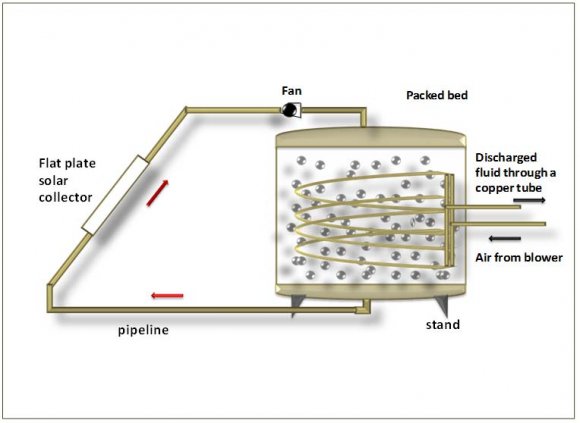
An outline of the system to be optimized was shown in Figure 1.0. The system includes flat-plate solar collectors connected in parallel, fans and a storage system which contain a packed spherical shaped concrete and some concretes imbedded with copper tube. Solar heating media air circulates through the collectors and the bed in charging mode and the discharging occur through the air flowing inside the copper tube. The air heated at the collector flows into the upper part of the packed concrete bed and collected heat transfers from air to concrete/copper tube due to temperature difference, and then air flows into the collectors through the lower part of the bed.
A steady state model for the solar collector and the heat transfer model in the packed bed are used for the system analysis and these are carried out under the typical conditions shown in Tables 1.0 and 2.0.
The incident solar radiation depends on latitude, solar constant, date, weather, orientation and slope of collector. In terms of standard non-dimensional parameters for collectors, the thermal efficiency of a solar collector can be written as: ( ) The collector model which gives the air temperature at the collector outlet was derived from equation ( 2) and (4) as follows
( ) ( ) , ' ' in coll f L i T T F F U H ? ?? ? ? ? = ? ? ? ? ? ? ? (2) ' 1 p L f f A U m C f f p L m C F e A U ? ? ? ? ? ? ? ? ? ? ? ? ? ? = ? ? ? ? ? ? ? ? ? ? ? ? ?(3) ( ) ( ) 2 ', , f f out coll in coll coll C V T T HA ? ? ? ? ? = ? ? ? ? ? ? ? (4) ( ) ( ) ( ), , coll out coll in coll f f HA T T C V ? ? = + ? (5)5. c) Packed Bed Standard Model
In this study, the Schumann model was used as the standard model of the packed bed and the basic assumptions leading to the Schumann model are one dimensional plug flow, no axial thermal conduction, constant properties, no heat loss to environment and no temperature gradients within solid particles. It was additionally assumed that specific heat of air is neglected. The differential equations for fluid and solid temperatures were written as:
( ) , , , b f f f V b b s b f T C V h A T T x ? ? ? ? = ? ? ? ? ? ? ?(6) and ( ) ( ) , , , , , 1 bs b s b s b V b b f b s T C A h A T T t ? ? ? ? ? ? = ? ? ? ? ? ?(7) ( ) ( ) ( ) ( ) ( ) , , , 3 ,f V c V h d ? ? ? = ? ? ? ? ? ? ? (8)The charged thermal energy per day was derived from the temperature distribution in the packed bed as follows:
( ) ( ) ( ) , , , 0 1 b l s b s b s b a b s t end Q C A T T dx ? ? ? = ? ? ? (9)The dimensional proportion of the packed bed was fixed as 1:1:2 (length of the bed, l b ) for the standard model simulations.
6. IV. Results and Discussion
The results of the optimization of the standard model under the typical conditions (Table 1.0 and 2.0) and for air flow rates 0.0094, 0.012, 0.014, 0.017, 0.019, 0.021, 0.024, 0.026, 0.028, 0.031, 0.033, 0.035, 0.038, 0.040, 0.042 and 0.045m 3 /s were shown in Table 3.0.
The effect of the charged thermal energy on the packed bed volume was illustrated in Figure 1.0. In this Figure , A coll is the collector area, Q s is the charged thermal energy in a day and V is the rock bed volume.
The charged thermal energy increases generally along with the increasing of the bed volume, but the charged thermal energy has an upper limit corresponding to each air flow rate. The minimum volume of packed bed in which it is charged almost upper limit is regarded as the optimum volume of the packed bed from a capacity efficiency standpoint.
Regardless of the air flow rate, the increasing curves of the charged thermal energy overlap each other in the range of smaller concrete volume than the optimum one. The outlet temperatures of the collector at air flow rates 0.0094, 0.012, 0.014, 0.017, 0.019, 0.021, 0.024, 0.026, 0.028, 0.031, 0.033, 0.035, 0.038, 0.040, 0.042 and 0.045m 3 /s were shown in Figure 3.0. The increasing curves of the charged thermal energy in bed as shown in Figure 2.0 were represented by a model on the assumption of infinite air flow rate. On the other hand, the relationship between the maximum charged thermal energy in bed and air flow rate was represented by a model on the assumption of infinite bed volume. The relationship between air flow rate and the optimum volume of the bed was approximately obtained as theoretical solution of simultaneous equations for two models on the assumption of extreme conditions. 8) and ( 9) under the following assumptions. a. The outlet air temperature of the bed was identical to initial temperature of the bed at all time. b. The heat loss was taken account of only at the collector.
7. Global
Then, the outlet air temperature of the collector resulted to:
, coll out coll o f f HA T T C V ? ? = + ? (10)The thermal energy charged in a day was represented as the following equation.
8. (
)
, end in t s f f out coll o t Q C V T T dt ? = ? ? ?(11)Combining equations ( 10) and (11) and solve for thermal energy charged per collector area produced the following equation.
( ) ( ) ( ) ( ) ( ) ( ) ( ) { } ' ' ' , 1 2 end in s coll L coll coll f f t V L in coll f end in V V o t V V Q A F U V A A C F U T T t t F Hdt ? ?? = × + ? ? + ? ? ? ? ? ? ?(12)ii. The model of infinite air flow rate This model was derived from equation ( 5) on the following assumptions. a. The collected heat was entirely charged to spherical shaped concrete in the packed bed.
b. The temperature of air and the spherical shaped concrete in the bed was identical to the outlet air temperature of the collector. c. The heat loss was taken account of only at the collector. d. The heat capacity of air in the bed was neglected. The thermal energy charged in the bed per day resulted to:
( ) , / s b b b c ct o Q C V T T ? = ?(14)Combining equations ( 13) and ( 14) gives the charged thermal energy per unit collector area. The heat balance equation for the packed bed was represented as follows:
( ) ( ) ( ) ( ) ( ) ( ) ( ) ( ) ( ) ( ) ( ) ( ) ( ) ( ) ( ) ( ) ' , ' ' , ' , exp exp 1 exp end in L in coll f end in V V s coll o coll b b L in coll f end in t V V V coll t V b b L in coll f end in V V coll b b coll b b F U T T t t Q A F A C V F U T T t t A H dt C V F U T T t t A V C A C V ?? ? ? ? ? ? ? ? ? ? ? = ? × ? ? ? ? ? ? ? ? ? ? ? ? + ? ? ? ? ? ? ? ? ? ? ? ? ? ? ? ? ? ? ? ? ? ? ? ? ? ? ? ? ? ? ? ? ? ? ? ( ) a o T T ? × ? ? ? (15)9. c) The Extreme Models Results
result of the standard model and two extreme models at collector were shown in Figure 4.0. It was considered that the intersection point of two extreme models shows the optimum volume of packed bed storage system for an air flow rates 0.0094, 0.012, 0.014, 0.017, 0.019, 0.021, 0.024, 0.026, 0.028, 0.031, 0.033, 0.035, 0.038, 0.040, 0.042 and 0.045m 3 /s. The previous results of extreme models shown in Figure 4.0 suggest that the relationship between the optimum volume from a capacity efficiency standpoint and the air flow rate was presented in a form of apparent linear equation. The Combination of equations ( 12) and (15) produced the following linear equation.
opt opt coll V V Z A A ? ? = ? ? ? ? ? (16) ( ) ( ) ( ) ( ) ( ) ( ) ( ) ' ' ' 2 , end in opt opt t V f f opt o t V L V coll opt opt L o a end in V V V coll coll C V Where Z F Hdt F U D A V V FU T T t t D A A ? ?? ? ? = ? ? ? ? ? ? ? ? ? ? ? ? ?(( ) ( ) ( ) ( ) ( ) ( ) ( ) ( ) ( ) ( ) ( ) ( ) ( ) ( ) ( ) ( ) 2 2 end in end in t V f f L o a end in V V o t V t V b b L o a end in V V o t V C H dt U T T t t Z C H dt U T T t t ? ?? ? ?? ? ? ? ? = ? ? ? ? ?(19)The flat plate solar collector orientation was set due south so that solar radiation was symmetrical with respect to true solar time at 12 noon; therefore the double integration of solar radiation (H) resulted to:
( ) ( )( ) ( ) ( ) ( ) ( ) ( ) ( )2 end end in in t V t V end in V V t V t V t t H dt Hdt ? ? = ? ? ? ?(20)Optimum volume equation ( 16) can therefore be written as:
( ) ( ) ( ) f f end in V V opt opt b b coll C t t V V A C A ? ? ? = ?(21)optimum volume equation ( 21) shows that the optimum volume of a packed bed has heat capacity which is identical to the heat capacity of air which has passed through the bed during the charging period.
The relationship between the optimum volume of packed bed and the air flow rate obtained from two extreme models and the linear approximation model is shown in Figure 5.0. It can be seen from the graph that the linear approximation model agreed well with the extreme models.
Packed bed energy storage systems designers will easily obtain the packed bed volume from a linear approximation equation (21) and its charged thermal energy from equation (12) when air flow rate and collector operating time are given. V. Conclusion
In this study, the Schumann model was used as the standard model of the packed bed and the basic assumptions leading to the Schumann model are one dimensional plug flow, no axial thermal conduction, constant properties, no heat loss to environment and no temperature gradients within solid particles. It was additionally assumed that specific heat of air is neglected.
Optimization and economic analysis of the entire packed bed energy storage system was carried out and the following were discovered: 1) As a result of standard model, charged thermal energy increases generally with the increasing of the packed bed volume.
2) The intersection point of the two extreme models with flow rate shows the optimum volume of the packed bed.
e XV Issue IV Version I ( ) A

| Time, t(hr) | 6-7 | 7-8 | 8-9 9-10 10-11 11-12 12-13 13-14 14-15 15-16 16-17 17-18 | ||||||||
| Solar Insolation | 0.17 0.51 0.89 1.21 | 1.38 | 1.51 | 1.45 | 1.28 | 1.09 | 0.81 | 0.51 | 0.19 | ||
| (Langley/minute) | |||||||||||
| Solar Insolation | |||||||||||
| (W/m 2 ) | |||||||||||
| Year 2015 |
| 33 |
| XV Issue IV Version I |
| of Researches in Engineering ( ) Volume A |
| Journal |