1. Introduction
acility Management (FM) was mostly confined to Operations and Maintenance (O&M) before the IT revolution in India. The in-house maintenance team of the organization is responsible for Facility Management (Haiwena et al., 2010). The meaning and applications of Facility Management evolved with the growth in IT operations in India. This growth is accordant with practices in developed countries. Facility Management emerged as a new business opportunity and there came a new breed of professionals called Facility Manager specializing in managing owner's premises for the efficient utilization of the premise by the tenants or occupants of the building as identified by Yang et al. (2012). This is done as a third party mediating between the property owner and property user.
The services provided in the premises are being used by the tenant and rental is being paid for every service that is being provided by the owner. Facility Management company has the obligation to ensure the timely availability of all the facilities as per the contractual agreement on behalf of the property owner. Everything runs smoothly so long the tenant is not facing any difficulties, owner is getting his rental regularly and facility Management Company is managing without any complain from anywhere. In all these, energy consumption goes unnoticed even though huge amount of money is being paid every month by the tenant either due to ignorance or lack of information according to Fumo et al. (2010).
If the Facility Manager is mandated to Energy Management besides Facility management then not only energy can be saved but also substantial amount of money can be saved every month. According to Azizi et al. (2015) it is easy for the Facility Manager to do so as he is responsible for the complete Operation and Maintenance of the facility and capacitated with necessary manpower and accessories.
2. II.
3. Facility Management
Facility Management Company (FMC) is responsible as per the contractual agreement for daily operations of all equipment / machines in the premise to ensure all facilities / services are available in time at the correct place for the tenant's usage to perform their business without any hindrance. FMC is also responsible for daily housekeeping, landscape up keeping, transport management, safety, security, preventive and breakdown maintenance and coordination with OEM (Original Equipment Manufacturer) for Annual Maintenance Contract (AMC) as mandated in the contract. FM in India does not include Energy Management (EM) and creates a void in operations particularly in energy conservation as identified by Ramesh et al. (2010).
4. III.
5. Energy Management
Efficient utilization of energy to get the best output without compromising with the comfort / output level is energy management in simple term. EM is a scientific process tailor made to suit the operation and can be with no-cost to some cost which can be recovered from the savings in few months to few years' time depending upon the severity of the applications as suggested by Chunekar
6. a) Energy Efficiency Leads to Better Managed Buildings
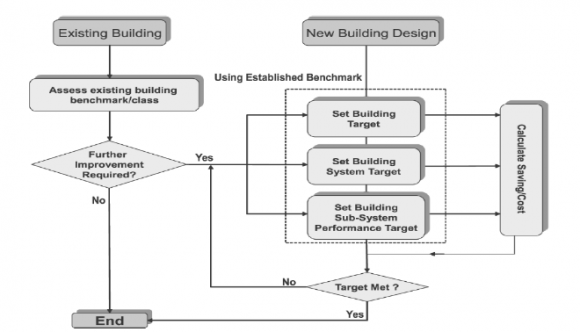
Energy efficiency will lead to efficient functioning of the machines that will lead to optimal performance, less breakdown and more productivity. Fewer breakdowns mean reduction in spares, maintenance cost and safe working condition. Building energy index will improve and can be used to compare between IT offices of the same organization located in different cities for bench marking. A typical benchmarking flow chart is suggested by Sapar et al. (2005) as shown below.
7. Fig. 6: Benchmarking Application Flow Chart b) Use of Energy Management in India
FM operations is slowly graduating in India and there is huge scope for improvements. Incorporating EM with FM is one such scope which can be effectively used by FM Company to outbid the competition and Property owner's to offer a competitive rate to the occupants / tenants as suggested by Ishak et al. (2016). Property owner can also utilize the savings in energy bill to self-finance any energy conservation project as funding such projects in India is a problem due to L1 (lowest Quoted Price) concept of procurement.
8. VI.
9. Conclusion
Asthe Facility Management business grow in India, particularly for IT sector, the need to incorporate energy management into FM services will become mandatory. Competition will grow but only those FMC will be able to survive who will be able to give better value for money to both the property owner and the tenants. Facility Managers will have to up skill their capability on energy conservation to meet the growing demands. Till now the FMCs have concentrated mainly on soft services like housekeeping, security and transportation etc. in the name of better services, but the time has come for energy conservation as the tenants are forced to look into opportunities to reduce the operational cost due to recession in IT business. IT industry has passed its peak and sustainability in this business is becoming challenging with passing days. Management in every IT company is forced to cut corners to maintain the profitability. Under this circumstance one of the easy ways to reduce the operating budget can be through reduction in energy cost that can easily be implemented with FM Operations at no extra cost implication. HVAC (Heating, Ventilation and Air-Conditioning) constitute major portion of the energy bill in India and experience through various studies show FM team can easily control the temperature at different locations inside the building, depending upon the occupation of the offices by the people, from control desk with the help of BMS (Building Automation System). One of the preferred modes is to offset the room set temperature by 1 -2 Degree Centigrade that will increase the compressor cut-off time leading to energy conservation.