1. Introduction
owadays, business firms are facing challenges in their business environment. The business environment is increasingly changing faster than ever before due to growing uncertainty, mismatch between supply and demand, and shortened product life cycle. If companies do not adequately respond to these changes, they may fade away to almost nothing in the market. If companies deal with these changes successfully, they may be able to develop and sustain competitive advantages longer than their competitors in the market.
Companies need efficient strategies to deal with the changing world. In the 1980s, the Competitive Forces Model proposed by M. E. Porter(1980) is a dominant paradigm in strategy discipline. It focuses on the external factors of the company's environment to develop the competitive strategies. However, this approach of focusing on the external factors does not explain why some companies are more competitive in the market than others (Teece et al., 1997).
In the 1990s, the Resource Based View(RBV)proposed by J.B. Barney(1991) offers an internally focused approach in order to better clarify the organizational foundation for successfully achieving competitiveness. Valuable, rare, inimitable and nonsubstitutable resources shape the foundation for sustainable competitive advantage because it is difficult for other organizations to copy or acquire these resources (Barney, 1991).However, according to Eisenhardt and Martin (2000) and Morgan(2009), the RBV has limitations in explaining how companies obtain and maintain competitive advantages in business environment with high level of uncertainty.
The Dynamic Capabilities Theory proposed by D.J. Teece(1997) provides an understanding of the relations between competitive advantage and business performance in the changing business environment in order to overcome the limitations of RBV. According to D.J. Teece(1997), this theory focuses on the processes to integrate, to build and to reconfigure the internal and external competence in order to address the changing environment.
Project Management (PM) is another efforts used by companies in order to deal with the changing business environment. A project is often used to introduce changes necessary to provide competitiveness to the companies, and project management is a valid countermeasure to respond to N the changing business environment. As companies have experienced the effectiveness of project, they have made use of more projects and more project resources Global Journal of Researches in Engineering ( ) Volume XIx X Issue III Version I 10 Year 2019 J in order to effectively implement the companies' strategies. In this situation, companies have recognized the importance of linkage between projects and the companies' strategy because they have faced difficulties in management control for efficient resource allocation, project selection and consistency between projects and companies' value.
It is the project portfolio management that help to overcome these difficulties with which companies are faced. This method enables the alignment between projects and companies' strategy in providing corporate competitive advantages as valid strategic means (Dins more, 1999; Levine, 2005).
This study uses the Dynamic Capabilities Theory to investigate what factors influence the introduction of project portfolio management for South Korean companies and to find out whether the introduction of project portfolio management can help to achieve competitive advantages for business firms. This study aims to clarify the following research questions: First question is whether the increase in corporate project resources affects the introduction of project portfolio management. Second question is whether project resources influence cooperative competitive advantage improvement through project portfolio management.
To sum up, the purpose of this study is as follows: First, it provides companies with a shift in awareness about the introduction of project portfolio management. It uses a method to demonstrate the need to introduce project portfolio management through dynamic capacity theory. Second, it will enable companies to introduce project portfolio management.
2. II.
3. Literature Review a) Dynamic capability theory
Dominant strategic approaches in the 1980shave focused on competitive forces model proposed by M.E. Porter (1980).This study concentrates on the external factors in the company's environment to determine the competitive strategies. However, this external approach does not fully explain why some companies are more competitive in the market than others (Teece et al.,1997). To better clarify the organizational foundation for competitive advantage, the Resource Based View(RBV) (Smithetal.,1996; Werner felt, 1995) offers an internally focused approaches. The RBV framework focuses on identifying and determining organizational resources such as tangible and intangible assets etc. in the organization. The RBV presumes that resources are not identical throughout organizations and uses the differences to give explanation of different success rates among or ganizations. Valu able, rare, inimitable and non-substitutable resources shape the foundation for sustainable competitive advantage, because it is difficult for other organizations to copy or acquire these resources (Barney, 1991). However, RBV does not fully explain how companies can obtain and maintain competitive advantages in business environment with high uncertainty (Eisenhardt and Martin, 2000;Morgan, 2009).
Under this background, Teece et al.,(1997) tried to overcome the shortcomings of the resource based view with dynamic capability. They reported about this notion while defining it as the ability to integrate, build, and reconfigure the company's resources and capabilities to compete in dynamic environments. They explained dynamic capabilities through PPP(Processes, Positions, and Path) framework shown in Figure 1. The core of competence capability is deep in the process that specific organization employed, and it is materialized by organization's assets and evolutionary path that they have come through. PPP framework shows the relationship mechanism between resources, dynamic capabilities and achievement. The dynamic capabilities mean organization's routines or processes. For its sustainability, processes have to be based on organizational resource position, organizational decision making which forms the core of dynamic capabilities, and historical, futuristic path that affect organizational learning.
4. J
The RBV assumed that valuable, rare, inimitable and non-substitutable resources within organization must be difficult to copy or imitate to provide sustainable competitive advantage, but dynamic resources are in rough way easy to copy and acquire (Eisen hardt and Martin, 2000). Eisenhardt and Martin(2000) has defined dynamic capability as a process that utilize, integrate and rearrange resources which brings out market change and reacts to business environment changes. Cho(2010) confirmed practical factors that affect formation of dynamic capabilities in the research against South Korean export companies and suggested an integrated model to analyze the process where resources and dynamic capability affects competence capability. With this model, it was confirmed that sustain input of resources is the main factor of dynamic capability. In the result, it was examined that human resources and dynamic capability directly affect competence capability while physical resources do not have to do with the competence. Dynamic capabilities are obtained through creation and expansion with ordinary competences (Winter, 2003). For higher level of competences, there needs to be investment by corporations which has specific patterns. That is, there is path dependence in capability development. The dynamic capabilities approaches also focus on learning and competence building process (Brady and Davies, 2004;Söderlund et al., 2008). Furthermore, the dynamic capabilities approach has been used to researches on strategic connectivity competence sand organizational learning competences (Hel fat, 2000).
5. Project Management (PM)
According to ISO (2012), project is a set of processes to achieve specific goal which has start and due dates, while activities are coordinated and controlled. The activities to achieve goals successfully are called project management and ISO(2012) defines Project Management(PM) is to apply method, tools, technology and capability to projects. PM is achieved by process, which are closely related activities. The process can be categorized into project management process, product process and support process. In project management process, decision about how to manage activities selected for the project is made. Product process is flexible depends on the results from previous stage and service. Lastly, support process offers proper, valuable support to PM and various areas such as logistics, finance, accounting and stability.
Recourses are necessarily put into project. In this paper, resources put into project procedure are collectively called project resources. Among the project resources there are human resource, raw materials, equipment and fund. Human resource is one of the most important factors where people are categorized depend on their level of knowledge, experience and technology, and given proper work position. Shortage of raw materials can cause critical delay to project schedule. When shipment of raw materials or assembly parts from other companies is delayed, it becomes significant problem. The size or type of equipment can be varied and they can be borrowed from other sources if the project team does not retain them. Fund, also, is one of important resources; fluent cash flow makes project procedure smoother.
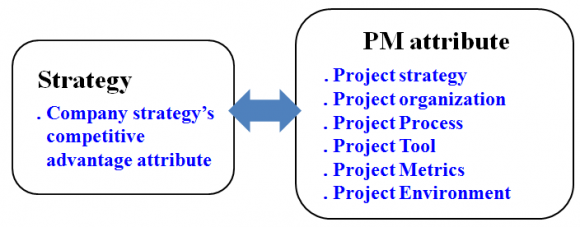
According to Korean Agency for technology and standard (2013), organizations offer guidelines of development and opportunity with strategies. And they aim for achieving strategic goals by executing sets of projects. Its relationship is shown on <Figure 2>. As importance of project as a strategic execution method is being emphasized, strategic connectivity becoming more important due to project's increasing scale and complexity (Dins more, 1999). Milosevic and Srivan naboon (2006) suggested the theoretical framework of linked project management and company strategy as methods to evaluate the connectivity level of the strategy. This framework shows how the 6 factors of the strategy are linked together. Figure 3 shows the frame work. According to Levine (2005), management control becomes harder as the number of on-going projects increases, and its efficiency against resourceshuman resources or budget distribution-becomes lower. When there are many proposals for projects, executive office falls in deep thinking about which projects to be selected to meet its strategic goals. In addition, the board room reminds itself that they are responsible for continuous evaluation of project so that it can contribute to strategic goals of their company, that is, successful project result is directly connected to achievement of strategic goals and business performances. In this way, necessity of project portfolio management which controls multiple projects has risen. Dins more(1999) argued that projects and strategies can be effectively arranged through project portfolio management. Therefore, it is fair to say that practical research to build effective link between strategies and projects was led to the birth of this notion.
6. Global
A project portfolio is an assortment of projects managed collectively to achieve the benefits of the portfolio and to realize the overall strategy of the organization (Y. Petro et al., 2015). Project management institute (2013) defines project portfolio as a set of programs, projects, or operations that managed in group and Association of project management group(2011) defines it as an every investments to changing factors. Regarding project portfolio management, Project management institute (2013) said it is to recognize, prioritize the projects and rearrange input resources for effective control and Association of project management group (2011) defines it as a harmonious collection of strategic processes and decision making that brings equilibrium between organizational change and ordinary business. M.G. Kaiser et al..(2014) defines project portfolio management as a commonly employed technique to align a project portfolio with strategic goals. According to the Project management institute(2013), project portfolio management can be largely divided into 8 parts: the first part is recognition where projects are defined by making lists of on-going or upcoming projects. In categorizing session, recognized projects are grouped with similar projects. The projects in the same strategy category have common goals and evaluated with same criteria. The third process is evaluation in which projects are compared each other for the next session. In the selection process, projects are listed based on their priorities. The next process is per iodization. In this session, listed projects are prioritized based on its strategic categories, profit against risks, structures and so on. Equalization session includes activities to form up the best portfolio mix where project portfolio gets final confirmation. The processes that mentioned above are summarized as a recognition capability for focusing and selection of projects. The next step is confirmation where the result of the sessions are officially reported to executive officers, and resources such as budget, human resource are distributed from selected portfolio. In this stage, resource arrangement capability is required for efficient distribution of project resources. In the last stage, reviewing, report and strategy rearrangement process, on-going project portfolio's efficiency is reviewed while project itself and resources are rearranged and strategies are changed for better optimization. In this stage, rearrangement capability for projects and process is applied.
According to Jonas et al.,(2013), maximizing a project portfolio's success implies maximizing the success of all the projects that comprise the portfolio. Their scale uses 'average project success' that is cost, quality and satisfaction of each project in the portfolio. Kopmann et al.,(2015) suggested that project portfolio success can be measured by 'strategic fit', 'synergies' between running projects such as technical or market synergies, 'portfolio balance' which is the adjustment of the portfolio between high and low risks, new and old area and use of new and existing technologies in projects. In addition, Voss and Kock (2013) presented 'overall business success' and 'future preparedness'. Overall business success means about market, commercial, and financial performance of projects results. Preparing for the future reflects the preparedness of the organization and infrastructure for sustainable competitive advantage.
These five dimensions of project portfolio success were defined that is constantly updated and revised. By these definitions are the focus of project portfolio management's strategic success.
7. Global
Journal of Researches in Engineering ( ) Volume XIx X Issue III Version I 13 Year 2019 J According to Serrador and Turner (2015) presented between 'project portfolio success' and 'project portfolio efficiency'. The project portfolio success means the realizing the benefits of the short term or long term nature. The project portfolio efficiency means that realized the benefits presented by the organization's objective or enhance the chance of project success using the project management tools and techniques.
The study of Patana kul (2015) attributes that effectiveness of project portfolio management can be realize strategic alignment, adaptability to internal and external environment changes, and expected value.
8. c) Grafting dynamic capability theory and project portfolio management
The dynamic capabilities approach is relatively new, so that more empirical study is necessary to reinforce the framework (Eisen hardt and Martin, 2000; Zahra et al., 2006;Martinsuo and Lehtonen, 2007).For the project portfolio management approach, previous project portfolio management literatures have been a the oretical (Killen,2010). Killen(2010) finds that the dynamic capability framework is appropriate view point in order to provide a consistent theoretical framework for project portfolio management approach and to explain project portfolio management's mechanisms contributing to competitive advantage. Killen(2010) applied the 'processes, positions and paths'(PPP) dynamic capability frame work by Teece et al.,(1997) to structuralize researches on project portfolio management. In research model shown in Figure 4, the process links company strategies and projects with each other and it emphasizes the importance of business model in case of decision making. Also it is directly involved in sustainable competitive advantage and improved business achievements. In other words, the process is a project portfolio management as a dynamic capability. The position refers to the entire organizational resources and competence capabilities, and to be more specific, it means resources (fund, equipment, workforce, knowledge) that distributed to specific project, and supporting resources or capabilities (customers, group culture, management capability) that indirectly affect project activities. In "the path", path dependence is essential factor in realizing project portfolio management capability. The project portfolio management capability develops along with maturity paths of companies, which suggests the fact that company's project portfolio management capability is improved based on previous decision makings, accumulation on experiences and organizational culture. Across the paper, we examined that the project portfolio management capability is a process supported by organization structure and workforces, and it brings competitive advantage to the company at the end. According to Porter(1980), there are three methods for companies to cope with five industry-level forces(entry barrier, threat of substitution, bargaining power of buyer, bargaining power of supplier, and rivalry method is differentiation. The companies offer among industry incumbents) earn higher profit than competitors. The first method is cost leadership, which is lowing price of goods with same utility. The second which differentiated from that of competitors. The third, centralization, is a method that brings company resources together into characterized, subdivided market with reduced competition range. differentiated products and compensate increased costs by increasing its prices. This attempt makes consumer to recognize the products as unique one According to other researchers (Hill, 1988;Miller and Friesen, 1986
9. Research Method a) Research hypotheses
In this research, based on the research model, hypothesizes were established to investigate if project resources influence the application of project portfolio management, and if its application improves strategic connectivity and competence capability by applying dynamic capability theory, project management and project portfolio management theories.
Project resources refer to company resources that support the projects directly or indirectly, and it accompanies qualitative, quantitative expansion of project when the number of on-going projects increases. Project portfolio management is one method to deal with management obstacles about increasing project resources (man power, budget distribution etc.) (Levine, 2005).
The following hypothesizes were established based on these theoretical backgrounds.
10. Hypothesis 1:
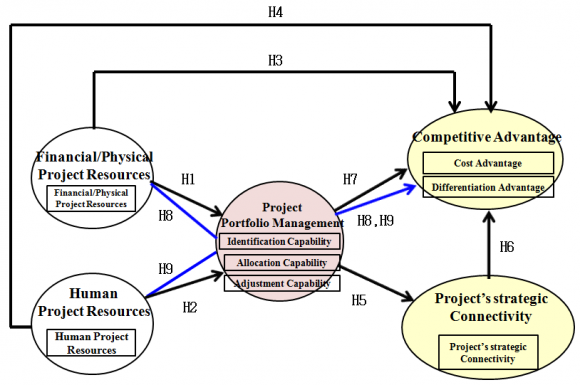
H1: Increased financial/physical project resources will positively influence the project portfolio management capability.
11. Hypothesis 2:
H2: Increased human project resources will positively influence the project portfolio management capability.
Corporate resources make strategic business actions possible, which lead to sustainable competitive advantage. The competitive advantage is created by integration of competitive resources and largely influenced by organization member's knowledge and recognition ability (Rosen bloom, 2000). The increase of project resources offers company the opportunity to carry out more projects which create a unique product, service or result(PMI, 2012) and deliver a desired outcome such as fast time-to-market, high-quality, lowcost products (Milosevic 2006).From this point, hypothesizes can be established: Hypothesis 3: H3: The increase of financial/physical project resources will positively influence the company's competitive advantage. H3-1: The increase of financial/physical project resources will positively influence the company's cost advantage.
H3-2: The increase of financial/physical project resources will positively influence the company's differentiation advantage.
12. Hypothesis 4:
H4: The increase of human project resources will positively influence the company's competitive advantage.
H4-1: The increase of human project resources will positively influence the company's cost advantage. H4-2: The increase of human project resources will positively influence the company's differentiation advantage.
Dins more (1999) reported a set of situation where the importance of project as a method of strategic execution increases along with the project scale, quantity and complexity, then argued that company's strategies can be arranged through project portfolio management. Based on this, following hypothesis was made. Hypothesis 5: H5: Project portfolio management capability will positively influence the project's strategic connectivity.
As company is interested in conducting bigger, more complicated, and a growing number of projects, the project's link with company strategy should be tightened. Under the circumstances, project connectivity can be improved with portfolio management (Levine, 2005).Hypothesis was established based on the fact that portfolio management makes company strategies to be achieved in higher chances which lead to creation of competitive advantage.
13. Hypothesis 6:
H6: The increased connectivity between project and strategy will positively influence the company's competitive advantage in direct way.
H6-1: The increased connectivity between project and strategy will positively influence the company's cost advantage in direct way.
14. H6-2:
The increased connectivity between project and strategy will positively influence the company's differentiation advantage in direct way.
The project portfolio management was found as a method for efficient distribution of resources, improved connectivity between strategy and project. This method is a means to arrange strategies and project, a tool for strategic execution which affects competitive advantage (Dins more, 1999; Levine 2005).
15. Hypothesis 7:
H7: The project portfolio management capability will positively influence the company's competitive advantage.
H7-1: The project portfolio management capability will positively influence the company's cost advantage.
16. Hypothesis 8:
H8: The project portfolio management capability will bring the positive mediated influence to the relationship between financial/physical project resources and competitive advantage. H7-2: The project portfolio management capability will positively influence the company's differentiation advantage.
Hypothesis 9: H9: The project portfolio management capability will bring the positive mediated influence to the relationship between human project resources and competitive advantage.
17. b) Research Model
As shown in <Figure 5>, the research model of this study was designed based on existing model by Teece et al.,(1997) and Killen(2010), which set financial/physical project resources and human resources as "the position", and put project portfolio management into "the process" section. However, "the path" was removed from the model because it does not match with the study's goal which is to examine the reason that project portfolio management has introduced. The previous works on "the path" have determined its meaning as company's historic and future paths -the maturity of project portfolio management-that is required for dynamic capabilityproject portfolio management-to gain competitive advantage. Instead, in this research model, strategy connectivity and competence capability were added as dependent variables to closely examine the influence of project portfolio management. So to speak, the goal of this study is to show the process that financial/physical and human resources influence project portfolio management, and the connection between strategy and project is established, and competitive advantage is gained.
18. d) Data gathering
This study conducted a survey from Nov. 6 to Oct. 19, 2015, of companies in South Korea. Google Drive was employed as the survey method. A combined 210 questionnaires were collected, of which203 were deemed relevant and statistically analyzed. Table 1 shows the profiles of the sample. The biggest share of the population was the age range of 40~49 (43.3 percent), and the majority of respondents were male (93.1 percent). In work experience, the majority (29.6 percent) of informants had been working for 10~15 years. By position, the majority (31 percent) were department heads. In addition, the 203 valid samples were all working for Korean companies and the sectors to which they belonged are below <Table 2>: The vast majority (53.7 percent) worked for the defense industry, followed by construction, plants and engineering (18.7 percent), ICT (14.3 percent), machinery and shipbuilding (3.4 percent), finance and services (3.4 percent), education and consulting (3.4 percent), and others (three percent).
19. Global
20. IV.
21. Data Conditioning a) Reliability
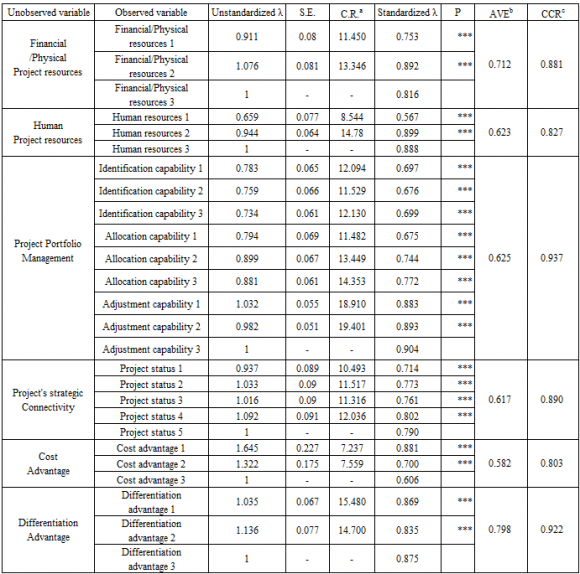
For resources of financial, physical and human projects, project portfolio management, project's strategic connectivity, and cost and differentiation advantages, the factor analysis results are below in <Table 3>: The resources of financial, physical and human projects were found as independent variables through factor examination, while project portfolio management was found as a parameter and the project's strategic connectivity and cost and differentiation advantages were confirmed as dependent variables. For verification of each factor, Cronbach ? was used in which all the factors were deemed reliable since the factor loading was found near 0.8.
22. b) Convergent validity
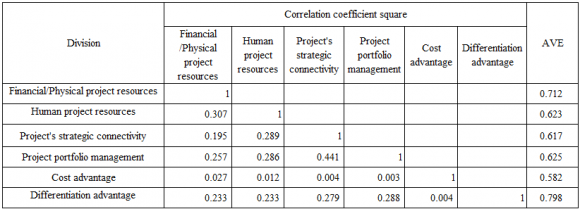
As shown in <Table 4>, convergent validity was examined as the next step, in which the AVEs of every six factors were found to exceed 0.5 and CCRs surpassed 0.7, thus validity was verified as being high enough. As shown in <Table 5>, discriminate validity was examined with AVE values of the factors; to be valid, AVE values must be higher than those of squared parameters. As a result, all AVE values were found to be higher than those of squared parameters.
23. Global
24. Table 5: Discriminant validity
In addition, measurement model suitability was verified with ?2(CMIN) values among absolute fit indexes. The result was 622.063 with d. f. 279, making CMIN/d. f. 2.230 and verified as validated since the value was smaller than 3. The bottom line of GFI (Goodness of Fit Index) for validation is 0.9, and the result of 0.812 was close to 0.9. In RMR (Root Means Square Residual) and RMSEA (Root Means Square Error of Approximation), lower indexes mean a higher validation level, and this is relevant when RMR values are lower than 0.05 while those of RMSEA are considered validated when within 0.05~0.1. In this model, no big difference was seen between the standard value and that of RMR (0.062);that of RMSEA (0.078) was confirmed to be proper. In addition, the CFI (Comparative Fit Index) and NFI (Normed Fit Index) are considered validated when their values exceed 0.9, and the result in this model showed a CFI of 0.909 and NFI of 0.849.
25. d) Measurement & Research model suitability
Based on these validation assessments, the conclusion was that the model is validated overall. The results are also shown in <Table 6>. In sequence, the suitability of the research model was verified with ?2(CMIN) values among absolute fit indexes. The result was 521.572 and d. f. of 277, thus the CMIN/d. f. was 1.883 and verified as validated since the value was smaller than 3. The bottom line of GFI for validation is 0.9 and the result was 0.84, which is close to 0.9. In RMR and RMSEA, lower indexes mean a higher validation level, and this is relevant when RMR values are lower than 0.05 while those of RMSEA are considered validated when within 0.05~0.1. In this model, no big difference was seen between the standard value and that of RMR (0.057);the RMSEA value of 0.066 was confirmed to be proper. In addition, the CFI and NFI are considered validated when their values exceed 0.9. The results in this model found a CFI of 0.935 and NFI of 0.873.
Based on these validation assessments, the conclusion was that the model is validated overall. The resultsare also shown in<Table7>.
26. Global
27. Results and Discussion
Hypothesis 1 to hypothesis 7 were verified by Path analysis according to structural equation model, and hypothesis 8 and hypothesis 9 were analyzed by mediation regression analysis and bootstrap Maximum Likelihood.
28. Introduction of Project portfolio management (tests of H1-H7)
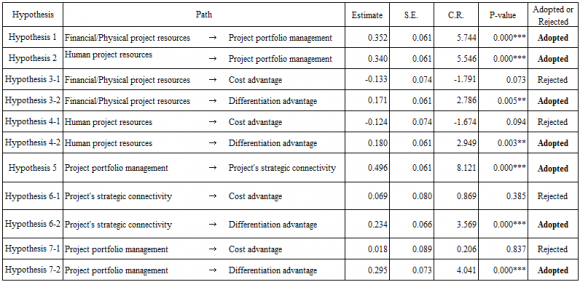
Hypothesis 1 to hypothesis 7 were verified by Path analysis according to structural equation model, and the result is as below in <Table 8>: It was confirmed that financial/physical project resources and human project resources affect project portfolio management as hypothesis 1 and hypothesis 2 was examined to be validated. The growth in the number of projects increases the project resources qualitatively and such an number of project resources, the company experiences difficulties in management control (manpower resource allocation, budget allocation etc.). In order to solve this problem, it is proved through the adoption of hypothesis 1 and hypothesis 2 that companies need to introduce project portfolio management.
Hypothesis 3 and hypothesis 4 were to verify the influence of financial/physical and human project resources on competitive advantage, where it was examined that the resources do not affect cost advantage (H3-1, H4-1) but positively influence the differentiation advantage (H3-2, H4-2), therefore hypothesis 3 and hypothesis 4 were employed. Quantitative and qualitative increases in project resources provide companies with the opportunity to undertake more projects. This condition gives companies more opportunity to offer differentiated products or services to their customers. This has been proven through the adoption of hypothesis 3 and hypothesis 4 that firms can gain competitive advantage (in particular, differentiation advantage).
Hypothesis 5 was employed according to the result of examination, and it is fair to say that project portfolio management is involved in the increase of strategic connectivity. Projects are becoming more and more large, complex and accretive. At this time, the project may have difficulty in linking with corporate strategy. In this context, the adoption of hypothesis 5 proves that project portfolio management needs to be introduced in order to effectively align corporate strategies and projects.
Hypothesis 6 was regarding the influence of strategic connectivity on company's competitive advantage. The strategic connectivity of the project does not influence the cost advantage (H6-1), and, on the other hand, it influences differentiation advantage positively (H6-2), therefore hypothesis6 was employed. As demonstrated in hypothesis 5, project portfolio management enhances the level of linkage between projects and corporate strategy. In this situation, it is more likely that corporate strategy can be achieved more effectively through project implementation. This has been proven through the adoption of hypothesis 6 that the firm leads to securing competitive advantage (in particular, differentiation advantage) Hypothesis 7 verified the influence of portfolio management on competitive advantage. The project portfolio management was examined to be not involved in cost advantage (H7-1). Meanwhile, it positively affects differentiation advantage (H7-2), so hypothesis 7 was validated. The company introduces project portfolio management in order to link effectively projects and corporate strategy and to allocate efficiently project resources. This enables companies to achieve efficient allocation of resources and effective alignment between corporate strategy and projects. The adoption of hypothesis 7 proves that this situation leads to the achievement of corporate competitive advantage (in particular, differentiation advantage).
29. Effect of Project portfolio management on Competitive advantage (tests of H8-H9)
Before we examine hypothesis 8 and hypothesis 9, reliability of parameter effect on project portfolio management was verified. To do so, mediation regression was analyzed in the first hand, and bootstrap maximum likelihood was applied. The cost advantage was removed from the analysis, because it has failed to be validated.
Regarding hypothesis 8, it was confirmed that the significant probability of was zero when there was no mediation with portfolio management while the figure has risen to 0.118, which is not relevant, in case of the mediation. Therefore, it was verified that the management has complete mediation effect between the financial/physical resources and the differentiation advantage as it is shown in <Table 9>. The mediation effect of hypothesis 9 was examined that the beta variable of the human project resource was 0.281 in case of no mediation. However, on the other hand, the variable was decreased to 0.112 when the management was involved. Through this result, it was confirmed that the portfolio management partially mediate the human project resources and differentiation advantage as shown in <Table 10>. ultimately the portfolio management strengthens the competitive advantage by distributing increased resources effectively.
30. Global
As shown in <Table 11>, the bootstrap maximum likelihood method was used in the test of hypothesis 8 and hypothesis 9 based on structural equation model. To sum up, verification was conducted for hypothesizes that financial/physical project resources and human resources affect project portfolio management, and it was examined to be relevant with 0.004 significant value.
31. Conclusion
Across the thesis, we tried to examine the factors that affect execution of project portfolio management, and how it brings competitive advantage.
First of all, introduction factor of the portfolio management was figured out to be financial/physical project resources and human project resource, which raise the need of integrated control management method (project portfolio management) at organization level as the number of the projects and its resources increases. Secondly, the connectivity between the portfolio management and company strategies was examined, and we found the relevant link that the centralized control management brings the strategies and the projects together. Thirdly, the influence of financial/physical project resources, human project resource, the connectivity between projects and company strategy and portfolio management on the improvement of competitive advantage were examined, and we concluded that all these factors have to do with the differentiation advantage meanwhile there was no relevant link with the cost advantage. This is because the project is basically the tool for company to offer differentiated products or services. Finally, regarding the mediation effect on the company's competitive advantage, it was examined that the project portfolio management act as complete mediation for financial/physical project resources, therefore strengthen the competitive (differentiation) advantage. On the other hand, for the human project resources, portfolio management was involved in it as partial mediation. It is fair to say that the attempt to integrate project resources and projects that are individually managed improves company's competitive advantage.
For these results of practical studies, it is encouraged for companies to employ project portfolio management to achieve competitive advantage effectively. This paper is meaningful in the point that it has examined the need of portfolio management through practical research, which has not tried in South Korea yet.
However, it is hard to say that it reflects overall characteristics of every industry since over 50% of the sample was from defense industry. Therefore, there needs to be more varied samples from each industries, also the comparison between the industries has to be done. This study was focused on the execution of project portfolio management, however, in the future research, connection of improved maturity of portfolio management and competitive advantage needs to be examined, and the study on cost advantage, which was not employed in this research and its relationship with portfolio management, should also be done.

| III. |
| Year 2019 |
| 14 |
| ( ) Volume XIx X Issue III Version I J |
| Journal of Researches in Engineering |
| Global |
| Year 2019 |
| 15 |
| ( ) Volume XIx X Issue III Version I J |
| Journal of Researches in Engineering |
| Defense | 109 | 53.7% |
| Construction/Plant/Engineerin g | 38 | 18.7% |
| ICT | 29 | 14.3% |
| Machinery/Shipbuilding | 7 | 3.4% |
| Finance/Service | 7 | 3.4% |
| Education/Consulting | 7 | 3.4% |
| Others | 6 | 3.0% |
| Sum | 203 | 100.0% |
| Items(n=203) | Range | Frequency | Ratio |
| Year 2019 | |||
| 16 | |||
| ( ) Volume XIx X Issue III Version I J | |||
| Journal of Researches in Engineering | Industry | Frequency | Ratio |
| Global | |||
| © 2019 Global Journals |
| Model | 622.063 | 279 | 2.230 | .812 | .062 | .078 | .909 | .849 |
| Standard | - | - | Under 3 | Over 0.9 | Under 0.05 | 0.05~1 | Over 0.9 | Over 0.9 |
| Year 2019 |
| 19 |
| J |
| * p<0.10, ** p<0.05, *** p<0.01 |
| 1 (Constant) | 1.000E-013 | .068 | .000 | 1.000 | |
| Financial/Physical project resources | .275 | .068 | .275 | 4.058 | .000*** |
| Regression model F= 16.465, p=.000, R 2 = .076, df=202 | |||||
| 2 (Constant) | 1.001E-013 | .59 | .000 | 1.000 | |
| Financial/Physical project resources | .100 | .064 | .100 | 1.570 | .118 |
| Project portfolio management | .498 | .064 | .498 | 7.835 | .000*** |
| Regression model F= 41.397, p=.000, Adjusted R 2 = .286, df=202 | |||||
| Year 2019 |
| 21 |
| ( ) Volume XIx X Issue III Version I J |
| Journal of Researches in Engineering |
| Project | |||
| portfolio | - | - | - |
| management | |||
| Cost advantage | .489 | .489 | - |
| Differentiation advantage | .004*** | .004*** | - |
| Unstandardized | Standardize | ||||
| Model | coefficient | d coefficient Model | p | ||
| B | S.E. | B | |||
| Year 2019 | |||||
| 22 | |||||
| Journal of Researches in Engineering ( ) Volume XIx X Issue III Version I J | Financial/Physical project resources | Human project resources | Project portfolio management | ||
| Global | |||||
| © 2019 Global Journals | |||||