1. Introduction
iquid mixtures have attracted considerable attention due to their unusual behavior. In chemical process industries, material are normally handled in fluid form and as the consequence, the physical, chemical, and transport properties of fluids assume importance. Fluid mixtures in process industries are often separated into their components by mass transfer operations. Design of such operations requires quantitative estimation of the properties of fluid mixtures. Recently there has been considerable progress in the studies on intermolecular interactions and the internal structure of liquid mixtures. Thus data on some of the properties associated with the liquids and liquid mixture like density, viscosity and ultrasonic velocity find extensive application in solution theory and molecular dynamics. These results are necessary in chemical, electrochemical, biochemical and kinetic studies. a) Thermo Physical Properties Thermo physical properties of liquid mixtures have extensive practical applications in day to day life. Any problem connected with heat, momentum and mass transfer entails knowledge of thermo physical properties and their variation with temperature.
The data on some of the thermo physical properties associated with the liquids and liquid mixtures find applications in solution theory and molecular dynamics (Mchaweh et al 2004). These results are necessary for interpretation of data obtained from thermo chemical, electrochemical, biochemical and kinetic studies (Kenart et al 2000). These are needed in many engineering problems such as process calculations, simulations and pipe design and automobile fuel selection. The automobile fuel has to be checked for the consistency of its properties before it is supplied to the engine. The thermo physical properties of liquid mixtures like density, viscosity, refractive index, surface tension and ultrasonic velocities are often applied for calculations of other parameters characterizing binary and ternary liquid mixtures.
i. Density Density belongs to the group of most useful intensive physiochemical properties widely applied studies of pure liquids and liquid mixtures. It behaves as an additive volumetric property for ideal solutions. Results of many experimental works show that the analysis of deviation from density as a function of the composition of the mixture is more useful for studies of intermolecular interactions in liquid mixtures that the analogous examination of changes of density. The knowledge of density of liquid mixtures is necessary for calculations of other properties like viscosity and thermo acoustical parameters.
ii. Viscosity Viscosity is not a simple additive property. It is an important transport property for process design in petroleum, petrochemical and other chemical industries involving fluid transportation, mixing, agitation, filtration, heat exchange and concentration. The investigation of viscosity can be a powerful tool for characterization of interactions present in the mixtures.
iii. Ultrasonic Velocity
The ultrasonic studies are extensively used to estimate the thermodynamic properties and predict the intermolecular interaction of liquid mixtures. Ultrasonic velocity of binary liquid mixtures could be related either
2. C
to size and shape of the molecules or to the entropy effect because of volume and space filling effects with mixing processes. The principle used in the measurement of velocity is based on the accurate determination of the wavelength in the medium. The high frequency generator generates variable frequency, which excites the quartz crystals. The excited quartz crystal generates ultrasonic waves in the experimental liquid. The liquid will serve as an acoustical grating element when ultrasonic waves passes through the ruling of the grating, successive maxima and minima occurs, satisfying the condition for diffraction. Ultrasonic waves are high frequency mechanical waves. Ultrasonic velocity in a medium depends inversely on density and the compressibility of the medium. The variation in the ultrasonic velocity of the liquid mixtures increases or decreases of intermolecular free length of mixing and vice versa. iv. Intermolecular Forces Intermolecular forces are electrostatic forces of attraction that exist between an area of negative charge on one molecule and an area of positive charge on a second molecule. Intermolecular forces are a secondary method of holding a solid state structure together. As the name implies, these are forces that exist between molecules. Bonds exist within molecules. For reasons that will not be discussed here, intermolecular forces are only associated with systems that use covalent bonding within the molecules. Intermolecular forces are not encountered in systems that employ ionic bonding. Some elements, such as the noble gases, exist with intermolecular forces and no bonding at all. Intermolecular forces exist in three different levels of strength. The differing strengths are a function of the magnitude of the areas of charge that hold them together. These three different forces are Hydrogen bonding (the strongest), Dipole-dipole forces, London dispersion forces (the weakest). Two of the intermolecular forces are associated with polar structures Hydrogen bonding and Dipole-dipole forces. One of the intermolecular forces is associated with non polar structures is London dispersion forces. The constants can be evaluated if the viscosity data is available for binary system at a particular temperature using least squares method.
iii. Jouyban-Acree model Jouyban proposed a model for correlating the viscosity of liquid mixture at various temperatures.
ln ? m = x 1 ln ? 1 + x 2 ln ? 2 +(x 1 x 2 /T) ? a i (x 1 -x 2 ) i `Where ? m , ? 1 ,and ? 2 are the viscosities of the mixture and solvents 1 and 2 at temperature T, respectively. A i are the model constants. c) Models based on excess properties i. Redlich-Kister model
Y = x 1 x 2 ? a i-1 (x 1 -x 2 ) i -1Where, Y refers to V E or ?? d) Models based on ultrasonic velocity Sound speed by Jacobson's free length theory "Jacobson (1952) is calculated using the following formula.
U flt =k / l f(mix) ? 1/2 exp Where k is the Jacobson's constant (k= (93.875+0.375t) 10 -8 ) and depends only on temperature and l f(mix) is intermolecular free length of mixture.
U van = [(x 1 /m 1 u 1 2 +x 2 /m 2 u 2 2 ) (x 1 m 1 +x 2 m 2 )] -1/2Where x 1 and x 2 are mole fractions and u 1 and u 2 is speed of sound of acetophenone and benzene respectively. The sound speed in the mixture is given by impedance dependence relation "shipra and parsania (1995) as
U idr =[(? 1 z 1 +? 2 z 2 )/ (? 1 ? 1 +? 2 ? 2 )]Where ? i, z i and ? i are the mole fractions, impedance and density of the i th component respectively.
3. II.
4. Experimental Setup & Procedure
The aim of this research is to measure the density and Viscosity of the Acetophenone Ethylchloroacetate binary mixtures at two different temperatures (303, and 323) K and over the entire composition. These values have been used to calculate the excess molar volume (V E ), deviation in viscosity (Î?"?). The Viscosity values were fitted to the models of McAllister, Krishnan-Laddha and Jouyban-Acree. The excess values were (like excess molar volumes, deviation in viscosity) fitted to Redlich-Kister type equation to obtain their coefficients and standard deviations. The experimental setup has been shown in the figure 1.
5. a) Viscometers
Capillary viscometers are the most commonly used instruments for Newtonian liquids. Most glass capillary viscometers are operated by force of gravity. Because of small driving force this class of devices is useful for low viscosity liquids ranging from 0.4 to 16000 centistokes. Glass capillary instruments are low stress instruments the shear stress ranges from 10 to 500 dynes/cm 2. The principle of these instruments is derived from viscometer originally used by Ostwald.
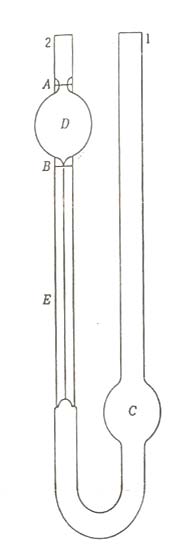
The Kinematic viscosities were measured at the desired temperature using Ostwald viscometer as shown in Figure 2. The time was measured with a precision of 0.01s and the uncertainty in the viscosity was estimated to be less than 0.0003mpa.s. Ostwald viscometer was previously calibrated using water. In the viscometer a sample of liquid was charged from tube 1 to bulb C, so that level in the arm stands at the mark. The viscometer with the sample is immersed in a water bath so that it attains the desired temperature. Suction is applied so that liquid is drawn up to mark 'A' through bulb D. The efflux time of the liquid between marks A and B is noted after releasing the vacuum. The liquid mixture was charged into the viscometer. After the mixture had attained bath temperature, flow time has been determined. The above steps were continued and reported. The kinematic viscosity was obtained from the working equation ? = at -b/t Where the two constants a and b were obtained by measuring the flow time t of benzene.
6. b) Pycnometer
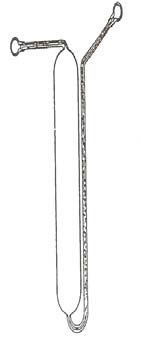
Pycnometer is a vessels with capillary necks in which volume of liquid is weighed. The volume is determined by weighing the vessel filled with water at definite temperature. Densities were determined by using 25cm 3 bicapillary Pycnomete. The quantity of liquid is adjusted so that the liquid meniscus is at the mark on the horizontal capillary while the other arm is completely filled. Tilting the completely filled unit slightly makes this adjustment and drawing liquid slowly from other capillary by touching a piece of filter paper to it. The Pycnometer filled with air bubble free experimental liquids was kept in a transparent walled water bath (maintained constant to ± 0.01K) for 15 minutes to attain thermal equilibrium. The precision density measurements were within ±0.0003g.cm -3 .
7. c) Thermostatic bath
Water bath was used for maintaining a constant temperature during the testing. It was capable of controlling temperature with an accuracy of ±0.01 0 C.
8. d) Experimental Procedure
The charge for viscometer was prepared by taking 20 cc of the solution obtained by mixing the two liquids in different proportions. The thermostat was set to the desired temperature. After it had been cleaned and dried the viscometer was immersed in the bath so that the mark A is at least 2 cm below the surface of the bath liquid. The liquid V TC VP MP mixture was charged into tube 1 of the viscometer so that the air bubbles were absent and the level in this arm stood at the mark at the bulb when the temperature was attained. After the sample had attained the bath temperature it was blown up to a point 2cms above the mark A and the liquid was allowed to flow freely and time required for the liquid to flow from top to bottom mark was taken as the flow time. The above steps were continued and an average of 5 sets of flow time was reported. The stop watch used had an accuracy of 0.01 sec.
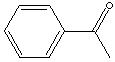
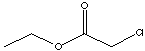
The chemicals used in this investigation are:
? Acetophenone.
? Ethylchloroacetate.
The purities of the compounds were checked by comparing the measured densities and viscosities with those reported in the literature.
9. Results & Discussions
Assuming the shapes of the molecules are spherical, the size ratio of the molecules is given by the formula
r 1 /r 2 = [(M 1 /M 2 )(? 2 /? 1 )] 1/3For McAllister model the size ratio should be less than 1.5. Where, r 1 , r 2 are the radius of the component 1 and 2 ? 1, ? 2 are the density of the pure component 1 and 2 M 1 , M 2 are the molecular mass of component 1 and 2 Ethylchloroacetate/Acetophenone =0.9897
Since the size ratio for binary system is less than 1.5, so the system was considered for McAllister three-body model. McAllister model, Krishnan and Laddha model were tested with experimentally obtained viscosity data for the binary and ternary mixtures at 30 0 C, 50 0 C for the following mixtures.
10. Ethylchloroacetate (1) + Acetophenone (2)
The respective binary and ternary constants ? 12 , ? 21 , were determined by the method of least squares for each system. With these constants viscosity was then calculated for binary and ternary systems at each composition. The deviation of experimental value from the predicted was calculated as follows.
Percentage Deviation, d = ((? exp -? calc )/? calc )*100 Standard Deviation was calculated using the relationship, SD = (? (? exp? calc ) 2 / (N-m) 1/2 Where,
11. N-Number of data points, m -Number of coefficients
The binary viscosity and density values are used to calculate viscosity deviation using the relationship
Î?"?= ?12-(x 1 ? 1 + x 2 ? 2 )The density values have been used to calculate excess molar volume using the formula
V E = (x 1 m 1 + x 2 m 2 ) / ? 12 -x 1 m 1 / ? 1 -x 2 m 2 / ? 212. Results of Present Investigation show that
McAllister model, Joubyan-Acree can be used to predict viscosity of binary mixtures. Redlich-Kister equation can be used to predict Excess molar volume of binary liquid mixtures.
13. Discussion
Deviation of physical property of liquid mixtures from the ideal behavior is the measure of the interaction between the molecules which is attributed to either adhesive or cohesive forces. McAllister equation, Krishnan-Laddha equation and Jouyban-Acree equation were tested with the experimentally obtained data at 30 0 C and 50 0 C. The constants were obtained by the method of least squares. With these constants the viscosity values were calculated at each composition. The calculated values agreed with the experimental values with a high degree of precision for McAllister model compared to Krishnan-Laddha model. The viscosity of a mixture strongly depends on entropy of the mixture, which is related to liquid structure and enthalpy; and consequently to molecular interactions between the components of the mixtures.
14. Global
The variation of ? ? and V E with mole fraction of Ethylchloroacetate for the system Ethylchloroacetate (1) + Acetophenone (2) was studied at 30 0 C and 50 0 C respectively. The excess molar volume and deviation in viscosity were fitted with Redlich -Kister type equation.
For the mixtures without strong interactions the viscosity deviations are negative. According to this, V E is the result of contributions from several opposing effects. This may be divided arbitrarily into three types namely, physical, chemical and structural. Physical effects contribute to positive term of V E . The chemical or specific intermolecular interactions result in a volume decrease and contribute negative values to V E . The structural contributions are mostly negative and arise from interstitial accommodation and changes in free volume. The actual volume change therefore depends on the relative strength of these effects.
The V E values were for found to be negative. Negative values of V E suggest specific interaction between mixing components. Ethylchloroacetate is a weak dipolar molecule, with a dipolar moment of 2.69. Whereas Acetophenone is strong dipolar molecule, with a dipole moment of 3.028. Oxygen group in Acetophenone is attracted towards the Chlorine group in Ethylchloroacetate, which forms dipole-dipole bond. The negative deviations in viscosity over the whole composition range suggest that in these mixtures, the forces between unlike molecules are lesser than the force between like molecules. a) In this work density (?), viscosity (µ) and ultrasonic velocity (u) of pure acetophenone and ethylchloroacetate as well as binary mixture constituted by these two chemicals at temperatures of 303k and 323k respectively. The literature survey showed that no measurements have been previously reported for the mixture studied in this project.
15. Conclusion
Viscosities and densities for the binary liquid mixture of Ethylchloroacetate and Acetophenone system was found out as a function of mole fraction at atmospheric pressure and at temperatures of 303K and323K. From the density and viscosity data, the values of excess molar volumes (V E ) and the viscosity deviations (Î?"?) were determined at 303K and 323K. Excess molar volumes (V E ) and the viscosity deviations (Î?"?) were used to predict the intermolecular interactions in the mixtures.
McAllister's three-body-interaction model, Krishnan-Laddha model and Jouyban-Acree model were used to correlate the kinematic viscosity of the systems. The excess volume and viscosity deviation data were fitted by means of the Redlich-kister equation.

| b) Models based on viscosities of pure component | ||||
| i. McAllister model | ||||
| The Eyring's theory of absolute reaction rates | ||||
| was used to develop a model to predict the viscosity of | ||||
| liquid mixtures. Mcallister (1960) proposed a model | ||||
| which assumes the free energy of activation for viscosity | ||||
| are additive on mole fraction basis. | ||||
| From Eyring's McAllister used the above equation for binary | ||||
| liquid mixtures considering various interactions between | ||||
| the molecules in one plane. The size ratio of the 2 | ||||
| molecules should be less than 1.5. | ||||
| ln ? = x 1 | 3 ln? 1 + 3 x 1 2 x 2 ln? 12 +3x 1 x 2 2 ln? 21 + x 2 | 3 ln? 2 - | ||
| ln(x 1 +x 2 m 2 /m 1 )+3x 1 | 2 x 2 ln(( 2+ m 2 /m 1 )/3 ) + 3x 1 x 2 2 ln(1+2m 2 /m 1 )/3) + x 2 | 3 ln(m 2 /m 1 ) | ||
| ln? mix = x 1 ln ? 1 + x 2 ln ? 2 -2.303x 1 x 2 (A+ B(x 1 -x 2 )) -ln(x 1M1 +x 2 M 2 )+x 1 lnM 1 +x 2 ln M 2 | ||||
| S. No. | Properties | Unit | Acetophenone | Ethylchloroacetate |
| 1 | Formula | -- | C 8 H 8 O | C 4 H 7 ClO 2 |
| 2 | Molar mass | Kg/kmol | 120.15 | 122.55 |
| 3 | Melting Point | o C | 20 | -26 |
| 4 | Boiling Point | o C | 201.7 | 144 |
| 5 | V.Pressure | mmHg | 0.3 | 5 |
| Saturation | ||||
| 6 | Concentration | ppm | 1300ppm | 13160ppm |
| 7 | Critical Temp | o C | 428 | 345 |
| 8 | Critical Press | mmHg | 3.8 | 37.4 |
| 9 | Density | Kg/m 3 | 1.027 | 1.15 |
| 10 | Solubility in Water | g/L | 5.5 | Insoluble |
| 11 | Viscosity | cp | 2.28 | 2.93 x10 -3 |
| 12 | Surface Tension | g/s 2 | 39.8 | 31.7 |
| 13 | Refractive index | -- | 1.5339 | 1.4235 |
| 14 | Heat of Vaporization kJ/mol | 49.0 | 49.4 | |
| S.No | Molefraction of | Ethyl | Chloroacetate | (x 1 ) | Density | ? | ( g/cc ) | Excess Volume | V E | (cc/gmole) | kinematic | Viscosity | ? (cS) | Absolute | Viscosity | ? ( cP) | Viscosity | Deviation | Î?"? ( cP) | ||
| 1 | 0 | 0.947 | 0 | 1.4969 | 1.41831 | 0 | |||||||||||||||
| 2 | 0.1089 | 1.000 | -4.4368 | 1.1523 | 1.15287 | -0.2596 | |||||||||||||||
| 3 | 0.2151 | 1.002 | -2.4388 | 1.1222 | 1.12489 | -0.2068 | |||||||||||||||
| 4 | 0.3199 | 1.006 | -0.7810 | 1.058 | 1.06580 | -0.1887 | |||||||||||||||
| Year 2015 | 5 6 7 | 0.4223 0.5231 0.6224 | 1.047 1.064 1.072 | -0.3277 -3.0582 -1.8051 | 1.015 0.9312 0.8809 | 1.06300 0.99135 0.94454 | -0.1522 -0.1574 -0.1302 | ||||||||||||||
| 6 | 8 9 | 0.7191 0.8144 | 1.058 1.085 | 1.65118 0.82216 | 0.8474 0.8273 | 0.89722 0.89786 | -0.0882 -0.0339 | ||||||||||||||
| I | 10 | 0.9086 | 1.094 | 1.8223 | 0.787 | 0.86145 | -0.000 | ||||||||||||||
| Global Journal of Researches in Engineering ( ) Volum C e XV Issue I Version | 11 (x1) 0.10 Molefraction of 0 0.21 0.31 0.42 0.52 0.62 0.71 081 0.90 1 ethylchloroacetate | 1 0.9475 Density ? g/cc 1.0005 1.0024 1.0069 1.0473 1.0646 1.0722 1.0588 1.0853 1.0946 1.1322 | 1.132 U ms -1 1478 Ultra-sonic velocity 1430 1472 1396 1364 1340 1403 1324 1222 1390 1188 | 0 (Ks) x10 -10 m 2 N -1 4.8287 Isentropic compress-ibility 4.8850 4.6040 5.0903 5.1261 5.2249 4.7365 5.3812 6.1662 4.7256 6.2494 | 0.7164 Molar Volume cm 3 /mol 126.860 120.390 120.405 120.107 115.698 114.036 113.435 115.086 112.478 111.725 108.191 | Inter- | 0.81114 molecular free length L f x 10 -11 m 4.559 4.586 4.452 4.681 4.698 4.743 4.515 4.813 5.153 4.510 5.187 | 0 Impedance 1400.78 Acoustical (Z)x10 6 kg/m 2 s 1431.11 1475.53 1406.43 1429.35 1427.41 1504.58 1402.69 1326.67 1521.93 1346.01 | |||||||||||||
| Prediction of Volumetric and Viscometric Properties of Acetophenone -Ethylchloroacetate Binary | ||||||||
| Mixture at 303K & 323K with different Model Analysis | ||||||||
| 0.3199 | 1396 1374.19 1464 1396 | 1.628x10 -14 | -4.624 | 1.6451 | ||||
| 0.4223 0.5231 0.6224 0.7191 | 1364 1343.37 1510 1364 1340 1314.12 1589 1340 1403 1286.31 1714 1403 1324 1260.14 1915 1324 | 0 1.696x10 -14 1.62x10 -14 0 | -9.656 -15.64 -18.70 -30.81 | 1.5949 2.0296 9.0865 5.1307 | Year 2015 | |||
| 0.8144 0.9086 | 1222 1235.18 1435 1222 1390 1211.29 1304 1390 | 0 0 | -14.86 6.615 | -1.0349 14.786 | 7 | |||
| by (R-K model) for the mixture at 303 K u VAN m s -1 u FLT ms -1 % Deviation u FLT m s -1 u VAN ms -1 1478.4 1478 1478 -1.538x10 -14 0 0.1089 1430 1441.49 u Exp m s -1 u IDR m s -1 0 1478 1448 1430 0 -1.227 0.2151 1472 1406.95 1444 1472 0 1.924 Molefraction of Ethyl (x 1 ) ? expt (cS) ? pred (cS) (McAllister Model) ? pred (cS) (Jouyban-Acree Model) 0 1.4969 1.5268 1.4969 0.1089 1.1523 1.9793 1.1862 0.2151 1.1222 1.8463 1.0538 0.3199 1.0585 1.3875 1.0666 0.4223 1.015 0.9373 1.0478 0.5231 0.9312 0.6241 0.9555 0.6224 0.8809 0.4437 0.8637 0.7191 0.8474 0.3607 0.8286 0.8144 0.8273 0.3529 0.8294 0.9086 0.787 0.4347 0.7931 1 0.7164 0.7164 0.7164 Chloroacetate 1 1188 1188.8 1188 1188 0 0 | u IDR 0 m s -0.7698 -1 4.6229 ? pred (cS) (K-L model) 1.4969 1.1864 1.0540 1.0668 1.0481 0.9558 0.8640 0.8289 0.8296 0.7933 0.7164 -1.9x10 -14 | Global Journal of Researches in Engineering C ( ) Volume XV Issue I Version I | ||||||
| 0.3199 1396 1374.19 | 1464 | 1396 | 1.628x10 -14 | -4.624 | 1.6451 | |||
| 0.4223 1364 1343.37 | 1510 | 1364 | 0 | -9.656 | 1.5949 | |||
| 0.5231 1340 1314.12 | 1589 | 1340 | 1.696x10 -14 | -15.64 | 2.0296 | |||
| 0.6224 1403 1286.31 | 1714 | 1403 | 1.62x10 -14 | -18.70 | 9.0865 | |||
| 0.7191 1324 1260.14 | 1915 | 1324 | 0 | -30.81 | 5.1307 | |||
| 0.8144 1222 1235.18 | 1435 | 1222 | 0 | -14.86 | -1.0349 | |||
| 0.9086 1390 1211.29 | 1304 | 1390 | 0 | 6.615 | 14.786 | |||
| 1 | 1188 | 1188.8 | 1188 | 1188 | 0 | 0 | -1.9x10 -14 | |
| Molefraction | of Ethyl | Chloroacetat | u Exp m s -1 | u IDR m s -1 | u VAN m s -1 | u FLT ms -1 | % Deviation | |||||
| u FLT | m s -1 | u VAN | ms -1 | u IDR | m s -1 | |||||||
| 0 | 1478 | 1478.4 1478 1478 | -1.538x10 -14 | 0 | 0 | |||||||
| 0.1089 | 1430 1441.49 1448 1430 | 0 | -1.227 | -0.7698 | ||||||||
| 0.2151 | 1472 1406.95 1444 1472 | 0 | 1.924 | 4.6229 | ||||||||
| Molefraction of Ethyl | Gibbs free | Gibbs free energy at |
| Chloroacetate (x 1 ) | energy at 303K | 323K |
| 0 | 9.222 | -6.3311 |
| 0.1089 | -457.120 | -688.87 |
| 0.2151 | -326.553 | -546.015 |
| 0.3199 | -279.174 | -453.261 |
| 0.4223 | -194.740 | -384.524 |
| 0.5231 | -224.702 | -374.524 |
| 0.6224 | -180.233 | -266.613 |
| 0.7191 | -98.368 | -105.783 |
| 0.8144 | 18.107 | -139.395 |
| 0.9086 | 67.268 | 0.3919 |
| 1 | -4.204x10 -5 | -1.142x10 -5 |
| Molefraction of | Ethyl | Chloroacetate | (x 1 ) | ? expt (cS) | ? pred (cS) Model) (McAllister | ? pred (cS) Model) (Jouyban-Acree | ? pred (cS) (K-L model) |
| 0 | 1.4969 | 1.5268 | 1.4969 | 1.4969 | |||
| 0.1089 | 1.1523 | 1.9793 | 1.1862 | 1.1864 | |||
| 0.2151 | 1.1222 | 1.8463 | 1.0538 | 1.0540 | |||
| 0.3199 | 1.0585 | 1.3875 | 1.0666 | 1.0668 | |||
| 0.4223 | 1.015 | 0.9373 | 1.0478 | 1.0481 | |||
| 0.5231 | 0.9312 | 0.6241 | 0.9555 | 0.9558 | |||
| 0.6224 | 0.8809 | 0.4437 | 0.8637 | 0.8640 | |||
| 0.7191 | 0.8474 | 0.3607 | 0.8286 | 0.8289 | |||
| 0.8144 | 0.8273 | 0.3529 | 0.8294 | 0.8296 | |||
| 0.9086 | 0.787 | 0.4347 | 0.7931 | 0.7933 | |||
| 1 | 0.7164 | 0.7164 | 0.7164 | 0.7164 | |||
| Molefraction of | Ethyl | Chloroacetate | (x 1 ) | ? expt (cS) | ? pred (cS) Model) (McAllister | ? pred (cS) Model) (Jouyban-Acree | ? pred (cS) (K-L model) | ||
| 0 | 1.3832 | 1.4108 | 1.3832 | 1.3832 | |||||
| 0.1089 | 0.9647 | 1.7765 | 0.9768 | 1.6401 | |||||
| 0.2151 | 0.9379 | 1.4981 | 0.8992 | 1.5207 | |||||
| 0.3199 | 0.8949 | 0.9798 | 0.9276 | 1.2388 | |||||
| 0.4223 | 0.8474 | 0.5697 | 0.8590 | 1.1215 | |||||
| 0.5231 0.6224 0.7191 0.8144 | 0.7836 0.7568 0.7467 0.6828 | 0.3307 0.2111 0.1673 0.1776 | 0.7721 0.7454 0.7427 0.7033 | 1.0689 0.9602 0.8230 0.7314 | Year 2015 | ||||
| 0.9086 1 | 0.6694 0.6222 | 0.2693 0.6222 | 0.6572 0.6222 | 0.6802 0.6222 | 9 | ||||
| Molefraction of Ethyl Chloroacetate(x 1 ) 0 0.1089 0.2151 0.3199 0.4223 Molefraction of EthylChloroacetate (x 1 ) 0 0.1089 0.2151 0.3199 0.4223 0.5231 0.6224 0.7191 0.8144 0.9086 1 | V E (pred) (R-Kmodel) (cc/gmole) 9.222 -457.120 -326.553 -279.174 -194.740 (x 2 ) dynamic viscosity at 30 ?C (g/cm.s)(? mix ) 1.2831 0.8911 Molefraction of Acetophenone 1 0.9481 0.7849 0.9382 0.6801 0.9000 0.5777 0.8832 0.4769 0.8323 0.3776 0.8096 0.2809 0.7881 0.1856 0.7399 0.09144 0.7317 0 0.7031 | Î?"? (pred) (R-K model) -6.3311 -688.87 -546.015 -453.261 -384.524 deviation parameter (d) 0 -2.4435 Grunberg-Nissan -1.0878 -0.7456 -0.4900 -0.4735 -0.3662 -0.2719 -0.4012 -0.1819 0 | I Version I Global Journal of Researches in Engineering ( ) Volume XV Issue C | ||||||
| 0.5231 | -224.702 | -374.524 | |||||||
| 0.6224 | -180.233 | -266.613 | |||||||
| 0.7191 | -98.368 | -105.783 | |||||||
| 0.8144 | 18.107 | -139.395 | |||||||
| 0.9086 | 67.268 | 0.3919 | |||||||
| 1 | -4.204x10 -5 | -1.142x10 -5 | |||||||
| © 2015 Global Journals Inc. (US) | |||||||||
| Temperature | A | B | SD |
| 303K | -2.25 | -1.434 | 0.4662 |
| 323K | -30111 | -2.307 | 0.4807 |
| ethylchloroaacetate + acetophenone at 303 K & 323 K |
| ethylchloroaacetate + acetophenone at 303 K & 323 K |
| Prediction of Volumetric and Viscometric Properties of Acetophenone -Ethylchloroacetate Binary | |||||||||||
| Mixture at 303K & 323K with different Model Analysis | |||||||||||
| Year 2015 | Temp T (K) 303K 323K | A 0 2.27 4.49 | A 1 -0.8 3.255 | A 2 -3.2 5.099 | A 3 0.79 -3.51 | A 4 0.28 -0.8 | A 5 0.95 0.23 | A 6 -0.2 | SD 0.0406 0.473 | ||
| 10 | |||||||||||
| I | |||||||||||
| e XV Issue I Version | Temp T (K) 303K 323K | A 0 -1906 4605 | A 1 605.5 4645 | A 2 2111 -3474 | A 3 -556 3901 | A 4 -200 47.4 | A 5 -66 -207 | A 6 --19 | SD 0.0370 0.0003 | ||
| Global Journal of Researches in Engineering ( ) Volum C | Temp T (K) 303K 323K T (K) 303K 323K Temp | ethylchloroaacetate + acetophenone at 303 K & 323 K A 0 A 1 A 2 A 3 A 4 A 5 207 -187 -298 208.02 103.2 -19.4 -11.9 A 6 173 -179 -236 192 80.17 11.51 16.61 A 1 A 2 A 3 A 4 A 5 A 6 8.89 A 0 -6.563 -9.66 6.84 1.32 -0.24 -0.54 13.0 -8.493 -14.6 9.09 2.46 -0.56 -0.86 | SD 1.214 0.993 SD 0.596 0.042 | ||||||||
| © 2015 Global Journals Inc. (US) | |||||||||||
| intermolecular free length (Lf) of ethylchloroaacetate + acetophenone at 303 K & 323 K | |||||||||
| A 0 | A 1 | A 2 | A 3 | A 4 | A 5 | A 6 | SD | ||
| K S E x 10 -10 m 2 N -1 | -358 | -21 | 393.2 | 21.67 | -57 -0.5 22.44 | 3.56 | |||
| L f | E X10-11m | -353 | -18 | 397.9 | 20.57 | -65 -2.3 21.15 | 3.13 | ||
| Molefraction | of | EthylChloroac | etate | V E (pred) | (cc/gmole) | Î?"? (pred) | Î?"Ks(pred) | Î?"L f (pred) |
| 0 | 0 | 0 | 0 | 0 | ||||
| 0.1089 | -4.1232 | -0.2409 4.7433 4.5181 | ||||||
| 0.2151 | -3.2017 | -0.2639 5.1736 4.0809 | ||||||
| 0.3199 | -1.0267 | -0.1541 4.3877 4.0530 | ||||||
| 0.4223 | -1.7988 | -0.1231 5.1930 4.9025 | ||||||
| 0.5231 | -3.1453 | -0.1376 5.5625 5.2154 | ||||||
| 0.6224 | -2.036 | -0.1086 4.8229 4.3045 | ||||||
| 0.7191 | 0.8659 | -0.0444 4.9854 4.2894 | ||||||
| 0.8144 | 2.4135 | -0.01189 6.3702 5.6870 | ||||||
| 0.9086 | 1.246 | -0.0147 4.7013 4.3620 | ||||||
| 1 | 0 | 0 | 0 | 0 | ||||