1. Introduction
orrosion is a fundamental process playing an important role in economics and safety? particularly for metals. The use of inhibitors is one of the most practical methods for protection against corrosion? especially in acidic media [1]. Most Wellknown acid inhibitors are organic compounds containing nitrogen ? sulfur? and oxygen atoms. Among them? surfactant inhibitors have many advantages such as high inhibition efficiency? low price? low toxicity? and easy production [2][3][4][5][6]. Ionic surfactants have been used for the corrosion inhibition of iron [7][8][9][10][11][12], copper [13], aluminum [14][15][16], and other metals [17,18] in different corroding media. The adsorption of the surfactant on the metal surface can markedly change the corrosionresisting property of the metal [19,20] and so the study of the relations between the adsorption and corrosion inhibition is of great important. Nonionic surfactants have shown a high inhibition efficiency for iron in both HC [l21, 22] and H 2 SO 4 [23] solutions. Nonionic surfactants were II.
2. Experimental Methods
3. a) Materials
Tests were performed on mild steel of the following composition (weight %):0.15-0.20 % C, 0.60-0.90 % Mn, 0.04 % P, 0.05 % S, and the remainder Fe b) Inhibitors Tween 20 and 60 obtained from Shanghai Chemical Reagent Company of China and used as received. Table 1 shows the molecular structure of the Tweens. It is obvious that Tweens are O-heterocyclic compounds. The main functional group is hydroxyl. The molecular weights of Tweens are also high because of a number of units CH 2 CH 2 O.
Table 1 : The names and molecular structures of the investigated Tweens c) Solutions
The aggressive solutions, 0.5 M HCl were prepared by dilution of analytical grade HCl (37%) with bi-distilled water. The concentration range of the inhibitors used was 20-120 ppm d) Gravimetric measurements Seven parallel mild steel sheets of 2.5 × 2.0 × 0.06 cm were abraded with emery paper (grade 320-500-800) and then washed with bidistilled water and acetone. After accurate weighing, the specimens were immersed in a 250 ml beaker, which contained 250 ml of HCl with and without addition of different concentrations of Tween-20 and 60.
All the aggressive acid solutions were open to air. After 3 h, the specimens were taken out, washed, dried, and weighed accurately. The average weight loss of seven parallel mild steel sheets could be obtained. The inhibition efficiency (%IE) and the degree of surface coverage ,?, of Tween-20 and 60 for the corrosion of mild steel was calculated as follows [29],
%IE = ? x 100 = [Wº ? (W? Wº)] ×100(1)Where Wº and W are the values of the average weight loss without and with addition of the inhibitor, respectively.
4. e) Polarization measurements
Polarization experiments were carried out in a conventional three-electrode cell with a platinum counter electrode and a saturated calomel electrode (SCE) coupled to a fine Luggin capillary as the reference electrode. The working electrode was in the form of a square cut from mild steel embedded in epoxy resin of polytetrafluoroethylene (PTFE) so that the flat surface was the only surface in the electrode. The working surface area was 1.0×1.0 cm. Tafel polarization curves were obtained by changing the electrode potential automatically from -600 to +300 mV at open circuit potential with a scan rate 5 mVs -1 . Stern-Geary method [30] used for the determination of corrosion current is performed by extrapolation of anodic and cathodic Tafel lines to a point which gives log i corr and the corresponding corrosion potential (E corr ) for inhibitor free acid and for each concentration of inhibitor. Then i corr was used for calculation of inhibition efficiency and surface coverage (?) as below:
% IE = ? x 100 = [1-(i corr(inh) / i corr(free ) ] × 100(2)Where i corr(free) and i corr(inh) are the corrosion current densities in the absence and presence of inhibitor, respectively.
Impedance measurements were carried out in frequency range from 100 kHz to 10 mHz with amplitude of 5 mV peak-to-peak using ac signals at open circuit potential. The experimental impedance were analyzed and interpreted on the basis of the equivalent circuit. The main parameters deduced from the analysis of Nyquist diagram are the resistance of charge transfer R ct (diameter of high frequency loop) and the capacity of double layer C dl which is defined as:
C dl =1/ (2 ? f max R ct )(3)The inhibition efficiencies and the surface coverage (?) obtained from the impedance measurements are defined by the following relation:
IE % = ? x 100 = [1-(R°c t /R ct )] ×100(4)Where R o ct and R ct are the charge transfer resistance in the absence and presence of inhibitor, respectively.
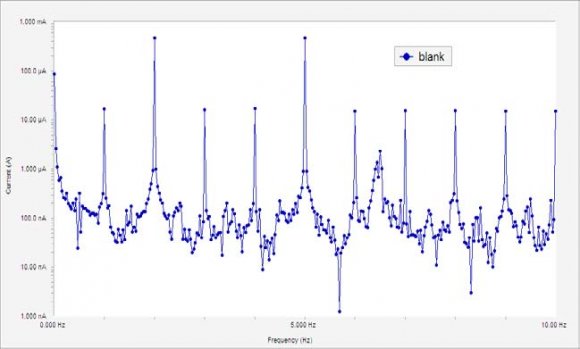
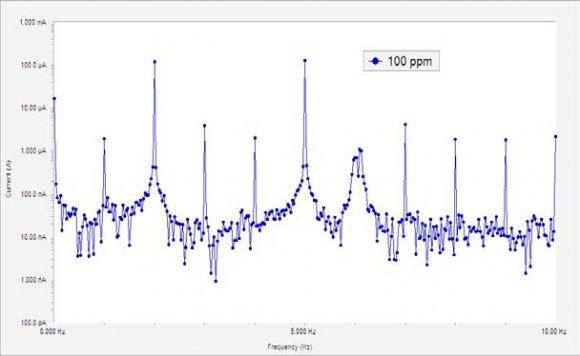
Electrochemical frequency modulation, EFM, was carried out using two frequencies 2 and 5 Hz. The base frequency was 0.1 Hz, so the waveform repeats after 1 s. The higher frequency must be at least two times the lower one. The higher frequency must also be sufficiently slow that the charging of the double layer does not contribute to the current response often; 10 Hz is a reasonable limit. The Intermodulation spectra contain current responses assigned for harmonical and intermodulation current peaks. The larger peaks were used to calculate the corrosion current density (i corr ), the Tafel slopes (? c and ? a ) and the causality factors CF-2& CF-3 [31].
The electrode potential was allowed to stabilize 30 min before starting the measurements. All the experiments were conducted at 30 ± 1°C. Measurements were performed using Gamry Instrument Potentiostat/Galvanostat/ZRA. This includes a Gamry framework system based on the ESA 400. Gamry applications include DC105 for corrosion measurements, EIS300 for electrochemical impedance spectroscopy and EFM 140 for electrochemical frequency modulation measurements along with a computer for collecting data. Echem Analyst 5.58 software was used for plotting, graphing, and fitting data.
5. III.
6. Results and Discussion
7. a) Weight loss measurements
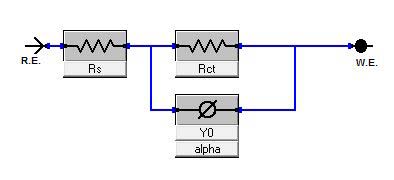
The weight loss-time curves of mild steel with the addition of tween 60 in 0.5 M HCl at various concentrations is shown in Fig. 1 as an example. The curves of Fig. 1 show that the weight loss values of mild steel in 0.5 M HCl solution containing Tween 60 decrease as the concentration of the inhibitor increases; i.e., the corrosion inhibition strengthens with the nonionic surfactant concentration. This trend may result from the fact that the adsorption of surfactant on the mild steel increases with the increase of inhibitor concentration thus the mild steel surface is efficiently separated from the medium by the formation of a film on its surface [32]. Figure 2 shows the anodic and cathodic Tafel polarization curves for mild steel in 0.5 M HCl in the absence and presence of varying concentrations of tween 60 at 25 o C as an example. The effect of temperature on the IE % for Tweens was studied using this technique. From Fig. 2, it is clear that both anodic metal dissolution and cathodic reduction reactions were inhibited when Tweens were added to 0.5 M HCl and this inhibition was more pronounced with increasing inhibitor concentration. Tafel lines are shifted to more negative and more positive potentials with respect to the blank curve by increasing the concentration of the Tweens. This behavior indicates that the undertaken additives act as mixed type inhibitors [33,34]. The results show that the increase in inhibitor concentration leads to decrease the corrosion current density (i corr ), but the Tafel slopes (? a ? ? c )?are approximately constant indicating that the retardation of the two reactions (cathodic hydrogen reduction and anodic metal dissolution) were affected without changing the dissolution mechanism [35][36][37][38] (Table 2). The effect of inhibitor concentration on the impedance behavior of mild steel in 0.5 M HCl solution at 25ºC is presented in Fig. 3a. The curves show a similar type of Nyquist plots for mild steel in the presence of various concentrations of Tween 60. Similar curves were obtained for Tween 20 (not shown). The existence of single semi-circle showed the single charge transfer process during dissolution which is unaffected by the presence of inhibitor molecules. Deviations from perfect circular shape are often referred to the frequency dispersion of interfacial impedance which arises due to surface roughness, impurities, dislocations, grain boundaries, adsorption of inhibitors, and formation of porous layers and in homogenates of the electrode surface [39,40]. Inspections of the data reveal that each impedance diagram consists of a large capacitive loop with one capacitive time constant in the Bode-phase plots (Fig. 3b). The electrical equivalent circuit model is shown in Fig. (4). It used to analyze the obtained impedance data. The model consists of the solution resistance (R s ), the charge-transfer resistance of the interfacial corrosion reaction (R ct ) and the double layer capacitance (C dl ). Excellent fit with this model was obtained with our experimental data. EIS data (Table 3) show that the R ct values increases and the C dl values decreases with increasing the inhibitor concentrations. This is due to the gradual replacement of water molecules by the adsorption of the inhibitor molecules on the metal surface, decreasing the extent of dissolution reaction. The high (R ct ) values, are generally associated with slower corroding system [41,42].
The decrease in the C dl can result from the decrease of the local dielectric constant and/or from the increase of thickness of the electrical double layer suggested that the inhibitor molecules function by adsorption at the metal/solution interface [43]. The % IE obtained from EIS measurements are close to those deduced from polarization measurements. The order of inhibition efficiency obtained from EIS measurements is as follows: Tween 20 > Tween 60. 4).
From Table 4, the corrosion current densities decrease by increasing the concentration of investigated compounds and the inhibition efficiencies increase by increasing investigated concentration of the investigated compounds. The causality factors in Table 4 are very close to theoretical values which according to EFM theory should guarantee the validity of Tafel slopes and corrosion current densities. Values of causality factors in Table 3 indicate that the measured data are of good quality. The standard values for CF-2 and CF-3 are 2.0 and 3.0, respectively. The deviation of causality factors from their ideal values might due to that the perturbation amplitude was too small or that the resolution of the frequency spectrum is not high enough also another possible explanation that the inhibitor is not performing very well. The obtained results showed good agreement of corrosion kinetic parameters obtained with the EFM, Tafel extrapolation and EIS methods. Organic molecules inhibit the corrosion process by the adsorption on metal surface. Theoretically, the adsorption process can be regarded as a single substitutional process in which an inhibitor molecule, I, in the aqueous phase substitutes an "x" adsorbed on the metal surface [44,45]
Where x is known as the size ratio and simply equals the number of adsorbed water molecules replaced by a single inhibitor molecule. The adsorption depends on the structure of the inhibitor, the type of the metal and the nature of its surface, the nature of the corrosion medium and its pH value, the temperature and the electrochemical potential of the metal-solution interface. Also, the adsorption provides information about the interaction among the adsorbed molecules themselves as well as their interaction with the metal surface.
The values of surface coverage, ?, for different concentration of the studied compound at different temperatures have been used to explain the best isotherm to determine the adsorption process.
By far the results of investigated Tweens were best fitted by Langmuir adsorption isotherm. Figures 6 and 7 show the plotting of C/? against C at different temperatures for Tween 20 and 60, respectively. These plots gave straight lines with unit slope indicating that the adsorption of investigated Tweens on mild steel surface follows Langmuir adsorption isotherm [46]:
C / ? = 1/ K + C (6)Where C is the concentration of inhibitor, ? the fractional surface coverage and K is the adsorption equilibrium constant related to the free energy of adsorption ?Gº ads as [47]. K = 1/ 55.5 exp (-Î?"Gº ads / RT) (7) Where R is the universal gas constant, T is the absolute temperature. The value 55.5 is the concentration of water on the metal surface in mol/ L.
The calculated Î?"Gº ads values, using Eq. ( 7), were also given in Table 5. Î?"Gº ads is expressed in kJ mol -1 of Org ads . The negative values of Î?"Gº ads ensure the spontaneity of the adsorption process and the stability of the adsorbed layer on the mild steel surface. It is well known that values of Î?"Gº ads of the order of 40 kJ mol -1 or higher involve charge sharing or transfer from the inhibitor molecules to metal surface to form coordinate type of bond (chemisorption); lower indicate a physisorption [48,49].
The calculated Î?"Gº ads values are in the range 38.6-41.9 kJ mol -1 indicates, therefore, that the adsorption mechanism of the investigated compounds on mild steel in 0.5 M HCl solution is a simple physical adsorption. The higher negative values of Î?"G?a ds indicate that these inhibitors are strongly adsorbed on the mild steel surface. Moreover, |Î?"G?a ds | of investigated compounds decreases in the order Tween 60 > Tween 20.This is in good agreement with the ranking of inhibitors efficiency obtained from the different investigated techniques. The higher values of K for tween 20 and 60 are 1.04x10 5 , 1.71x10 5 M -1 respectively; indicate stronger adsorption on the mild steel surface in 0.5 M HCl solution. The strong interaction of inhibitor with mild steel surface can be attributed to the presence of O atoms and ?-electrons in the inhibitor molecules. Lagrenee et al [50] have reported that the higher K value (> 100 M -1 ), the stronger and more stable adsorbed layer is forming which results in the higher inhibition efficiency. Thermodynamic parameters are important in studying the inhibitive mechanism. The values of enthalpy of adsorption, Î?"Hº ads and entropy of adsorption, Î?"Sº ads were obtained from the plot of Î?"Gº ads versus T and from the basic thermodynamic equation ( 8):
Î?"Gºads = Î?"Hºads -T Î?"Sºads(8)Î?"Hº ads obtained were -10.9 and -18.9 kJ mol -1 for Tween 20 and 60 respectively. The negative sign of Î?"Hº ads obtained indicates the exothermic nature of the corrosion process [51] which indicates that % IE decreases with increasing the temperature. Generally, an exothermic process signifies either physisorption or chemisorption while endothermic process is attributable unequivocally to chemisorption [52]. In an exothermic process, physisorption is distinguished from chemisorption by considering the absolute value of a physisorption process is lower than 42 kJ mol -1 while the adsorption heat of a chemisorption process approaches 100 kJ mol -1 [53]. In the present case, the absolute value of the heat of adsorption is lower than 42 kJ mol -1 approaching the typical value of physisorption. The values obtained for Î?"Sº ads were 90 and 70 J mol -1 K -1 for Tween 20 and 60 respectively. The negative values of Î?"Sº ads mean that the process of adsorption is accompanied by decrease in entropy. It might be explained as follows: before the adsorption of Tweens onto the mild steel surface, the chaotic degree of mild steel surface was high, but when inhibitor molecules were orderly adsorbed onto the mild steel surface, as a result, a decrease in entropy [54].
8. g) Effect of temperature
The effect of temperature on the rate of corrosion of mild steel in 0.5 M HCl containing different concentration from tween 20 or tween 60 was tested by potentiodynamic polarization measurements over a temperature range from 25 to 55 o C.
The effect of increasing temperature on the corrosion rate (i corr ) and IE obtained from potentiodynamic polarization measurements.
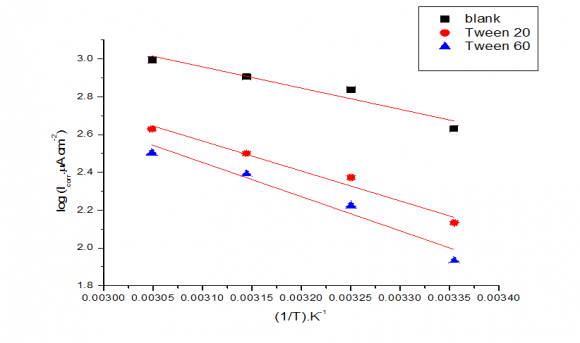
The results revealed that, on the increasing solution temperature there is an increase of i corr while IE decrease for all compound used. The activation energy (E * a ) of the corrosion process was calculated using Arrhenius equation:
k = A exp (-Ea * / RT) (9)Where k is the rate of corrosion, A is the Arrhenius constant, R is the gas constant and T is the absolute temperature.
Figure 8 present the Arrhenius plot in the presence of 40 ppm from investigated Tweens. E * a values determined from the slopes of these linear plots are 21.8, 31.3 and 35.1 kJ mol -1 for blank, tween 20 and tween 60 respectively. The linear regression (R 2 ) is close to 1 which indicates that the corrosion of mild steel in 0.5 M HCl solution can be elucidated using the kinetic model. The values of E * a for inhibited solution is higher than that for uninhibited solution, suggesting that dissolution of mild steel is slow in the presence of tween and can be interpreted as due to physical adsorption [55]. It is known from Eq. 6 that the higher E * a values lead to the lower corrosion rate. This is due to the formation of a film on the mild steel surface serving as an energy barrier for the mild steel corrosion [56].
Enthalpy and entropy of activation (Î?"H * , Î?"S * ) of the corrosion process were calculated from the transition state theory: Where h is Planck's constant and N is Avogadro's number. A plot of log (i corr / T) vs. 1/ T for mild steel in 0.5 M HCl at 80 ppm from investigated compounds, gives straight lines as shown in Figure 9. Values of ?H * are, 8.5, 12, 14.2 kJ mol -1 for blank, tween 20 and tween 60, respectively and these values are positive. This indicates that the corrosion process is an endothermic one. The entropy of activation is large and negative and in the range 97.3 to 110.9 Jmol -1 K -1 . This implies that the activated complex represents association rather than dissociation step , indicating that a decrease in disorder takes place, going from reactants to the activated complex [52]. In general, inhibition of different tween compounds depends on their structures. The inhibition efficiency increases in the following order: T 20 < T 60.
(i corr ) = (RT/ Nh) exp (Î?"S * /R) exp (-Î?"H * /RT) (10)This sequence reflects the effect of type of the fatty acid included in the tween formula, on their inhibitive action, since all tween compounds are mainly polyoxyethylene sorbitane combined with alkyl chain of different fatty acids which determine the tween number. Now, one can rewrite the above sequence, according the alkyl chain as following. Laurate (C12) < stearate (C18)
This new sequence illustrates the effects of both hydrocarbon length and presence of a double bond in the inhibitor structure. Thus, the inhibition efficiency increases as the number of carbon atoms in the alkyl chain increases.
9. IV.
10. Conclusions
It was found that the percentage inhibition efficiency depends on the concentration, temperature and chemical structure of Tweens and the inhibition efficiency is in the order: Tween 60 > Tween 20. The inhibition efficiency increases as the length of the tween hydrocarbon chain is increased. Polarization curves demonstrate that the examined Tweens behave as mixed type inhibitors. The results of EIS indicate that the double layer capacitance decreases with respect to the blank solution when these inhibitors are added; this fact may be explained on the basis of adsorption of these inhibitors on mild steel surface. The adsorption of investigated Tweens on mild steel surface in HCl solution follows Langmuir adsorption isotherm. The negative values of Î?"Gº ads show the spontaneity of the adsorption of Tweens on mild steel surface. The percentage inhibition efficiency of Tweens obtained from the weight loss, potentiodynamic polarization curves, EIS and EFM techniques are in good agreement.

| Comp. | Conc., ppm | -E corr mV vs SCE | i corr , µA cm -2 | -? c , mVdec ?1 | ? a , mVdec ?1 | ?"¨ | IE% | C.R , µm y -1 |
| Blank | 0.0 | 484 | 425.6 | 118 | 89 | 0.000 | 00.0 | 4940 |
| 20 | 486 | 162.2 | 104 | 79 | 0.619 | 61.9 | 1883 | |
| Tween 20 | 40 60 80 100 | 486 477 478 485 | 157.9 141.0 136.0 115.2 | 106 103 106 97 | 82 73 80 75 | 0.629 0.669 0.680 0.729 | 63.0 66.9 68.0 72.9 | 1833 1637 1579 1337 |
| 120 | 474 | 103.7 | 105 | 70 | 0.756 | 75.6 | 1204 | |
| 20 | 457 | 115.3 | 106 | 69 | 0.729 | 73.0 | 1339 | |
| Tween 60 | 40 60 100 | 455 450 447 | 98.91 91.8 85.56 | 103 107 105 | 67 69 65 | 0.768 0.784 0.799 | 76.8 78.4 80.0 | 1148 1066 993 |
| 120 | 452 | 84.12 | 104 | 69 | 0.802 | 80.2 | 976 |
| at 25ºC |
| XIV Issue III Version I | ||||||||||
| ( ) C Volume | ||||||||||
| Global Journal of Researches in Engineering | Comp. Blank Tween 20 Tween 60 | Conc., M 6 3 B 00 7 2 B 20 8 1 B 40 9 0 B 60 9 9 B 80 1 0 8 B 100 1 1 7 B 20 1 2 6 B 40 1 3 5 B 60 1 4 4 B 80 | of various concentrations of tweens in 0.5 M HCl at 25 ? C ? CF-3 CF-2 ? a , mVdec ?1 ? c , mVdec ?1 µA cm -2 i corr , 5 7 B -----5 8 B 2.16 5 9 B 1.42 6 0 B 67 6 1 B 59 6 2 B 454.8 6 6 B 0.424 6 7 B 2.98 6 8 B 1.91 6 9 B 102 7 0 B 89 7 1 B 262.0 7 5 B 0.467 7 6 B 3.86 7 7 B 1.92 7 8 B 102 7 9 B 85 8 0 B 242.6 8 4 B 0.485 8 5 B 3.09 8 6 B 1.92 8 7 B 103 8 8 B 85 8 9 B 234.3 9 3 B 0.568 9 4 B 3.20 9 5 B 1.93 9 6 B 105 9 7 B 86 9 8 B 196.6 1 0 2 B 0.604 1 0 3 B 2.86 1 0 4 B 1.94 1 0 5 B 105 1 0 6 B 86 1 0 7 B 180.2 1 1 1 B 0.666 1 1 2 B 2.90 1 1 3 B 2.41 1 1 4 B 97 1 1 5 B 92 1 1 6 B 151.7 1 2 0 B 0.724 1 2 1 B 3.41 1 2 2 B 2.42 1 2 3 B 98 1 2 4 B 95 1 2 5 B 125.6 1 2 9 B 0.748 1 3 0 B 2.75 1 3 1 B 1.79 1 3 2 B 102 1 3 3 B 94 1 3 4 B 115.2 1 3 8 B 0.764 1 3 9 B 3.64 1 4 0 B 1.85 1 4 1 B 112 1 4 2 B 91 1 4 3 B 107.5 | IE % 5 6 B -----6 5 B 42.4 7 4 B 46.7 8 3 B 48.5 9 2 B 56.8 1 0 1 B 60.4 1 1 0 B 66.6 1 1 9 B 72.4 1 2 8 B 74.8 1 3 7 B 76.4 | CR , mmy -1 5 5 B 176.4 6 4 B 101.6 7 3 B 94.21 8 2 B 90.88 9 1 B 76.24 1 0 0 B 69.90 1 0 9 B 58.84 1 1 8 B 48.69 1 2 7 B 44.67 1 3 6 B 41.69 | |||||
| 1 5 2 B 104.9 | 1 5 1 B 92 | 1 5 0 B 103 | 1 4 9 B 1.82 | 1 4 8 B 2.90 | 1 4 7 B 0.769 | 1 4 6 B 76.9 | 1 4 5 B 40.68 | |||
| Year 2014 |
| 19 |
| XIV Issue III Version I |
| ( ) C Volume |
| Journal of Researches in Engineering |
| Global |
| © 2014 Global Journals Inc. (US) |