1.
angladesh is endowed with plentiful supply of renewable source of energy [1]. Out of various renewable sources solar, wind, biomass can be effectively used in Bangladesh. Renewable energy practices in Bangladesh are [2]-? Solar energy ? Biomass energy ? Wind energy ? Hydro power energy
Wind & Hydro power have a limited scope of success in Bangladesh, but could solar & biogas provides a viable solution to our existing energy problems [3]. Solar power is not new in Bangladesh. Since, 1996 different companies have tried to market solar energy systems to the public [4]. Yet in a technologically backward country like Bangladesh the ides took a fair while to gestate. Solar and biogas energy is a renewable energy without causing pollution to the environment. Grameen Shakti and few other companies are working to provide solar biogas energy to the villages in Bangladesh. The Government of Bangladesh is working to provide more energy to its people to accelerate economic growth, social development and reduce poverty [5]. On one hand, government is working to promote the use of renewable energy technologies. On the other hand, the government works with industry public sector power utilities and private households to increase the use of energy efficient appliance and production processes and promote energy generation. Renewable energy and energy efficiency is a priority area of Bangladeshi-German development co-operation [6].
Sun is the richest source of energies like light and heat. Huge amount of energies are available for us to take and make big impact on our electricity requirements [7]. Our sun throws as much amount of energy on earth in one day which is equivalent to the energy requirement for the entire year. Sun surface is about 109 times bigger than surface of the earth [8]. It takes millions of years for energy generated from the center of the sun to reach to the surface of the sun [9]. Our mother earth is about 149.63 * 106 kilometers away from the sun, and light takes about 8 minutes and 31 seconds to reach to the surface of the earth. Light from the sun travels 186,262 miles per second to reach to earth [10] [11]. Energy emitted from the sun which reaches earth is in massive amount and can be extremely dangerous for mankind on earth if direct exposure is made.
2. B
3. Global
4. Journal of Researches in Engineering
Volume XIII Issue XIII Version I
5. ( )
Year a) Solar Energy Solar electricity is the energy which is extracted by Sun using solar power plants.
6. i. Photovoltaic or Solar Cell
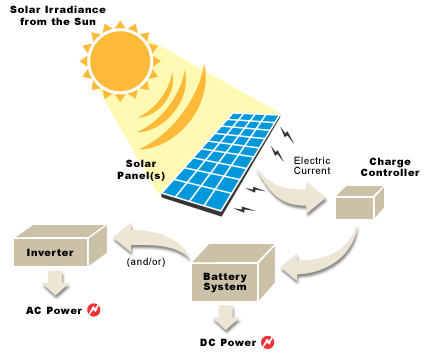
It is possible to convert solar energy directly into electrical energy by means of silicon wafer photovoltaic cells, also called solar cells, without any intermediate thermodynamic cycle [12]. The solar cell operates operate on the principle of photovoltaic effect, which is a process of generating an EMF as a result of the absorption of ionizing radiation. Thus a solar cell is a transducer, which converts the sun's radiant energy directly into electrical energy.
7. ii. Storage Device
The electricity produced by the PV modules is stored in batteries for later use when there is no sun [13]. Charge controllers regulate the rate of flow of electricity from the modules to the battery or the loads or to both simultaneously. It keeps the battery from overcharging or overloading thus prolonging its life.
8. iii. Inverters
The inverter converts the DC electricity produced by the solar modules into alternating current (AC) since most electrical appliances and equipment run on AC electricity [14].
9. b) Biogas Energy
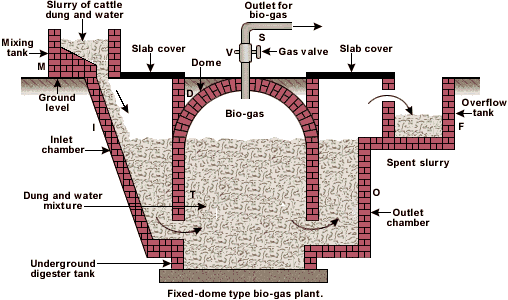
Biogas originates from bacteria in the process of biodegradation of organic material under anaerobic (without air) conditions [15]. The natural generation of biogas is an important part of the biogeochemical carbon cycle. Methanogens (methane producing bacteria) are the last link in a chain of micro-organisms which degrade organic material and return the decomposition products to the environment. In this process biogas is generated, a source of renewable energy.
10. i. Hydraulic Retention Time (HRT)
The retention time is the theoretical time that a particle or volume of liquid added to a digester would remain in the digester [16]. It is calculated as the volume of the digester divided by the volume of slurry added per day and it is expressed as days. The solids retention time (SRT) represents the average time that the solids remain in the system. The solids retention time can be determined by dividing the weight of volatile solids in the system by the weight per unit time of volatile solids leaving the system. The hydraulic retention time (HRT) is equal to the solids retention time in completely mixed non-recycled digester systems.
11. ii. Total Solid (TS)
The amount of solid material without considering the liquid part is termed as Total Solid (TS) [16]. Total solid is the material unit that indicates the production rate of Biogas. The favourable total solid value for smooth fermentation is 8%.
iii. Fresh Discharge Fresh discharge is the total amount of manure including moisture content directly obtained from the com, chicken, human etc. [16].
12. iv. Liquid Part
Liquid part is the amount of water to be added with fresh discharge to make the TS value is 8% [16].
We have designed a biogas plant with respect to human and kitchen waste of four hostel and a dormitory at a university campus and according to area of roof space of a academic building and four hostel, & We are establishing a solar panel which act as an ideal model for reducing load shedding and at the absence of load shedding it will provide electricity at national grid. The conversion of sunlight into electricity is defined as the solar power. It has done with the help of directly using photovoltaic (PV), or indirectly using concentrated solar power (CSP). CSP use lenses or mirrors and tracking systems to focus a large area of sunlight into a small beam. Photovoltaic Cell converts light into electric current using the photoelectric effect which is the basic principle of solar power generation.
The determination of Solar panel requirements and the composition of Biogas are provided below. a) Determination of Solar Panel Requirements For 100 Watt Solar Panel required area is = 7.392 square ft. Consider, Four Student Hostel and One Academic Building where roof space of each hostel is 4000 sq.ft. and Academic Building is 5000 sq.ft. respectively. For 4000 square ft. of every hostel 54.11 KW power can be generated and total panel required in every hostel = 540 pieces. For 5000 sq. ft. of Academic Building 67.64 KW power can be generated and total panel required in every hostel = 670 pieces.
13. b) Composition of Biogas based Plant
The average composition of biogas is shown in table with respect to percentage 55%-75% biogas is methane gas. We know, From every person 0.5 Kg waste is obtained per day.
Total discharge for human waste = (496×0.5) Kg = 248 Kg.
TS of fresh discharge = (248×0.2) = 49.6 Kg.
To make the TS value of 8% for favourable condition we have to mix some additional water with fresh discharge. The required water added can be calculated by the following way. ( )
FTo make the TS value of 8% for favourable condition, we have to mix some additional water with fresh discharge. The required water to add can be calculated by the following way.
8 Kg solid equivalent of influent.
6 Kg solid equivalent = Kg = 250 Kg .
To make the TS value of 8% for favourable condition we have to mix some additional water with fresh discharge. The required water to added can be calculated by the following way.
Working volume of digester = Q × HRT =250×40= 10.00 m 3 . The total generation capacity from human waste, kitchen waste and solar energy is given in the table-2 shown in below.
The important loads are listed as the table-3 as shown. Now, the distributions of the loads are given below: Bangladesh has a great opportunity to generate biogas and solar based power plant with the help of human waste, kitchen waste and sun shine. This renewable energy sources can be used for generating electricity and removing load shedding problems in Bangladesh. As the load shedding problems may not be removed in near future, this is the best alternative source to generate electricity. Our thesis paper represents the back-up source during load shedding at a University Campus according to biogas and solar based where human waste, kitchen waste and sun-shine is used as new materials. Complete design including system specification has been worked out. To remove load shedding problem, our represented thesis paper can be used as an ideal model for every University Campus in Bangladesh.



| Position | Type Waste Type Power (KW) | |||
| Student hostel | AC | Human | 8.54*4 = 34.16 | |
| 1,2,3,4 | ||||
| Teachers Dormitory AC | Human | 3.41 | ||
| Student hostel | AC | Kitchen | 50.29 | |
| 1,2,3,4 & Teacher's | ||||
| Dormitory | ||||
| Student hostel | DC Solar energy 54*4 = 216 | |||
| 1,2,3,4 | ||||
| Academic Building DC Solar energy | 67 | |||
| TOTAL | 370.86 | |||
| Position | Type | Waste | Power | Volume and |
| Type | (KW) | Roof space | ||
| respectively | ||||
| of Biogas | ||||
| and Solar | ||||
| Student | AC | Human | 8.54*4 | 31m of each |
| hostel | = 34.16 | Digester | ||
| 1,2,3,4 | ||||
| Teachers | AC | Human | 3.41 | 12m of |
| Dormitory | Digester | |||
| Student | AC | Kitchen | 50.29 | 71m |
| hostel | ||||
| 1,2,3,4 & | ||||
| Teacher's | ||||
| Dormitory | ||||
| Student | DC | Solar | 54*4 = | 4000 sq. ft. of |
| hostel | energy | 216 | each Hostel | |
| 1,2,3,4 | ||||
| Academic | DC | Solar | 67 | 5000 sq. ft. |
| Building | energy | |||
| TOTAL | 370.86 | |||
| Time of | 00:00 - | 06:00 - | 08:00 - | 14:00 - | 18:00 - |
| Day | 06:00 | 08:00 | 14:00 | 18:00 | 24:00 |
| Running | Load1 | Load1 | Load1 | ||
| Load2 | Load2 | ||||
| Load3 | Load3 | Load2 | Load3 | Load3 | |
| Load3 | |||||
| Load5 | Load4 | Load4 | Load5 | ||
| 49.40 | 15 KW | 22.58 | 22.58 | 55.98 | |
| KW | KW | KW | KW |
| Building | Load in | Quantity of | Rating per | Quantity | Rating |
| name | KW | light | light (watt) | of fan | per fan |
| (watt) | |||||
| Student hostel | 92.256 | 992 | 23 | 992 | 70 |
| 1,2,3,4 | |||||
| Teachers | 11.6 | 200 | 23 | 100 | 70 |
| dormitory | |||||
| Academic | 115.32 | 1240 | 23 | 1240 | 70 |
| building |
| Time of | 00:00 - | 06:00- | 08:00- | 14:00 - | 18:00 - |
| day | 06:00 | 08:00 | 14:00 | 18:00 | 24:00 |
| Running | Load A | Load A | Load A | ||
| load | Load B | Load B | Load B | ||
| Load C | Load C | Load C | Load C | Load C | |
| Load D | Load D | ||||
| Load E | Load E | ||||
| Total | 128.856 | 25 | 39.258 | 9.258 | 135.436 |
| Load | KW | KW | KW | KW | KW |
| (KW) |
| Year | ||||||
| 160 | ||||||
| 31 | ||||||
| Time of Day | Load in KW (from renewable energy) 0 00:00 to Load in KW (from BPDB) 49.4 00:06 06:00 to 00:08 15 79.456 40 60 80 100 120 140 10 20 | Total cost (from renewable energy) in Taka 00:08 to 14:00 14:00 to 18:00 22.58 22.58 16.678 16.678 | Total cost (from BPDB) in Taka 18:00 to 24:00 79.456 55.98 | Journal of Researches in Engineering Volume XIII Issue XIII Version I ( ) | ||
| 00:00-06:00 06:00- | 49.40 15.00 | 79.456 10.000 | 49.40*6*5=1482 15*2*5=150 | 79.459*6*5=2383.68 10*2*5=100 | Global | |
| 08:00 | ||||||
| 08:00- | 22.58 | 16.678 | 22.58*6*5=677.4 | 16.678*6*5=500.34 | ||
| 14:00 | ||||||
| 14:00- | 22.58 | 16.678 | 22.58*4*5=451.6 | 16.678*4*5=333.56 | ||
| 18:00 | ||||||
| 18:00- | 55.98 | 79.456 | 55.98*6*5=1679 | 79.456*6*5=2383.68 | ||
| 24:00 | ||||||
| Load shedding period | Demand (KW) |
| 11 am -12 pm | 22.58 |
| 03 pm-04 pm | 22.58 |
| 07 pm -09 pm | 55.98 |