1. Introduction
ike untreated soil, lime and lime -cement stabilized soil is not entirely pure isotropic, elastic and homogenous material but rather a material with elasto-plastic behaviour. To stimulate the complex behaviour of both natural and treated soils, constitutive models assuming linear elastic perfectly plastic brittle weakening behaviour are assessed. Elasto-plasticity constitutive models of soil have received the attention of many writers like Gens et al. (2008), Bazant & Prager, (1985), Beer & Watson (1992), Kolar & Nemec (1989), Merouani, (2004), Vermeer & Neher, (1999) and Chen et al. (1994). The stress strain response in these models assumes that the material a linear elastic behaviour prior to yielding and perfectly plastic behaviour after yielding. In these cases, the peak and residual strength values can be different depending on the type of soil. This study pays attention to plasticity models such as Tresca, Author : Ardhi University (ARU), Tanzania, P.O. Box 35176, Dar es Salaam, Tanzania. E-mail : [email protected], [email protected] von Mises, Drucker-Prager, Drucker-Prager Cap, Mohr-Coulomb, Rankine Model, Modified Cam Clay, Lade and Egg Cam-clay models. The purpose of the study therefore is to test the performance of the said soil models in the simulation of drained triaxial tests on both untreated and lime and cement treated expansive soils.
2. II.
3. Model Development Theories
Lime and lime-cement treatment or stabilization has been conventionally used in engineering to enhance the properties of expansive soils. The Lime and lime cement stabilized soils exhibit yielding behaviour when loaded. The material behaviour of soil cannot be described as a linear isotropic elastic material but a combination of elastic, plastic and viscous flow behaviors (often referred to as creep). Therefore, the two major aspects of soil behaviour, namely elastic and plastic (elasto-plastic) are under consideration in this study. The great difference between plasticity and nonlinear elasticity is that elastic deformation is fully recoverable (reversible) on unloading whereas plastic deformation is non-recoverable (permanent). The relationship between stress and strain can be presented in two forms that are strain hardening and strain softening. Normally consolidated soils and loosely parked soils are strain hardening because they tend to compress and reach a critical state when sheared. Densely packed soils and overconsolidated soils are strain softening because they tend to expand (dilate) requiring large work to overcome the interlocking as they reach critical state at large strains. In densely packed soil the hardening appears just before the peak stress and the softening just after. On the other hand, the loosely parked soil posses strain hardening only.
Any material under a multi-axis state of stress will yield when the maximum shear stresses exceed the yield shear strengths of the material. The plasticity theory for granular materials that include a yield surface is best described by Tresca Model (Yu, 2006). Figure 1 shows Tresca model in 3-D space of principal stresses system for Yield criterion. The model is often idealized for cohesionless (c=0) frictionless ( 0 ) soils. The maximum shear strength is as shown in equation 1: and k is material constant representing a yield stress in a pure shear test . For failure to occur the equation above is rearranged to yield the following expression:
0 2 max 3 1 f . (2)For uniaxial tension: On the other hanad, Von Mises postulated (1913) that a material will yield when the distortional energy at the point in question reaches a critical value (Yu, 2002). Figure 2 shows a typical sketch of an isotropic elastic-perfectly plastic von Mises model. The model is based on distortional energy necessary to initiate yielding. Von Mises criterion incorporates the contribution of the intermediate stress to the yield state. It highlights that yield occurs when the second invariant of the deviatoric stress reaches a certain value. The exact solution for the von Mises yield criterion is given by the following expression:
0 2 2 k J f ( 5 )where:
2 2 2 1 2 3 2 2 3 1 2 6 1 k J ( 6 )For yielding in uniaxial tension:
0 1 ; 0 3 2 ( 7 )Substituting equation 7 into equation 6, the following expression is obtained:
2 2 0 2 0 6k ( 8 )Substituting (8) in yield criteria (5) the following usual form of von Mises yield criterion is obtained:
0 2 1 2 1 3 2 3 2 2 2 1 2 1 ( 9)Another failure criterion is according to Drucker-Prager Model which bases on the fact that the strain rates increase with the increase in yield strength (Drucker and Prager, 1952). The model is used to modulate materials that exhibit pressure-dependent yield such as soil and rocks. The model has an advantage that it handles the gross inelastic coupling between deviatoric and volumetric behaviours of soils. Figure 3 shows Drucker model without a cap that was later modified to the cap model (Figure 4). The Drucker-Prager Cap Model failure criterion for cohesive soils (Chen, 1994)] is as follows: ( 10) where:
0 1 2 k I J fand k = material constants related to the friction ad cohesion of soil respectively determined from the Mohr-Coulomb stress invariant To capture soil behaviour in general, Mohr-Coulomb introduced an elastic perfectly-plastic model to serve as a first-order model (Ti et al., 2009). Failure criterion in the Mohr-Coulomb bases on the assumption that the maximum shear stress as well as principal stresses is the only measure of failure. Figure 5 represents the Mohr-Coulomb yield surface in deviatoric plane while Figure 6 represents it in 2-D system. The failure of the Mohr-Coulomb is the best straight-line envelope touching the Mohr's circle (Figure 6). Mathematically the equation for the best straight-line envelope is as follows: tan c
( 1 1 ) where:
is the shear stress, is the normal stress (negative in compression), c is the cohesion of the material, and is the material angle of friction.
In terms of principle stresses, the Mohr-Coulomb failure criterion is as follows:
0 cos sin c f m f (12)Where Another important theory is the Rankine Modela which is the maximum normal strength hypothesis based on similar supposition to that of Coulomb. It states that failure occurs whenever one of the maximum three principle stresses equals the strength. It finds its use in ductile materials. The yield surface associated with this criterion is given by: where ' t f is the tensile strength at failure. Furthermore, Roscoe and Burland (1968) originally described the Modified Cam Clay Model (MCCM) to distinguish it from the earlier model called Cam clay (Roscoe and Schofield, 1963and Ortiz, Pandolfi, 2004& Carter and Liu, 2005). The modified Cam clay model employs the concept of yield criteria defined by the ellipsoid as is shown in Figure 7. It is an elasto-plastic model having no-linear elasticity characteristics prior to yielding. The model takes into account the aspect of plastic volume change in compression. The model captures the commonly observed properties such as an increasing stiffness as a material undergoes compression, hardening/softening and compaction/dilatancy behaviour, and eventually reaching a state in which the strength and volume become constant. The model is described in terms of effective stresses p and q which are very important to the area of soil response in conventional triaxial test. For simplification, the failure model is simply presented in 2-D system (Figure 8). The cam clay yield rule (flow rule) reads as: For Cam Clay Cap Model (Figure 9) the yield function is affected by a as follows:
0 ) , , ( 0 2 2 0 p p p M q p q p f f yield yield ( 16) Failure Criterion is as follows: 0 ) ( ) , ( p M q q p f f fail fail0 ) , , ( 0 2 2 0 p p a p M q p q p f f yield yield (18)And the failure criterion is as follows: As the modification of Modified Cam-clay model, the Egg Cam-clay model (Figure 10) was proposed (Yu, 2002, Wood, 2004and Suebsuk et al., 2010). This model is able to capture two key features namely nonlinear elasticity model and plasticity model. ) are inevitable for some soil models. These are easily determined in Continuum Mechanics and to save on space only final expressions are included here: i. Stress Invariants (
0 ) ( ) , ( a p M q q p f f fail fail ( 1 9 ) M 2 0 a p 0 p p q 0 f c F a il4. The nonlinear elasticity model demonstrates an
5. Materials Employed a) Soil
The soil used in this study was obtained from a 3.5 m deep open pit dug in Kibaha, Tanzania where expansive soil is abundant. The soil in the area is classified as as a highly expansive clay of high plasticity (Lucian, 2008(Lucian, & 2009)). The maximum dry density (MDD) and optimum moisture content (OMC) for the soil in consideration are in the region of 1910kg/m 3 and 11.7% respectively. Some of the determined engineering properties of the natural soil are summarized in the following Table : b) Stabilizers
The stabilizer materials used in this study were Lime and Cement. The cement used was the Ordinary Portland Cement, Twiga brand from Tanzania Portland Cement at Wazo Hill, Tegeta, Dar es Salaam. The powder hydrated lime was also obtained locally in Tanzania. The required quantity of hydrated lime was sieved through No. 40 sieve before mixing.
6. c) Specimen Preparation
Air-dried soil samples for mixing were pulverized and sieved through No. 40 sieve and oven dried at 50°C for 24 hours. The soil was then mixed with the various amounts of the stabilizers and the required amount of water. Specimens were then prepared by compaction in specimen moulds. Hydrated lime and Ordinary Portland Cement were used to stabilize the samples. The initial consumption of lime (ICL) of the soil had been determined to be 3.5% and mellowing period to be 4 hours. Thus, 4%, 6%, 8% and 10% of lime by weight of dry soil was added to the soil and cured for 7, 14 and 28 days, after which laboratory experiments were conducted. Untreated soil and lime-treated samples were subjected to CU triaxial compression tests four hours after preparation (mellowing).
7. IV.
8. Experimental Results And Observations
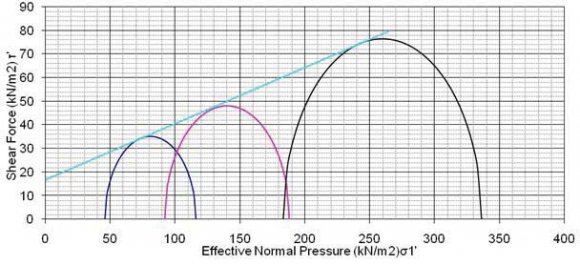
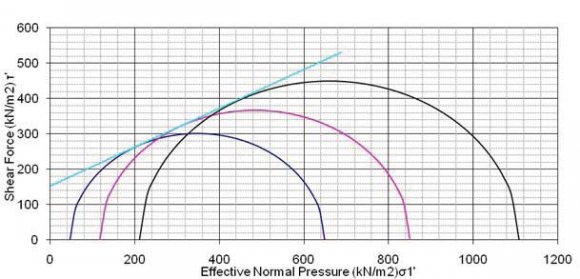
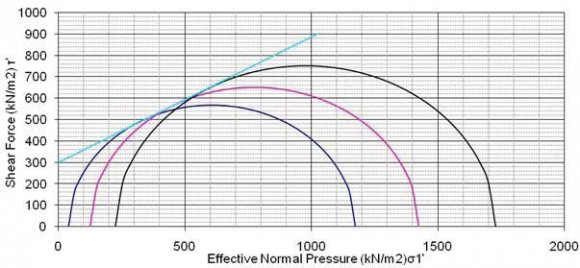
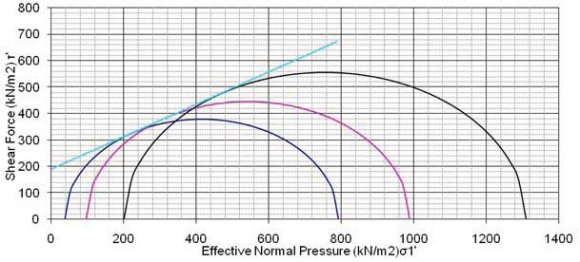
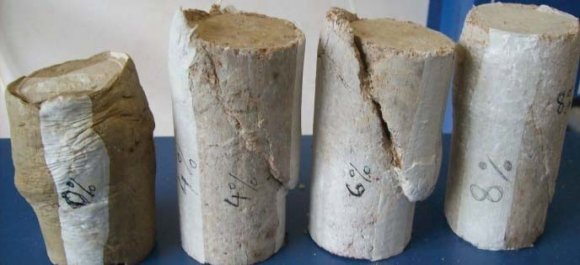
The results for CU triaxial compression tests are presented in Table 1 and Figure 11. Furthermore, Figures 13 -15 show effective stress Mohr circle and failure envelope obtained from triaxial test for nontreated, 4%, 6% and 8% lime treated expansive soils respectively. The best fit tangent failure lines were drawn tangent to the Mohr circles to show the failure envelope. For cement treated soils the Mohr-Coulomb failure turned out to be a curve, therefore it was not possible to report particular strength parameters. The results indicate that lime-treatment greatly improves the strength of the soil, both in terms of the internal angle of friction (from 14° to 33°) and cohesion (from 17 kPa to 300 kPa) in four hours mellowing period. Further, the samples treated with 6% lime show better strength properties than the other tested mix proportions. It is likely that higher lime content (e.g. 8% lime) creates excess lime in the mixture that makes the sample less cohesive and weaker than the lower (6%) lime-treated samples. The semi-barrelling form of failure for the 8% lime-stabilized sample supports this argument, when compared with the 6% lime-treated sample which shows a clear shear form of failure (closely similar to that of granular soils; ref. Figure 11). Although perhaps adequate as a first approximation, the Mohr-Coulomb criterion is the elastoplastic model of general scope with fixed yield surface, thus does not accurately model the actual failure conditions of real soils. Therefore, a model whose yield surface is not fixed but expands due to plastic straining to account for the plastic deformation of expansive soils is called for. When the plastic deformation occurs, the yield surface changes in size, shape and degree of inclination. To capture that complex behaviors of expansive soils as well as predict the true triaxial test results, the modified Cam Clay Model (MCCM) is introduced (Figure 12). It can be seen
9. Concluding Remarks
Practical application of models in finding solution of real-world problems attracts little theoretical or practical attention from Geotechnical Engineers. Therefore, proper application of these models requires thorough understanding of applications, basic features and limitations of various models. Efforts in this paper have been directed to several soil models to describe the behaviour of lime vs. cement stabilized expansive soils in Kibaha, Tanzania. It is obvious from the models that for the case of Theories of Shear Strength and Deformation, the Mohr-Coulomb failure criterion pays no attention to strain which accompany soil failure at peak strength. On the other hand the Von-Mises criterion is typically applicable for elastic plastic material. However, it enjoys superior level of acceptance for friction behaviour of idealized undrained frictional cohesive material like sand. Rankine model is the best fit for brittle materials. Mohr-Coulomb and Drucker-Prager elasto (visco)-plastic models are typically for soils and other frictional materials. However, the Mohr-coulomb model neglects the effect of the intermediate stress, 2 but the Drucker-Prager takes it into account. The Drucker-Prager, however, overestimates the strength of soil. The Tresca Model is ideal for cohesionless soils only.
The Lade Model is limited to failure criteria for granular soils as well as normally consolidated clays. The modified Cam clay model takes into account elastoplastic behaviour of soil leaving alone none-linear elasticity characteristics prior to yielding. The Egg Camclay model addresses precisely the nonlinear elasticity and plasticity of the soil. Of the failure criteria for clay soils in subcritical region, the Modified Egg Cam Clay is the most appropriate one for the description of expansive soil behavior with reasonable accuracy. The model is superior because it is characterized with the limited number of constitutive parameters easily determined in the laboratory or even in situ. Indeed, engineers can make use of this model which provides a reasonable fit to data obtained from laboratory tests.

| Bulk | Dry density Density of | Swell | Swell | Compaction | UCS | Triaxial test (CU) | |||
| density | solids | potential | pressure | (Heavy Proctor) | |||||
| ? | ? d | ? s | S | P s | MDD | OMC | q f | ? | c |
| kg/m 3 | kg/m 3 | kg/m 3 | % | kPa | kg/m 3 | % | kN/m 2 | °kN/m 2 | |
| 2120 | 1910 | 2650 | 19.2 | 560 | 1944 | 11.7 | 106 | 14 | 17 |
| that the modified Cam Clay Model gives avery good | ||||
| Untr. Soil | 4% Lime | 6% Lime | 8% Lime | |
| [°] | 14 | 31 | 32 | 33 |
| c [kN/m 2 ] | 17 | 152 | 300 | 187 |