1. INTRODUCTION
he consumer demand in multimedia applications for high data rate services, has led to grow the expansion of wireless communication systems. Major companies such as Intel and Motorola are promoting the WiMAX interfaces. Deregulation of the telecom industry and rapid growth of the internet, evaluated in favour of WiMAX. According to WiMAX forum, Physical represents Broadband Wireless Access Techniques. WiMAX operates in both LOS and NLOS operation such as 10-66 GHz and 2-11 GHz. Multipath fading occurs mostly in NLOS operation region, since each frequency arrives at the receiving point via a different radio path. This can be reduced by increasing delay spread. Frequency selective fading can also be equalized or reduced at the subcarrier level.
Inter Symbol Interference is reduced by cyclic prefix and longer symbol period. Fading can be completely removed using diversity techniques where multiple antennas are connected at transmitter and receiver ends. This paper deals with Multiuser Diversity such as Adaptive Modulation Coding for OFDMA Author ? : Assistant Professor/ ECE, Author ? : Associate Professor / ECE, Sri Krishna College of Engineering and Technology. Coimbatore-641 008. ( Ph.No : 9487974733. E-mail : [email protected]) (Wiesbeck, 2004), where different constellations are being used.
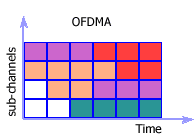
According to the IEEE 802.16 standard OFDM is to divide the available higher data rate into several low parallel data rate and these low data rate are mapped to individual subcarrier and being modulated. Orthogonal Frequency Division Multiplexing Access (OFDMA) uses multiuser diversity for adjacent subcarriers. Symbols are allocated to different users based on different data rate and channel condition. In OFDMA (Pinola, 2005), these subcarriers are divided to smaller group of subcarrier called sub channel.
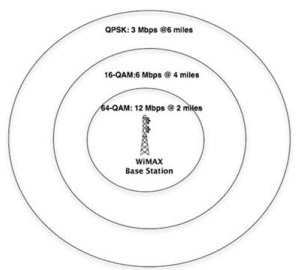
Scheduling (Marco Cecchi, Romano Fantacci and Daniele Tarchi, 2008) of the multimedia traffic has become recent trend for research community. In this paper various adaptive modulation schemes are being identified and adapted to improve the bandwidth efficiency of the system according to the various channel condition.
To have more flexibility and higher efficiency, adaptive OFDM schemes are adopted to maximize the system capacity and maintain the desired system performance in the inherent multi-carrier nature of OFDM allows the use of link adaptation techniques according to the narrow-band channel gains. Performance improvement (Alessandro Biagioni and Romano Fantacci, 2009) in Bit Error Rate and users various distances from base station has been simulated in this paper. Techniques for transmission which does not adapt for the transmission parameters to the fading channel are designed to maintain at acceptable performance under the worst-case channel conditions with a consequent of insufficient utilization of the available resources. Hence if the channels fade level is known at the transmitter then the Shannon capacity can be approached by matching transmission parameters to time-varying channel.
To improve the performance of existing algorithms (Alessandro Biagioni and Romano Fantacci, 2009), a combined proportional and equal capacity increment algorithm, C-Proeq, is proposed in this work.
2. II.
3. SYSTEM MODEL
Our system uses Mobile WiMAX OFDMA-PHY where K users communicate with the base station using a group of subcarrier called as sub channel or slot. Each subcarrier as in (Marabissi, According to Mobile WiMAX, slot or sub channel is formed by group of adjacent subcarrier which is subdivided into 48 data subcarrier and 6 pilot subcarrier for a total of 54 sub carriers. This structure uses TDD hence uplink and downlink is same. In this paper a bin is formed which has 6 subcarrier in which 5 data subcarrier and 1 pilot subcarrier. Total of 54 bits per channel transmitted, hence 6x54=324 bits are being transmitted.
4. RESOURCE ALLOCATION
In OFDMA system, resources are considered both in the low frequency and time dimension where different user can be assign sub carriers on a slot basis belonging to different frequencies or to different OFDM symbol times within the same frame. Hence, the available resources within the OFDMA frame form a grid of slots that are assigned to users according to suitable criteria. Subcarrier is divided into group of subcarrier called slots known as grid of frames.
Resource Allocation is usually formulated by two ways 1.minimization of total transmitted power under the constraint of user data rate. 2. Maximization of total data rate under the constraint of total transmitted power. Earlier Technique of Max Sum Rate or Greedy Optimization Algorithm is used to maximize the sum rate of the users with given power constraint.
Pk,l denotes transmitted power in the subcarrier l. Signal to interference plus noise ratio for user k in subcarrier l denotes as SINR k, l , can be expressed as in eq(1)
???? ?,? = ? ?,? ? ?,? 2 ? ? ?,? ? ?,? + ? 2 ? ? 2 ? ?=1 ?=? (1)Using Shannon capacity formula as the throughput measure, MSR algorithm maximizes the quantity by eq(2)
???? ?,? ? ? ? ? ? log?1 + ???? ?,? ?(2)? ?=1 ? ?=1With Total Power constraint is given by eq(3)
? ? ? ?,? 2 ? ?=1 ? ?=1 ? ? ???(3)The sum capacity is maximized if total throughput is maximized. Hence maximum sum capacity optimization problem can be decoupled into L simpler problem, one for each sub carrier. Further, capacity in subcarrier l is denoted as Cl written as in eq(4)
? ? = ? ??ð??" ? ?=1 ?1 + ? ?,? ? ???,?? ? ?,? + ? ? ?(4)a) Fair Allocation
In Fair allocation a slot is assigned the user in order to maximize the minimum number of users with user capacity Ck. This can be obtained by searching for each slot allocation matrix Xk that guarantees the minimum of Ck for k=1,2,....K. For example if 100 user are available then all available resources are allocated to them equally .The main drawback is more bandwidth is wasted for poor channel condition and Complexity. The fair allocation problem is formulated as follows as in eq (5),( 6),( 7)
argmax(min? ???? ? )(5)Subjected to
? ? ?,? ? = 1 (6) ? ? ? ?,? ? ? 1 ??1 ?=0 ??1 ?=0(7)5. b) Proportional Allocation
User with the best channel condition obtains lower number of resource with respect to the user with worst channel condition and hence channel capacity condition is not fully exploited. This is one of the drawbacks of Fair allocation this can be overcome by different allocation strategy by assuming the user with the best channel condition obtains larger amount of capacity. Being Maximum capacity is allocated to the each user given by (Keller and Hanzo, 2000), the slot allocation for the algorithm consideration searches for the capacity values for each user ? 1 : ? 2 : ? . . : ? ? = ? ???,1 :? ???,1 : ? ???,2 : ? . : ? ???,? Problem formulation i.e. maximization of ergodic rates is not instantaneous rate. This allocation is based on priority based allocation algorithm expressed as in eq (8),( 9)&(10) argmax(min
? ? ? ???,? )(8)Subjected to
? ? ?,? ? ?=1 = 1 (9) ? ? ? ?,? ? ? 1 ??1 ?=0 ??1 ?=0(10)The main difference between fair and this allocation algorithm is that in this case the selected user is the one who has the minimum ratio between the actual capacity value and maximum obtainable capacity value. For the fair allocation case suboptimal allocation achieves result close to optimal solution with low complexity.
6. c) Equal Capacity Increment Allocation
The equal increment of capacity for the entire user with respect to non adaptive strategy. For example 100 user are active in a network under some circumstances 10 user became inactive then for these user power is divided equally among them self. Thus bandwidth is not wasted. Slot is belonging to the different user can be distinguished only by the position in the time domain different channel condition has different frequency are averaged and the amount of capacity assigned to the Kth user results to be as in eq(11)
? ? ? = 1 ? ? ???,? = 1 ? ? ? ? ???? ?,? ? (11) ??1 ?=0 ??1 ?=0This value is used to be estimation of capacity of non adaptive algorithm. Gk is the difference between assigned capacity assigned in eq (12) to the k-th user and C'K
? ? = ? ? ? ? ? ? (12)Equal capacity increment allocation scheme is consider in maximizing the minimum Gk for all the users. It follows optimal slot allocation problem accordingly in eq(13),( 14),( 15)
argmax(min? ? )=argmax(min(? ? ? ? ? ? ))(13)Subjected to In this paper we combine proportional allocation algorithm with equal capacity increment allocation algorithm by allocating priority in adaptive manner. This allocation is done by BPSK modulation schemes. The computational complexity is low and suboptimal solution is obtained. The same equations are being carried for proportional and equal capacity increment.
? ? ?,? ? ?=1 = 1(14)IV.
7. SIMULATION RESULT AND DISSCUSION
In this section result of MATLAB simulation is presented and the system performance is assumed in carrying out our analysis. Simulation results are based on 1. OFDMA system based on 1024 FFT 2. Channel bandwidth of 10Mz 3. Rayleigh channel fading is assumed 4. No of active user is 20 5. Radio carrier frequency Fc =3.5Ghz 6. Guard band is 1/8 of OFDMA symbols duration Neglecting path loss on the performance of consideration of allocation schemes when users are at the same distance from base station the total number of active user is 20 and maximum throughput is achieved by adaptive modulation and coding. The path loss formula (Hata,1980) and (Okumura, Ohmori, and Fukua, 1968) is given by eq(16
) PL =L+10 . ?. ??ð??" 10 ? ? ? 0 ? , ? > ? 0 (16)Where D is the distance between user and base station, Do is the reference base station (100 meters) ? is the path loss exponent (set to 4.375 accordingly to an urban environment) and L equal to 20 log10 (4?D0 ) is the path loss value at the reference distance (with respect to the wavelength ?) that, in this case, is equal to 83.32 dB.
Cell radius of 10 km has been considered and the system provides SNR 7dB at the edge of the cell.
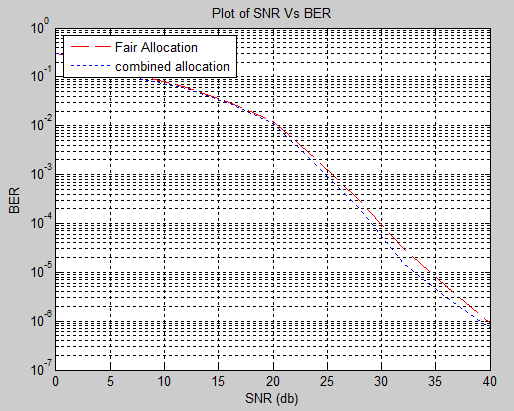
Fig. 3 : Simulation of SNR vs BER
In figure3 the performance of the bit error rate vs. signal to noise ratio has almost same optimal solution when the path loss effect is removed.
Figure 4 shows the best performance of throughput up to 7 km for combination allocation .This shows more spectral efficient. Fair allocation produces constant throughput at any distance, resulting disadvantages for the user near to the base station (because it has lower throughput than combined allocation) and profitable for the user far from the Base station Station.
Figure 5 represents users are at the same distance to the base station, fixed QAM modulation measures throughput with respect to distance. Hence adaptive allocation allows improving performance with respect to non adaptive allocation schemes. Figure 7 shows when the user are far from the base station throughput is high at the near end in combination allocation case as distance increases fair allocation regains throughput this is mainly due to the fact that fair allocation algorithm allocates subcarrier in the fair manner while the other combination allocation allocates in order to maximize the cell capacity by damaging far user. Fig. 6 : Simulation of User Near to the BS Figure 6 shows when user close to the base station the throughput is same (high) up to 3km after that throughput reduces as the distance proceeds.
8. CONCLUSION
The proposed C-Proeq resource allocation algorithm is proposed in adaptive manner for the different user based on the different channel condition. By combining the equal capacity and proportional fair allocation algorithms, better bandwidth efficiency of C-Proeq algorithm is obtained and better trade-off between fair and bandwith efficiency is achieved. Thus the performance is compared with respect to bit error rate vs signal to noise ratio & user with different distance from base station.

| modulation to QAM symbols. | |
| T | |
| Tarchi, Genovese, | |
| and | Fantacci,2007)is assigned power, user bit |